
Life of Edwin Forrest, the American Tragedian. Volume 2 (of 2)
William Rounseville Alger & Horatio, Jr. Alger
THE CLASSIC COLLECTION · 1894
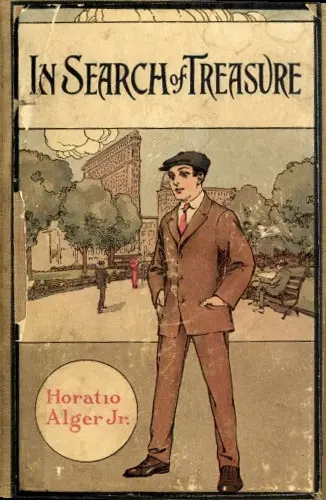
"In Search of Treasure" by Horatio Alger, Jr. is a novel written in the late 19th century. The story revolves around a bright and adventurous sixteen-year-old boy named Guy Fenwick, who wishes for a life beyond his father's ministerial duties in Bayport. Instead of pursuing glory through academia, Guy seeks excitement and the chance to explore the world when he discovers a hidden legacy tied to his late uncle—a pirate's treasure buried on a mysterious island. The opening of the novel introduces us to Guy and his father, Reverend Fenwick, discussing the boy's educational aspirations. Guy expresses disinterest in college, longing for adventure instead. After a poignant moment centered on family history, Guy explores an attic chest belonging to his deceased uncle George. Inside, he uncovers a letter containing details about a pirate's treasure hidden on an island. This catalyst sets Guy on a thrilling journey as he contemplates how to embark on the quest for this treasure to help improve his father's precarious financial situation, introducing themes of family loyalty, adventure, and the pursuit of one's dreams.
Introduction adapted from the source catalogue; source summaries may be automatically generated.
Free to read · English · 58,100 words · No account needed
MAKE TIME FOR A GOOD BOOK
On by default. Untick to stop anonymous reading totals. Each page counts after 10 seconds in view. How this works.
Anonymous counting is on unless you have switched it off.
“The only thing to do, Guy, is to stick up for your rights. Even if you are a boy, your rights are just the same. Should the captain break the contract, you could, of course, withhold the money you have agreed to pay the owners, and this would get him into hot water.”
“You advise me, then, to be firm?”
“Surely. It is your right and your duty. And by the way, Guy, you will remember that you are not alone. You have two strong and able assistants who are not boys, but independent men. They will help you to enforce your rights.”
“I see that your advice to me was good. Had I gone alone, I am afraid my plans would have failed. Does the captain know why I want to visit the island?”
“I presume so. Probably he thinks it a foolish enterprise, and that may account in part for his cavalier treatment of you. Of course, it is none of his business, and you need not hesitate to hint as much if he begins to talk roughly.”
Guy considered this good advice, and determined to act upon it. He felt that he must deport himself in a manner which might be unbecoming in an ordinary boy, but was called for by the fact that he was acting for Mr. Saunders. It was his duty to guard the interests of his employer.
When he bade good-bye to Captain Grover he felt a presentiment that the voyage on which he had embarked would be an unpleasant one, and that Captain Richmond would make it so. But Guy had pluck, and though he expected a conflict, he did not fear it.
The first outbreak came very soon after the sailing of the Osprey.
Dinner was announced. Guy was, of course, to eat at the captain’s table, but when he entered he found that no seats had been placed for his two assistants.
“How is this, Captain Richmond?” said Guy, as he took his seat. “I see no places at the table for Mr. Titcomb and Mr. Clark.”
“They will eat with the sailors,” replied the captain, curtly.
“I beg pardon, Captain Richmond,” said Guy, calmly, though he was very angry, “I will consent to no such arrangement.”
“You won’t, eh?” snarled the captain. “Who is the captain of this
craft--you or I?”
“You, sir; but my arrangement was not made with you, but with the
Messrs. Gray.”
“These men are your servants. I don’t have servants at my table.”
“They are not my servants. They, like myself, are in the employ of Mr.
Saunders, of Bombay.”
“I don’t know Mr. Saunders.”
Your reading position is saved on this browser. Take it to another device with a library code. Reading pages adapt to text, rather than matching a printed edition.
William Rounseville Alger & Horatio, Jr. Alger

William Rounseville Alger & Horatio, Jr. Alger

Horatio, Jr. Alger

Horatio, Jr. Alger
BEHIND THE BOOK
This eBook is for the use of anyone anywhere in the United States and most other parts of the world at no cost and with almost no restrictions whatsoever. You may copy it, give it away or re-use it under the terms of the Project Gutenberg License included with this eBook or online at www.gutenberg.org. If you are not located in the United States, you will have to check the laws of the country where you are located before using this eBook. Read the source licence.
The original source file, including credits and licence, is retained by this library. Request an original-format copy at no charge. Please include the book title and Project Gutenberg identifier #54016.
KEEP YOUR CURIOSITY GOING
Wilfrid Scawen Blunt
Wilfrid Scawen Blunt

E. W. (Edgar Watson) Howe
Coulson Kernahan

Maurice Baring
Frances Wright