
Life of Edwin Forrest, the American Tragedian. Volume 2 (of 2)
William Rounseville Alger & Horatio, Jr. Alger
THE CLASSIC COLLECTION · 1894
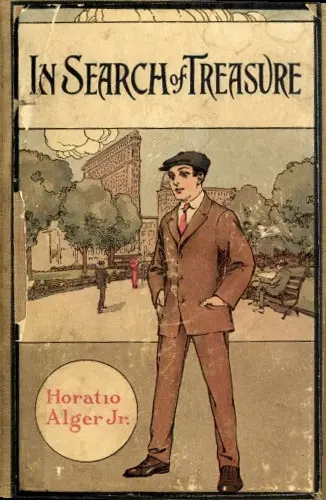
"In Search of Treasure" by Horatio Alger, Jr. is a novel written in the late 19th century. The story revolves around a bright and adventurous sixteen-year-old boy named Guy Fenwick, who wishes for a life beyond his father's ministerial duties in Bayport. Instead of pursuing glory through academia, Guy seeks excitement and the chance to explore the world when he discovers a hidden legacy tied to his late uncle—a pirate's treasure buried on a mysterious island. The opening of the novel introduces us to Guy and his father, Reverend Fenwick, discussing the boy's educational aspirations. Guy expresses disinterest in college, longing for adventure instead. After a poignant moment centered on family history, Guy explores an attic chest belonging to his deceased uncle George. Inside, he uncovers a letter containing details about a pirate's treasure hidden on an island. This catalyst sets Guy on a thrilling journey as he contemplates how to embark on the quest for this treasure to help improve his father's precarious financial situation, introducing themes of family loyalty, adventure, and the pursuit of one's dreams.
Introduction adapted from the source catalogue; source summaries may be automatically generated.
Free to read · English · 58,100 words · No account needed
MAKE TIME FOR A GOOD BOOK
On by default. Untick to stop anonymous reading totals. Each page counts after 10 seconds in view. How this works.
Anonymous counting is on unless you have switched it off.
Mr. Fenwick was sitting at his desk when Deacon Crane called. The deacon expected to find him nervous and agitated, and was surprised to note that he was as calm and placid as usual.
“Take a seat, Deacon Crane,” said the minister.
The deacon seated himself in a rocking-chair and began to rock. It was his custom when he was excited.
“I hear, Mr. Fenwick, that your son Guy has got home,” he began.
“Yes,” answered Mr. Fenwick, with a smile of satisfaction. “Guy has got
back.”
“Rather unexpected, wasn’t it?”
“Yes, unexpected, but very welcome. It has brightened me up a good
deal.”
“Has it? I thought perhaps you might have been disappointed.”
“Disappointed to see Guy? Oh, no! no!”
“You know what I mean,” returned the deacon, with some asperity.
“I don’t think I do.”
“I mean, of course, that it can’t be pleasant to have your son thrown on your hands when you thought he was earnin’ his livin’.”
“I think I must ask you to explain yourself.”
“If you wasn’t a minister, I might say that you seem a little dense,” said the deacon, impatiently. “However, I feel for you. You can’t afford to have a big boy eatin’ you out of house and home. I can find work for him on my farm, though, of course, I shouldn’t feel justified in payin’ much.”
“You are considerate, deacon,” said Mr. Fenwick, with a slight smile, “and perhaps I have misled you. Guy is not out of employment.”
“No?” said the deacon, opening his eyes in surprise. “Do you mean to say that he has a position?”
“He is in the employ of Mr. Saunders of Bombay.”
“How can that be?”
“He was sent to New York on business by his employer, and took the opportunity of visiting me.”
“This don’t seem a very likely story,” said the deacon, in a tone of disappointment. “Are you sure he isn’t deceivin’ you?”
“I am quite sure,” answered Mr. Fenwick, with dignity. “Does your son
ever deceive you?”
“That isn’t neither here nor there. If he told me such a story as Guy has told you I would punish him.”
“Guy doesn’t deceive me,” said the minister, quietly.
He was annoyed with the deacon for his incredulity, but he understood Mr. Crane’s suspicious nature, also his dislike for Guy, and he was not surprised.
“However,” continued the deacon, “that isn’t what I came over for. I hope you’ve considered the matter, and are resigned to my foreclosin’ the mortgage.”
“I do not propose to allow the mortgage to be foreclosed.”
Your reading position is saved on this browser. Take it to another device with a library code. Reading pages adapt to text, rather than matching a printed edition.
William Rounseville Alger & Horatio, Jr. Alger

William Rounseville Alger & Horatio, Jr. Alger

Horatio, Jr. Alger

Horatio, Jr. Alger
BEHIND THE BOOK
This eBook is for the use of anyone anywhere in the United States and most other parts of the world at no cost and with almost no restrictions whatsoever. You may copy it, give it away or re-use it under the terms of the Project Gutenberg License included with this eBook or online at www.gutenberg.org. If you are not located in the United States, you will have to check the laws of the country where you are located before using this eBook. Read the source licence.
The original source file, including credits and licence, is retained by this library. Request an original-format copy at no charge. Please include the book title and Project Gutenberg identifier #54016.
KEEP YOUR CURIOSITY GOING
Wilfrid Scawen Blunt
Wilfrid Scawen Blunt

E. W. (Edgar Watson) Howe
Coulson Kernahan

Maurice Baring
Frances Wright