
Life of Edwin Forrest, the American Tragedian. Volume 2 (of 2)
William Rounseville Alger & Horatio, Jr. Alger
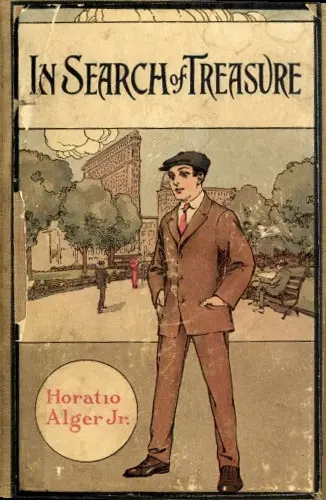
THE CLASSIC COLLECTION · 1894
"In Search of Treasure" by Horatio Alger, Jr. is a novel written in the late 19th century. The story revolves around a bright and adventurous sixteen-year-old boy named Guy Fenwick, who wishes for a life beyond his father's ministerial duties in Bayport. Instead of pursuing glory through academia, Guy seeks excitement and the chance to explore the world when he discovers a hidden legacy tied to his late uncle—a pirate's treasure buried on a mysterious island. The opening of the novel introduces us to Guy and his father, Reverend Fenwick, discussing the boy's educational aspirations. Guy expresses disinterest in college, longing for adventure instead. After a poignant moment centered on family history, Guy explores an attic chest belonging to his deceased uncle George. Inside, he uncovers a letter containing details about a pirate's treasure hidden on an island. This catalyst sets Guy on a thrilling journey as he contemplates how to embark on the quest for this treasure to help improve his father's precarious financial situation, introducing themes of family loyalty, adventure, and the pursuit of one's dreams.
Introduction adapted from the source catalogue; source summaries may be automatically generated.
Free to read · English · 58,100 words · No account needed
MAKE TIME FOR A GOOD BOOK
On by default. Untick to stop anonymous reading totals. Each page counts after 10 seconds in view. How this works.
Anonymous counting is on unless you have switched it off.
“I tell you I want a change,” said the deacon, with emphasis. “I want some bright, young man that’ll make a stir.”
“Do you think there are many that feel that way, deacon?”
“Not a doubt of it.”
“Who, for instance?”
“Well,” said the deacon, after a pause, “Mr. Bucklin, for instance.”
“Bucklin seldom goes to church, and last year he contributed but five dollars toward the minister’s salary.”
“Exactly so. Get a young man, and Bucklin would attend regularly, and pay a larger sum toward the church expenses.”
“He might double his subscription, but that would not amount to much,” said Mr. Ainsworth. “Now I pay fifty dollars, and I think I have a larger claim to consideration than Silas Bucklin.”
“To be sure, to be sure! But we want to put aside our own preferences and consult for the general good.”
“Do you do that, Deacon Crane?” asked Mr. Ainsworth, pointedly.
“Yes, sir! yes, sir!”
“You are prejudiced against the minister.”
“No, sir; I am only considering what will be for the good of the
parish.”
“You object, then, to the minister’s sermons? Is that all?”
“No, Brother Ainsworth. I object to Mr. Fenwick as a family man.”
“That’s something new. What is your objection?”
“Well, you see, he’s let his son Guy go off on a wildgoose chase to the other end of the world. Instead of keeping him at home to complete his education, or go into a store, he’s let him sail to India with Captain Grover.”
“That reminds me,” said Enoch Slade, the village carpenter. “Captain Grover arrived home yesterday.”
“Then where is Guy Fenwick? Nothing has been seen of him in the
village.”
“He didn’t come home with the captain.”
“Didn’t come home?” repeated Deacon Crane, in amazement. “Where is he?”
“He stayed in Bombay. I believe he got something to do there.”
“Well, that beats all I ever heard,” said the deacon, severely. “It shows just what sort of a bringing up the boy has had. The minister ought to have known better than to have let him leave home. Guy was always self-willed. My son Noah never liked him.”
This didn’t impress the deacon’s visitors as much as he anticipated, for Noah Crane was by no means an object of admiration in the village. He was generally considered sly and mean, while Guy was a universal favorite.
“I always liked Guy, myself,” said Mr. Ainsworth. “He is a good scholar and a good boy. I do hope he will come out all right.”
Your reading position is saved on this browser. Take it to another device with a library code. Reading pages adapt to text, rather than matching a printed edition.
William Rounseville Alger & Horatio, Jr. Alger

William Rounseville Alger & Horatio, Jr. Alger

Horatio, Jr. Alger

Horatio, Jr. Alger
BEHIND THE BOOK
This eBook is for the use of anyone anywhere in the United States and most other parts of the world at no cost and with almost no restrictions whatsoever. You may copy it, give it away or re-use it under the terms of the Project Gutenberg License included with this eBook or online at www.gutenberg.org. If you are not located in the United States, you will have to check the laws of the country where you are located before using this eBook. Read the source licence.
The original source file, including credits and licence, is retained by this library. Request an original-format copy at no charge. Please include the book title and Project Gutenberg identifier #54016.
KEEP YOUR CURIOSITY GOING
Wilfrid Scawen Blunt
Wilfrid Scawen Blunt

E. W. (Edgar Watson) Howe
Coulson Kernahan

Maurice Baring
Frances Wright