
Life of Edwin Forrest, the American Tragedian. Volume 2 (of 2)
William Rounseville Alger & Horatio, Jr. Alger
THE CLASSIC COLLECTION · 1894
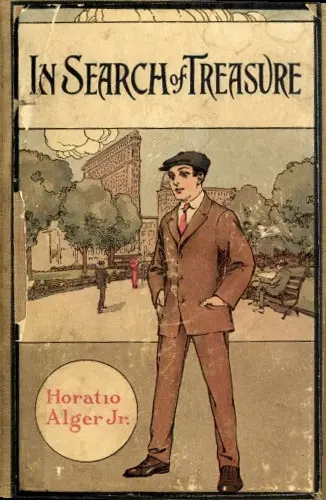
"In Search of Treasure" by Horatio Alger, Jr. is a novel written in the late 19th century. The story revolves around a bright and adventurous sixteen-year-old boy named Guy Fenwick, who wishes for a life beyond his father's ministerial duties in Bayport. Instead of pursuing glory through academia, Guy seeks excitement and the chance to explore the world when he discovers a hidden legacy tied to his late uncle—a pirate's treasure buried on a mysterious island. The opening of the novel introduces us to Guy and his father, Reverend Fenwick, discussing the boy's educational aspirations. Guy expresses disinterest in college, longing for adventure instead. After a poignant moment centered on family history, Guy explores an attic chest belonging to his deceased uncle George. Inside, he uncovers a letter containing details about a pirate's treasure hidden on an island. This catalyst sets Guy on a thrilling journey as he contemplates how to embark on the quest for this treasure to help improve his father's precarious financial situation, introducing themes of family loyalty, adventure, and the pursuit of one's dreams.
Introduction adapted from the source catalogue; source summaries may be automatically generated.
Free to read · English · 58,100 words · No account needed
MAKE TIME FOR A GOOD BOOK
On by default. Untick to stop anonymous reading totals. Each page counts after 10 seconds in view. How this works.
Anonymous counting is on unless you have switched it off.
“You cannot be trusted with it,” said Locke, coolly.
Dr. Musgrave, fairly boiling with passion, made a spring for Vivian, but August Locke anticipated the movement, and brought down the whip over the head master’s shoulders.
“Boys, come to the help of your teacher!” shrieked Musgrave.
Not a boy stirred except Simon.
He ran forward, and tried to attack Vivian Bell.
Guy let go of Vivian, and with a well-directed blow stretched Simon on
the ground.
“What do you mean by this outrage? Who are you?” asked the head master,
pale and agitated.
“I, sir, am August Locke, once your pupil,” replied Locke. “I am paying you off for some of your former brutality.”
“I will have you arrested--yes, and you, too!” shaking his head at Guy.
“Let me introduce my young companion, Dr. Musgrave,” went on Locke. “He is Master Guy Fenwick. He comes here as the agent of Mr. John Saunders, of Bombay, the guardian of Vivian Bell.”
“Is this true?” asked the head master, bewildered and incredulous.
“Yes, sir,” answered Guy. “I came here to find out how the boy was treated, but I have seen for myself. I withdraw him from your school. He is no longer a pupil of yours!”
Vivian Bell’s expression changed at once. He looked overjoyed.
“Oh!” he said, “is this true?”
“Yes,” answered Guy, putting his hand caressingly on the boy’s shoulder. “I shall take you away with me.”
Dr. Musgrave, though still shaking with anger, was not wholly destitute
of prudence.
“Gentlemen,” he said, “before anything is decided upon, I wish to explain that this boy has committed a daring act of rebellion, an act which merits summary punishment.”
Vivian looked up nervously into Guy’s face, but the expression he saw
there reassured him.
“Yes, sir; he ran away,” said August Locke, “and any boy would be justified in running away under the circumstances.”
“Sir,” said Dr. Musgrave, striving to recover some of his lost dignity, “in a school like this there must be discipline.”
“Yes, but not brutality.”
“You have evidently been misinformed as to the character of my discipline. It is firm, but parental.”
“Dr. Musgrave,” retorted August Locke, with a disgust which he could not conceal, “you forget that I was a former pupil of yours. Of all the abominable tyrants to be found in English schools, I think you carry off the palm.”
“I had hoped, Mr. Locke--I remember you now--that your maturer judgment would have enabled you to understand the reason of my occasional severity. My own conscience justifies me in what I have done.”
“Then you have a peculiar conscience; that is all I have to say.”
Your reading position is saved on this browser. Take it to another device with a library code. Reading pages adapt to text, rather than matching a printed edition.
William Rounseville Alger & Horatio, Jr. Alger

William Rounseville Alger & Horatio, Jr. Alger

Horatio, Jr. Alger

Horatio, Jr. Alger
BEHIND THE BOOK
This eBook is for the use of anyone anywhere in the United States and most other parts of the world at no cost and with almost no restrictions whatsoever. You may copy it, give it away or re-use it under the terms of the Project Gutenberg License included with this eBook or online at www.gutenberg.org. If you are not located in the United States, you will have to check the laws of the country where you are located before using this eBook. Read the source licence.
The original source file, including credits and licence, is retained by this library. Request an original-format copy at no charge. Please include the book title and Project Gutenberg identifier #54016.
KEEP YOUR CURIOSITY GOING
Wilfrid Scawen Blunt
Wilfrid Scawen Blunt

E. W. (Edgar Watson) Howe
Coulson Kernahan

Maurice Baring
Frances Wright