
Life of Edwin Forrest, the American Tragedian. Volume 2 (of 2)
William Rounseville Alger & Horatio, Jr. Alger
THE CLASSIC COLLECTION · 1894
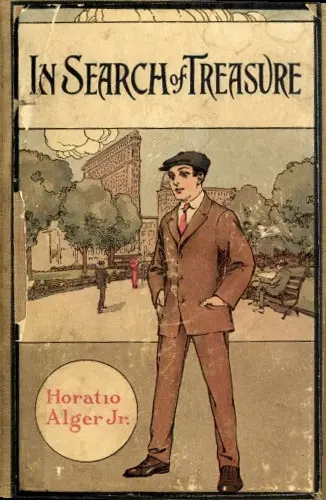
"In Search of Treasure" by Horatio Alger, Jr. is a novel written in the late 19th century. The story revolves around a bright and adventurous sixteen-year-old boy named Guy Fenwick, who wishes for a life beyond his father's ministerial duties in Bayport. Instead of pursuing glory through academia, Guy seeks excitement and the chance to explore the world when he discovers a hidden legacy tied to his late uncle—a pirate's treasure buried on a mysterious island. The opening of the novel introduces us to Guy and his father, Reverend Fenwick, discussing the boy's educational aspirations. Guy expresses disinterest in college, longing for adventure instead. After a poignant moment centered on family history, Guy explores an attic chest belonging to his deceased uncle George. Inside, he uncovers a letter containing details about a pirate's treasure hidden on an island. This catalyst sets Guy on a thrilling journey as he contemplates how to embark on the quest for this treasure to help improve his father's precarious financial situation, introducing themes of family loyalty, adventure, and the pursuit of one's dreams.
Introduction adapted from the source catalogue; source summaries may be automatically generated.
Free to read · English · 58,100 words · No account needed
MAKE TIME FOR A GOOD BOOK
On by default. Untick to stop anonymous reading totals. Each page counts after 10 seconds in view. How this works.
Anonymous counting is on unless you have switched it off.
When the time came for dinner, the captain sat down to it alone. Mr. Forbush, the mate, excused himself on the plea that he had no appetite.
Captain Richmond was angry, for he penetrated the mate’s objection to
sitting down with him.
“Just as you please, Mr. Forbush,” he said, in a tone of irritation, “but you are acting very foolishly.”
“You may regard it in that light, if you choose, Captain Richmond,” returned the mate, coldly.
“Have you anything to say to me?” asked the captain, defiantly.
“I have already expressed my opinion of your course,” said Forbush,
frigidly.
“I know what I am about,” blustered the captain.
“You have said that before. I can only repeat that I am glad of it.”
“Perhaps you mean to dispute my authority,” said the captain, in a
quarrelsome tone.
“Wait till I do, sir.”
Captain Richmond swore softly to himself, and eyed the mate with a
glance far from friendly.
So the day passed, and another dawned.
Captain Richmond was unusually irritable. He saw that all on board looked at him askance. The sailors obeyed him, so that he had no excuse for complaint, but there was an utter absence of cordiality, and he was in the position of a social outcast who is “sent to Coventry.”
This is not a pleasant position for anyone, least of all for an arrogant and ill-tempered man like Captain Richmond. While it cannot be said that he regretted his inhuman conduct, he was angry at the unpopularity he had acquired through it.
Besides, he could not doubt that it would be reported at Bombay, and the matter perhaps brought to the attention of the American consul. Whenever he thought of this he felt vaguely uncomfortable, but he was too self-willed to retrace his course and thus admit himself to be in the wrong.
“Where is all this going to end, Mr. Forbush?” asked the boatswain one day. “Are those poor fellows to be left to their fate?”
“No,” answered the mate, firmly. “I shall report the matter when we reach Bombay, and I will agree to head an expedition for their relief.”
“But how will they get along meanwhile? Won’t they starve?”
“No. Titcomb told me that the island produced enough to sustain life.”
“Will not Captain Richmond be punished?”
“I earnestly hope so. If my representations will effect it, he will lose
his command.”
“The man must be a fiend.”
“He is getting worse and worse. He does not treat me with ordinary civility, and he is beginning to abuse the men. He has not a pleasant word for anyone.”
Your reading position is saved on this browser. Take it to another device with a library code. Reading pages adapt to text, rather than matching a printed edition.
William Rounseville Alger & Horatio, Jr. Alger

William Rounseville Alger & Horatio, Jr. Alger

Horatio, Jr. Alger

Horatio, Jr. Alger
BEHIND THE BOOK
This eBook is for the use of anyone anywhere in the United States and most other parts of the world at no cost and with almost no restrictions whatsoever. You may copy it, give it away or re-use it under the terms of the Project Gutenberg License included with this eBook or online at www.gutenberg.org. If you are not located in the United States, you will have to check the laws of the country where you are located before using this eBook. Read the source licence.
The original source file, including credits and licence, is retained by this library. Request an original-format copy at no charge. Please include the book title and Project Gutenberg identifier #54016.
KEEP YOUR CURIOSITY GOING
Wilfrid Scawen Blunt
Wilfrid Scawen Blunt

E. W. (Edgar Watson) Howe
Coulson Kernahan

Maurice Baring
Frances Wright