
Life of Edwin Forrest, the American Tragedian. Volume 2 (of 2)
William Rounseville Alger & Horatio, Jr. Alger
THE CLASSIC COLLECTION · 1894
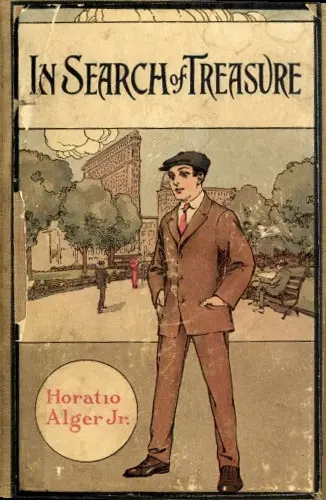
"In Search of Treasure" by Horatio Alger, Jr. is a novel written in the late 19th century. The story revolves around a bright and adventurous sixteen-year-old boy named Guy Fenwick, who wishes for a life beyond his father's ministerial duties in Bayport. Instead of pursuing glory through academia, Guy seeks excitement and the chance to explore the world when he discovers a hidden legacy tied to his late uncle—a pirate's treasure buried on a mysterious island. The opening of the novel introduces us to Guy and his father, Reverend Fenwick, discussing the boy's educational aspirations. Guy expresses disinterest in college, longing for adventure instead. After a poignant moment centered on family history, Guy explores an attic chest belonging to his deceased uncle George. Inside, he uncovers a letter containing details about a pirate's treasure hidden on an island. This catalyst sets Guy on a thrilling journey as he contemplates how to embark on the quest for this treasure to help improve his father's precarious financial situation, introducing themes of family loyalty, adventure, and the pursuit of one's dreams.
Introduction adapted from the source catalogue; source summaries may be automatically generated.
Free to read · English · 58,100 words · No account needed
MAKE TIME FOR A GOOD BOOK
On by default. Untick to stop anonymous reading totals. Each page counts after 10 seconds in view. How this works.
Anonymous counting is on unless you have switched it off.
On their branches were birds of strange plumage. They were singing, but the songs were unlike any that the three explorers had heard in America.
There were flowers, also, for on this far-away island it was the season of blooming, and their fragrance perfumed the air.
“I wonder if there are any inhabitants?” said Luke Clark.
“Probably there are no white inhabitants, and I hope there are none of a different race. They might prove dangerous, and interfere with our plans.”
“It almost seems a waste of productive power that such a delightful island should be uninhabited,” said Abner Titcomb. “Suppose it were within a few miles of Boston or New York, or near Portland, how it would attract visitors.”
“Like Peak’s Island,” suggested Luke Clark.
“Where is that?” asked Guy.
“Three miles from Portland. It is much smaller than this, but it attracts many visitors in the summer.”
“Unfortunately, we can’t move this island. Indeed, I shouldn’t want to till I have found the treasure.”
They reached the edge of the woods and plunged in. There was very little underbrush, but the trees rose straight and erect, branching at a considerable distance from the ground.
“What a fine grove for a camp meeting,” said Luke Clark. “Do you know how far the trees reach back, Guy?”
“Three or four miles, according to my description.”
“Shall we push through?”
“Yes. Back of the woods rises the small hill indicated on my plan of the island. I propose that we ascend that, and take a general view. It may be high enough for us to see the shore on the other side.”
It was not a work of difficulty to reach the hill and ascend it.
The rise was gradual, and the hill was comparatively bare of trees. Thus far they had discovered nothing that indicated any previous occupation by white men; but now on the summit of the hill they saw a pole looking somewhat like a telegraph pole.
“Do you see that, Guy?” said Abner Titcomb.
“Yes.”
“That must have been placed there by white visitors.”
“Probably by some of the pirates of whom my uncle speaks.”
“Yes; and so far it is a confirmation of his story.”
“You are right. It should be looked upon as encouraging.”
There was something else that suggested former visits. On the top of the hill, a hundred feet from the pole, was a rude seat made by a plank resting upon supports at either end.
“Let us sit down,” said Guy, “and take a general survey of the island.”
Your reading position is saved on this browser. Take it to another device with a library code. Reading pages adapt to text, rather than matching a printed edition.
William Rounseville Alger & Horatio, Jr. Alger

William Rounseville Alger & Horatio, Jr. Alger

Horatio, Jr. Alger

Horatio, Jr. Alger
BEHIND THE BOOK
This eBook is for the use of anyone anywhere in the United States and most other parts of the world at no cost and with almost no restrictions whatsoever. You may copy it, give it away or re-use it under the terms of the Project Gutenberg License included with this eBook or online at www.gutenberg.org. If you are not located in the United States, you will have to check the laws of the country where you are located before using this eBook. Read the source licence.
The original source file, including credits and licence, is retained by this library. Request an original-format copy at no charge. Please include the book title and Project Gutenberg identifier #54016.
KEEP YOUR CURIOSITY GOING
Wilfrid Scawen Blunt
Wilfrid Scawen Blunt

E. W. (Edgar Watson) Howe
Coulson Kernahan

Maurice Baring
Frances Wright