
Life of Edwin Forrest, the American Tragedian. Volume 2 (of 2)
William Rounseville Alger & Horatio, Jr. Alger
THE CLASSIC COLLECTION · 1894
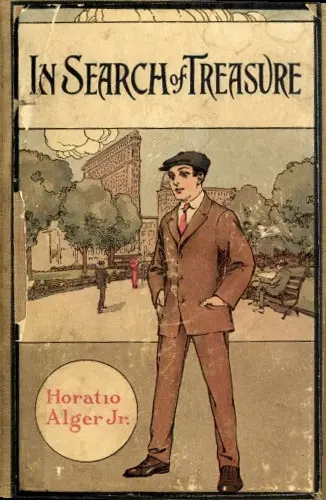
"In Search of Treasure" by Horatio Alger, Jr. is a novel written in the late 19th century. The story revolves around a bright and adventurous sixteen-year-old boy named Guy Fenwick, who wishes for a life beyond his father's ministerial duties in Bayport. Instead of pursuing glory through academia, Guy seeks excitement and the chance to explore the world when he discovers a hidden legacy tied to his late uncle—a pirate's treasure buried on a mysterious island. The opening of the novel introduces us to Guy and his father, Reverend Fenwick, discussing the boy's educational aspirations. Guy expresses disinterest in college, longing for adventure instead. After a poignant moment centered on family history, Guy explores an attic chest belonging to his deceased uncle George. Inside, he uncovers a letter containing details about a pirate's treasure hidden on an island. This catalyst sets Guy on a thrilling journey as he contemplates how to embark on the quest for this treasure to help improve his father's precarious financial situation, introducing themes of family loyalty, adventure, and the pursuit of one's dreams.
Introduction adapted from the source catalogue; source summaries may be automatically generated.
Free to read · English · 58,100 words · No account needed
MAKE TIME FOR A GOOD BOOK
On by default. Untick to stop anonymous reading totals. Each page counts after 10 seconds in view. How this works.
Anonymous counting is on unless you have switched it off.
It was tantalizing to reflect that it existed, and might make him rich, when it seemed wholly beyond his grasp. All the capital he could command was about twenty-five dollars in the Bayport Savings Bank.
The next question was: Should he tell his father of the discovery he had made? It might be his duty to do so. He did not know as to that.
His father had given him full permission to open and examine the chest and its contents. Possibly the papers and the secret belonged to him, but he knew very well that they would be of no earthly benefit to a quiet country minister who lived in his books and his study.
To him--Guy--on the other hand, it might prove of value. He did not know when or how, but he was young, and to the young all things are possible.
So, after thinking the matter over fully, Guy resolved to keep the
matter secret.
He glanced at the second paper, and found that it was a minute description of the island, but he had not got far enough along to feel interested in this. It would keep.
Guy went downstairs slowly, plunged in thought. He hoped his father would not ask about the contents of the chest, but he need not have felt alarmed. The matter had passed entirely out of the minister’s thoughts.
In order the better to think over the wonderful revelation, Guy went out for a stroll. Like many older persons, he found a walk was favorable to thought.
He walked slowly up the street to the post office. At the corner of the second street, just opposite the dry goods store, he met a boy whom he had never liked.
It was Noah Crane, the son of Deacon Crane, already referred to as
desiring a younger minister.
The thought of the deacon’s wish to drive his father from Bayport was not calculated to increase Guy’s friendship for the son. Yet he would be courteous, being naturally a gentleman.
“Where are you going, Guy?” asked Noah.
“I am only taking a walk.”
“Some other people may have to take a walk,” said Noah, with a coarse
laugh.
“What do you mean?” asked Guy, coloring, for he knew to what the
deacon’s son referred.
“Oh, I guess I’d better not tell,” replied Noah, in a tantalizing tone.
“Just as you please,” said Guy, coolly.
Noah was disappointed, for he wanted Guy to ask him a question which he was very ready to answer. Guy’s indifference piqued him.
“You’ll know soon enough,” added Crane.
“In that case I will be content to wait.”
Your reading position is saved on this browser. Take it to another device with a library code. Reading pages adapt to text, rather than matching a printed edition.
William Rounseville Alger & Horatio, Jr. Alger

William Rounseville Alger & Horatio, Jr. Alger

Horatio, Jr. Alger

Horatio, Jr. Alger
BEHIND THE BOOK
This eBook is for the use of anyone anywhere in the United States and most other parts of the world at no cost and with almost no restrictions whatsoever. You may copy it, give it away or re-use it under the terms of the Project Gutenberg License included with this eBook or online at www.gutenberg.org. If you are not located in the United States, you will have to check the laws of the country where you are located before using this eBook. Read the source licence.
The original source file, including credits and licence, is retained by this library. Request an original-format copy at no charge. Please include the book title and Project Gutenberg identifier #54016.
KEEP YOUR CURIOSITY GOING
Wilfrid Scawen Blunt
Wilfrid Scawen Blunt

E. W. (Edgar Watson) Howe
Coulson Kernahan

Maurice Baring
Frances Wright