THE CLASSIC COLLECTION✦The haunts of menCLASSIC FREE BOOKS
The haunts of men
Robert W. (Robert William) Chambers
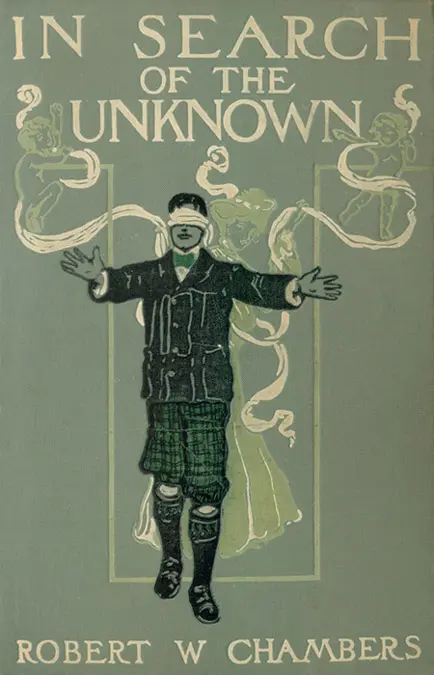
THE CLASSIC COLLECTION · 1904
"In Search of the Unknown" by Robert W. Chambers is a fictional work written in the early 20th century. The narrative revolves around the main character, who is a superintendent at the Bronx Zoological Gardens, as he embarks on a peculiar expedition to find the elusive and thought-to-be extinct great auk, along with a mysterious amphibious biped referenced in correspondence from a hermit named Burton Halyard. The story intertwines elements of adventure, mystery, and potential encounters with the unknown in nature. The opening portion of the book introduces us to the protagonist's rather skeptical disposition regarding a letter claiming the existence of live great auks. As he begins his new role, he is urged by his superior, Professor Farrago, to take the lead on an expedition to Black Harbor to investigate Halyard's assertions. Halyard, a somewhat eccentric character, hints at additional peculiarities involving another creature called the harbor-master. The narrative establishes a blend of scientific ambition and personal intrigue as the protagonist wrestles with his duties and the strange occurrences surrounding him, ultimately setting the stage for further adventures into the unknown.
Introduction adapted from the source catalogue; source summaries may be automatically generated.
Free to read · English · 71,474 words · No account needed
MAKE TIME FOR A GOOD BOOK
On by default. Untick to stop anonymous reading totals. Each page counts after 10 seconds in view. How this works.
Anonymous counting is on unless you have switched it off.
"Certainly," I replied, astonished; "it's the southernmost glacier in
British America."
"Right," he said. "And did you ever hear tell of the Hudson Mountings,
mister?"
"Yes," I replied.
"What's behind 'em?" he snapped out.
"Nobody knows," I answered. "They are considered impassable."
"They ain't, though," he said, doggedly; "I've been behind 'em."
"Really!" I replied, tiring of his yarn.
"Ya-as, reely," he repeated, sullenly. Then he began to fumble and search through the pages of his book until he found what he wanted. "Mister," he said, "jest read that out loud, please."
The passage he indicated was the famous chapter beginning:
"Is the mammoth extinct? Is the dingue extinct? Probably. And yet the aborigines of British America maintain the contrary. Probably both the mammoth and the dingue are extinct; but until expeditions have penetrated and explored not only the unknown region in Alaska but also that hidden table-land beyond the Graham Glacier and the Hudson Mountains, it will not be possible to definitely announce the total extinction of either the mammoth or the dingue."
When I had read it, slowly, for his benefit, he brought his hand down smartly on one knee and nodded rapidly.
"Mister," he said, "that gent knows a thing or two, and don't you forgit it!" Then he demanded, abruptly, how I knew he hadn't been behind the Graham Glacier.
I explained.
"Shucks!" he said; "there's a road five miles wide inter that there table-land. Mister, I ain't been in New York long; I come inter port a week ago on the Arctic Belle, whaler. I was in the Hudson range when that there Graham Glacier bust up--"
"What!" I exclaimed.
"Didn't you know it?" he asked. "Well, mebbe it ain't in the papers, but it busted all right--blowed up by a earthquake an' volcano combine. An', mister, it was oreful. My, how I did run!"
"Do you mean to tell me that some convulsion of the earth has shattered the Graham Glacier?" I asked.
"Convulsions? Ya-as, an' fits, too," he said, sulkily. "The hull blame thing dropped inter a hole. An' say, mister, home an' mother is good enough fur me now."
I stared at him stupidly.
"Once," he said, "I ketched pelts fur them sharps at Hudson Bay, like any yaller husky, but the things I seen arter that convulsion-fit--the things I seen behind the Hudson Mountings--don't make me hanker arter no life on the pe-rarie wild, lemme tell yer. I may be a Mother Carey chicken, but this chicken has got enough."
After a long silence I picked up his book again and pointed at the
picture of the mammoth.
"What color is it?" I asked.
Your reading position is saved on this browser. Take it to another device with a library code. Reading pages adapt to text, rather than matching a printed edition.
Robert W. (Robert William) Chambers
Robert W. (Robert William) Chambers

Robert W. (Robert William) Chambers
Robert W. (Robert William) Chambers
BEHIND THE BOOK
This eBook is for the use of anyone anywhere in the United States and most other parts of the world at no cost and with almost no restrictions whatsoever. You may copy it, give it away or re-use it under the terms of the Project Gutenberg License included with this eBook or online at www.gutenberg.org. If you are not located in the United States, you will have to check the laws of the country where you are located before using this eBook. Read the source licence.
The original source file, including credits and licence, is retained by this library. Request an original-format copy at no charge. Please include the book title and Project Gutenberg identifier #18668.
KEEP YOUR CURIOSITY GOING
Coulson Kernahan

Maurice Baring
Frances Wright
Cécile Tormay
Francis Greenleaf Allinson & Anne C. E. (Anne Crosby Emery) Allinson

Frederic Jesup Stimson