THE CLASSIC COLLECTION✦The haunts of menCLASSIC FREE BOOKS
The haunts of men
Robert W. (Robert William) Chambers
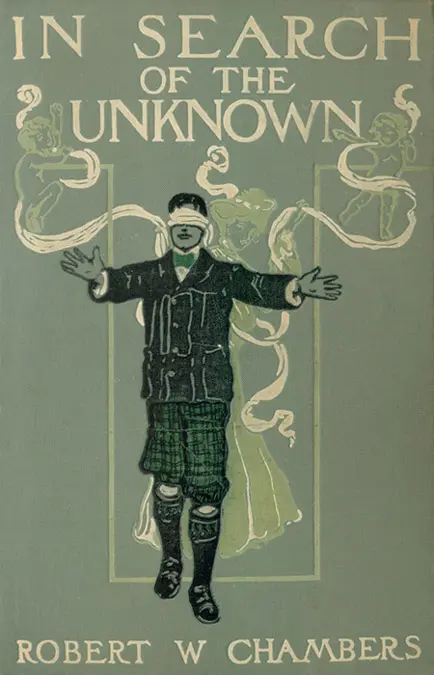
THE CLASSIC COLLECTION · 1904
"In Search of the Unknown" by Robert W. Chambers is a fictional work written in the early 20th century. The narrative revolves around the main character, who is a superintendent at the Bronx Zoological Gardens, as he embarks on a peculiar expedition to find the elusive and thought-to-be extinct great auk, along with a mysterious amphibious biped referenced in correspondence from a hermit named Burton Halyard. The story intertwines elements of adventure, mystery, and potential encounters with the unknown in nature. The opening portion of the book introduces us to the protagonist's rather skeptical disposition regarding a letter claiming the existence of live great auks. As he begins his new role, he is urged by his superior, Professor Farrago, to take the lead on an expedition to Black Harbor to investigate Halyard's assertions. Halyard, a somewhat eccentric character, hints at additional peculiarities involving another creature called the harbor-master. The narrative establishes a blend of scientific ambition and personal intrigue as the protagonist wrestles with his duties and the strange occurrences surrounding him, ultimately setting the stage for further adventures into the unknown.
Introduction adapted from the source catalogue; source summaries may be automatically generated.
Free to read · English · 71,474 words · No account needed
MAKE TIME FOR A GOOD BOOK
On by default. Untick to stop anonymous reading totals. Each page counts after 10 seconds in view. How this works.
Anonymous counting is on unless you have switched it off.
For a moment I had an indistinct impression of having met the elder lady somewhere, and under circumstances not entirely agreeable, but beyond a stony and indifferent glance she paid no attention to me. As for the younger lady, she did not look at me at all. She was very young, with pretty eyes, a mass of silky brown hair, and a skin as fresh as a rose which had just been rained on.
With that delicacy peculiar to lonely scientific bachelors, I modestly sat down beside the rough young man, although there was more room beside the younger lady. "Some lazy loafer reading a penny dreadful," I thought, glancing at him, then at the title of his book. Hearing me beside him, he turned around and blinked over his shabby shoulder, and the movement uncovered the page he had been silently conning. The volume in his hands was Darwin's famous monograph on the monodactyl.
He noticed the astonishment on my face and smiled uneasily, shifting the short clay pipe in his mouth.
"I guess," he observed, "that this here book is too much for me,
mister."
"It's rather technical," I replied, smiling.
"Yes," he said, in vague admiration; "it's fierce, ain't it?"
After a silence I asked him if he would tell me why he had chosen
Darwin as a literary pastime.
"Well," he said, placidly, "I was tryin' to read about annermals, but I'm up against a word-slinger this time all right. Now here's a gum-twister," and he painfully spelled out m-o-n-o-d-a-c-t-y-l, breathing hard all the while.
"Monodactyl," I said, "means a single-toed creature."
He turned the page with alacrity. "Is that the beast he's talkin'
about?" he asked.
The illustration he pointed out was a wood-cut representing Darwin's reconstruction of the dingue from the fossil bones in the British Museum. It was a well-executed wood-cut, showing a dingue in the foreground and, to give scale, a mammoth in the middle distance.
"Yes," I replied, "that is the dingue."
"I've seen one," he observed, calmly.
I smiled and explained that the dingue had been extinct for some
thousands of years.
"Oh, I guess not," he replied, with cool optimism. Then he placed a grimy forefinger on the mammoth.
"I've seen them things, too," he remarked.
Again I patiently pointed out his error, and suggested that he
referred to the elephant.
"Elephant be blowed!" he replied, scornfully. "I guess I know what I seen. An' I seen that there thing you call a dingue, too."
Not wishing to prolong a futile discussion, I remained silent. After a moment he wheeled around, removing his pipe from his hard mouth.
"Did you ever hear tell of Graham's Glacier?" he demanded.
Your reading position is saved on this browser. Take it to another device with a library code. Reading pages adapt to text, rather than matching a printed edition.
Robert W. (Robert William) Chambers
Robert W. (Robert William) Chambers

Robert W. (Robert William) Chambers
Robert W. (Robert William) Chambers
BEHIND THE BOOK
This eBook is for the use of anyone anywhere in the United States and most other parts of the world at no cost and with almost no restrictions whatsoever. You may copy it, give it away or re-use it under the terms of the Project Gutenberg License included with this eBook or online at www.gutenberg.org. If you are not located in the United States, you will have to check the laws of the country where you are located before using this eBook. Read the source licence.
The original source file, including credits and licence, is retained by this library. Request an original-format copy at no charge. Please include the book title and Project Gutenberg identifier #18668.
KEEP YOUR CURIOSITY GOING
Coulson Kernahan

Maurice Baring
Frances Wright
Cécile Tormay
Francis Greenleaf Allinson & Anne C. E. (Anne Crosby Emery) Allinson

Frederic Jesup Stimson