THE CLASSIC COLLECTION✦An outlaw’s diary: the CommuneCLASSIC FREE BOOKS
An outlaw’s diary: the Commune
Cécile Tormay
THE CLASSIC COLLECTION · 1904
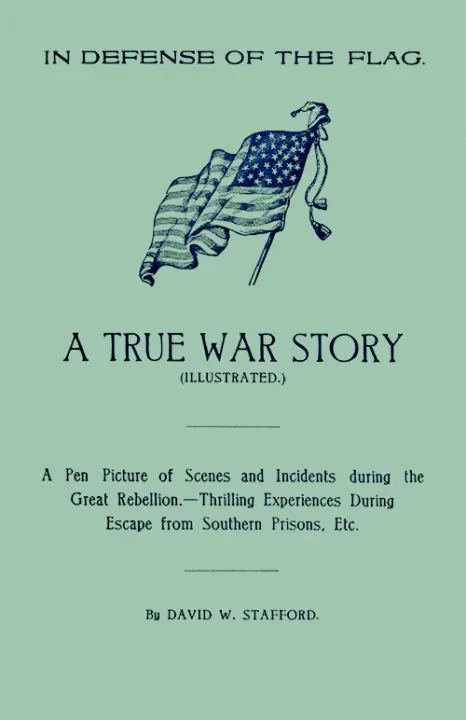
"In Defense of the Flag: A True War Story" by David W. Stafford is a historical account written in the early 20th century. This narrative recounts the true experiences of the author during the American Civil War, focusing on his enlistment, battles, the loss of his brother, and the harrowing details of being captured and imprisoned by the Confederate army. The book gives a personal glimpse into the challenges faced by soldiers of that era, particularly those who endured the intense hardships of war and imprisonment. The beginning of the story paints a vivid picture of Stafford's early life and motivations for joining the army at the tender age of seventeen. It details his initial enlistment in the 83rd Pennsylvania Volunteers, the struggle to keep his younger brother from following in his footsteps, and the profound heartbreak of losing him in battle. The opening sections also convey the chaos of war as Stafford narrates his experiences on the battlefield, his injuries, and the emotional turmoil of receiving tragic news about his brother’s fate while facing the prospect of imprisonment in a Southern prison. This portion sets the stage for a gripping tale of survival, resilience, and the search for freedom amidst the horrors of war.
Introduction adapted from the source catalogue; source summaries may be automatically generated.
Free to read · English · 28,392 words · No account needed
MAKE TIME FOR A GOOD BOOK
On by default. Untick to stop anonymous reading totals. Each page counts after 10 seconds in view. How this works.
Anonymous counting is on unless you have switched it off.
We had to change our course and leave this road, never to travel it again. We struck out to the west of this road, the road, as I have stated, running north and south. We made as good time as we could in order to reach a forest that seemed to lay off to the west. By this time it was now well on toward two o’clock in the morning. We succeeded in getting into a thick swampy region which we had every reason to believe saved our lives, for from the sounds we heard we came to the conclusion that we were being looked after in this swamp, and that it was no desirable place to be in. It was a very bad quagmire swamp, with moss hanging from the trees, and a bad place to stop in at night, let alone the day. For the next few days and nights, without a smell of meat or hoecake, or any such thing, except hard corn, we had nothing more to eat, and our company day and night was moccasin snakes and other rattling and hissing reptiles. Still we traveled, not fearing the wild animals as much as we did the rebels with their horns and hounds. Well, I must say that, young as I was at that time, it was one of the worst and most dreary times in the lines of life’s pages. To even contemplate it now seems almost like a dream.
Well, after sleeping and traveling almost night and day continually—cloudy weather some of the time and lost some of the time—we finally came out where there was a large plantation on this Shelterford road some sixty miles from where I had been shot at and to which I had been directed by hearing the dancing of two small negroes and the patting and singing of a large negro in one of the negro huts. Here we stopped and ate the last meal together and the last night that we ever traveled together in this southern country. Oh, how sad it makes me feel when I think back of the lonely nights that we both spent, traveling the balance of our journey! Well, as I was speaking of our last meal together: It was at the supper of two rebel bushwhackers, and these two rebels who were staying at this rebel plantation were men who would shoot down a poor fleeing prisoner on sight, and this made us uneasy to get away. This darkey had placed in the fire, in an old-fashioned fire place, a mess of large sweet potatoes for us to carry along with us, as he told us, but this he did intending to keep us until the two rebel guerillas came in on us. We had told this negro how well the old Quaker had used us during our stay with him, and I think that this darkey took advantage of this to fool us in telling us that one of these men staying here was a Quaker and he did not know what the other was. He seemed to be so uneasy that it aroused us, and we had just arose to go when the gate opened in front of the hut and the two little black darkies slipped out unbeknown to us. They had taken with them a ham that Henry carried along with him. Just at this time we did not know what to do, for an instant, but I had learned that my dear comrade was no coward, for here he showed the bravest thing that I had witnessed in a long time. I told the darkey that if he told of our whereabouts as we crawled under the bed, that we would kill him if it was the last thing we ever did. What my dear comrade did and which was his last brave act was to tell me to crawl under the bed and leave all to him. He thought he could get us out of the trouble all right. The two little darkies had already told the rebels of our eating up their supper, and one of these rebels, it seemed, went to the old planter’s house for a double-barreled shot gun and the other rebel came into the negro cabin. Now this cabin was like all other plantation huts. It had one door and one window on the east side, in the former of which a rebel stood, and a fire place in the north end, made of stone and sticks and daubed with red clay, and in the corner at the foot of the bed was a ladder. Between this ladder, close to the straw cot, lay my comrade, and just as soon as the rebel commenced to ask the negro what was the matter, and the darkey standing in the middle of the hut with mouth wide open, Henry arose to his feet and spoke to the rebel, bidding him good evening. It took the rebel so much by surprise it seemed as though poor Henry could have snatched one of his weapons from his scabbard and shot him with one of his own guns, but it seemed that the Lord had another way for us to get out of this dilemma. Henry was trying to find his cane that he had left in the corner that he might surprise the rebel still more, but the little darkies had made way with it. So after the first surprise the rebel began to think of his weapons, and drew them for the first time, asking Henry where he was going. Henry told him he was going north to a large river that we expected to cross. “Well,” said the rebel, “how many are there of you?” Henry told him there were two of us. Oh, how uneasy I was at this time, under a bed in a negro hut, betrayed, and, as I thought, almost in the jaws of death! Still he asked Henry where the other fellow was, and Henry told him I was out in the road. The rebel told Henry to go out and tell me to come in and he would fix him in about a minute. This was what Henry desired—to get out once for a start—so he went right off in a southern direction, and just as soon as the rebel started after him I got out of the hut as soon as I could. The darkey tried to stop me, but with one swing of my club I placed him out of my way. When I got to the road fence the rebels saw me running in the opposite direction. I made for the timber in a north-easterly direction as fast as I could, and very soon there was heard the blast of horns and the baying of hounds in pursuit of me. Oh, how gloomy and heart sick I was to find myself separated from my comrade, with hounds and rebels in pursuit of me. It must at this time have been about one o’clock in the morning. Soon thereafter it began to rain very hard. All at once the hounds came upon me, but they did not seem to be as fierce as the blood hounds of Andersonville. Shortly the blast of the horns ceased, and the hounds stopped following us. This was the last of our being together.
Your reading position is saved on this browser. Take it to another device with a library code. Reading pages adapt to text, rather than matching a printed edition.
BEHIND THE BOOK
This eBook is for the use of anyone anywhere in the United States and most other parts of the world at no cost and with almost no restrictions whatsoever. You may copy it, give it away or re-use it under the terms of the Project Gutenberg License included with this eBook or online at www.gutenberg.org. If you are not located in the United States, you will have to check the laws of the country where you are located before using this eBook. Read the source licence.
The original source file, including credits and licence, is retained by this library. Request an original-format copy at no charge. Please include the book title and Project Gutenberg identifier #49925.
KEEP YOUR CURIOSITY GOING
Cécile Tormay

Moritz Busch
John L. Ransom
Frances Wright
Cécile Tormay

Mabel Potter Daggett