THE CLASSIC COLLECTION✦An outlaw’s diary: the CommuneCLASSIC FREE BOOKS
An outlaw’s diary: the Commune
Cécile Tormay
THE CLASSIC COLLECTION · 1904
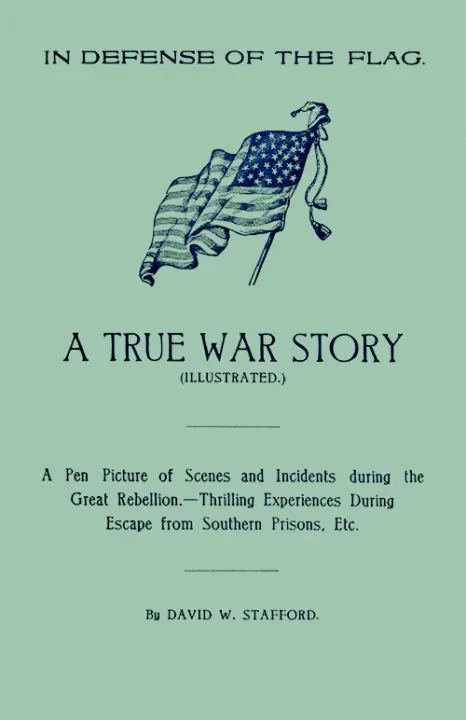
"In Defense of the Flag: A True War Story" by David W. Stafford is a historical account written in the early 20th century. This narrative recounts the true experiences of the author during the American Civil War, focusing on his enlistment, battles, the loss of his brother, and the harrowing details of being captured and imprisoned by the Confederate army. The book gives a personal glimpse into the challenges faced by soldiers of that era, particularly those who endured the intense hardships of war and imprisonment. The beginning of the story paints a vivid picture of Stafford's early life and motivations for joining the army at the tender age of seventeen. It details his initial enlistment in the 83rd Pennsylvania Volunteers, the struggle to keep his younger brother from following in his footsteps, and the profound heartbreak of losing him in battle. The opening sections also convey the chaos of war as Stafford narrates his experiences on the battlefield, his injuries, and the emotional turmoil of receiving tragic news about his brother’s fate while facing the prospect of imprisonment in a Southern prison. This portion sets the stage for a gripping tale of survival, resilience, and the search for freedom amidst the horrors of war.
Introduction adapted from the source catalogue; source summaries may be automatically generated.
Free to read · English · 28,392 words · No account needed
MAKE TIME FOR A GOOD BOOK
On by default. Untick to stop anonymous reading totals. Each page counts after 10 seconds in view. How this works.
Anonymous counting is on unless you have switched it off.
We did not get clear through to our friend John’s, but stopped after traveling about twenty-five miles or so. There were mile posts along this road, so that we could tell how far we were traveling in a day or night. After the second day had passed it found us again on the third night eating hard corn from the cob, as we had often done before, when it was not good for us to let ourselves be known along the way. We made up our minds to get to where John Coltraines lived this night if we could, for our old friend who had given us the direction of his abode, told us if we could only find him he would help us through to our lines without any trouble. We started with the full determination of getting through to our lines this night if the Lord was willing, and until midnight had past we had got out of the way and let squads of rebels pass and repass along the way and still we had made some headway. After about the midnight hour I had stopped several times to make some inquiries as to where John Coltraines lived, without apparently any success. I had also asked for hoecake, and in return I had a double-barreled gun pointed through the door at me. This kind of fare we had been receiving all along the way. Never on our whole journey did fate seem to be so much against us as it did at this place, for we had not obtained a bite to eat for most three days, except the first. I had began to get quite jealous of my dear friend Henry, for I had been stopping to enquire the way and he had not stopped, running the chances of being shot at, and I began to find fault, as every jealous person will, with my very best friend and comrade that I believe I ever met in this wide world. I do believe if I should meet him and he had but five dollars he would divide with me, and when Henry heard me talk to him about his being a little cowardly he felt very bad, and told me through his tears that he was no coward if I did think he was. This sad talk, and with such feeling, broke me up, and I caught my grieved old comrade by the hand and wanted him to forgive me for this unkind talk, which I promised would never again happen, and I wish to thank God that it never did. Henry was determined that he would show me that he was no coward and he told me that he meant to stop at the very next house. Now we had been told by our guide that we must not stop at William Coltraines’, or “Bill,” as he was commonly called, for he was captain of the rebel home guards, or of a band of guerillas. We had gotten very close to where John Coltraines lived, and it was best that we should go slow, as we had been told about the barn which was a very large one, on the west side of the road, and the big wood colored house on the other side located on a raised lawn. Several steps of square blocks led up to the house. We came to this place, and Henry, not heeding my warning, at once started up these steps. I continued to call to him to stop, but he would not. He went to the large piazza and knocked on the door. I still called to him, but he did not heed, so determined was he that he would demonstrate to me that he was no coward. I could see very plainly that this was the very house we had been warned not to stop at, yet Henry continued to knock. There was a gruff voice heard, which I will never forget until my dying day, asking who was there. Henry told him that it was a friend. He was not satisfied, but still insisted on knowing who it was. Then Henry inquired where John, his own brother, lived. The old captain told him he would soon let him know where he lived, so he came to the door and shoved out a double-barreled shot gun, and before poor Henry had time to dodge, shoved my poor comrade and friend to the ground. I thought when he struck the ground that he had been killed, but soon he rose to his feet and pleaded for the rebel to spare his life. Just at this moment I rushed up to the top of the lawn, or stone steps, when he caught sight of me, and just as he was about to level his gun on me I dropped backward and struck on all fours at the bottom of the steps. Just as I did so Henry took advantage of the situation and hurried behind the house. He ran clear around and down through a cane field in the direction we had been going, and as soon as I could gain my feet I started down the road as fast as my legs could carry me. The rebel by this time was also at the road side and sent another shot after me. The first shot came very close. Just as I fell to the ground the rebel turned his fire on my comrade just as he turned the corner of the house. Now as soon as the second shot was fired at me he hastened to the barn, no doubt to get some steed with which to pursue us. Just then there seemed to be a great stir at that plantation house. My desire was to again get with Henry, and stopping, I placed my fingers to my mouth and whistled the third brigade call. At the time of Henry’s capture he was despatch carrier for our brigade and also the bugler of our regiment. Now I had learned to give the call on my fingers. This is the call in words: “Dan, Dan Butterfield! Butterfield, get up you poor devil as quick as you can, and when you get tired I will rest you again.” This repeated in the first words on a horn or whistle is very interesting to anyone who has ever heard the call. Now to whistle this call right in the face of an enemy seemed a hard task, but it had to be done. Soon there came an answer, and within five minutes we were again on our way, but the thought of ever meeting with John Coltraines was now abandoned.
Your reading position is saved on this browser. Take it to another device with a library code. Reading pages adapt to text, rather than matching a printed edition.
BEHIND THE BOOK
This eBook is for the use of anyone anywhere in the United States and most other parts of the world at no cost and with almost no restrictions whatsoever. You may copy it, give it away or re-use it under the terms of the Project Gutenberg License included with this eBook or online at www.gutenberg.org. If you are not located in the United States, you will have to check the laws of the country where you are located before using this eBook. Read the source licence.
The original source file, including credits and licence, is retained by this library. Request an original-format copy at no charge. Please include the book title and Project Gutenberg identifier #49925.
KEEP YOUR CURIOSITY GOING
Cécile Tormay

Moritz Busch
John L. Ransom
Frances Wright
Cécile Tormay

Mabel Potter Daggett