THE CLASSIC COLLECTION✦My diaries, being a personal narrative of events 1888-1914, Part 2 (1900-1914)CLASSIC FREE BOOKS
My diaries, being a personal narrative of events 1888-1914, Part 2 (1900-1914)
Wilfrid Scawen Blunt
THE CLASSIC COLLECTION · 1920
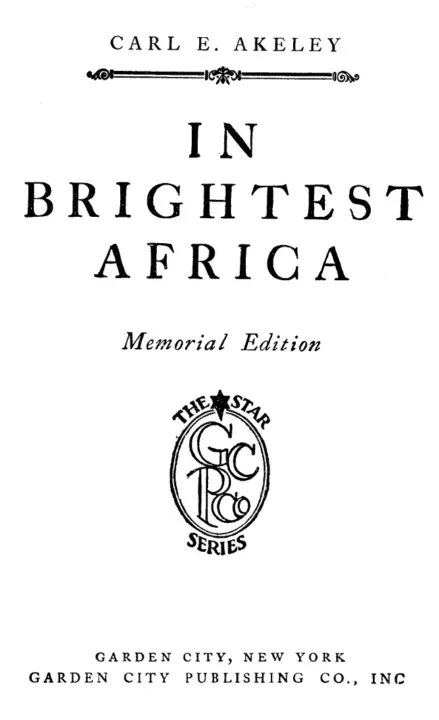
"In Brightest Africa" by Carl E. Akeley is a memoir and travelogue written in the early 20th century. The book chronicles the author’s adventurous experiences and observations as a taxidermist and sculptor in Africa, focusing on the majestic wildlife and the challenges of preserving it amidst the advances of civilization. Akeley’s narrative sheds light on his encounters with animals like elephants, lions, and gorillas, underlining both the beauty and the fragility of Africa's ecosystem. The opening of the memoir introduces Akeley's passion for taxidermy, which began in his youth on a farm in New York. As he recounts his journey, he expresses his fascination with animals and reveals his desire to learn the art of taxidermy in a proper setting, ultimately leading him to the esteemed Ward's Natural Science Establishment. The narrative then transitions to his expeditions in Africa, where he describes the rigorous work involved in studying and preserving various animal species, highlighting the harsh realities of their vanishing habitats, the ethical dilemmas he faces, and his deep admiration for the wildlife he encounters.
Introduction adapted from the source catalogue; source summaries may be automatically generated.
Free to read · English · 75,077 words · No account needed
MAKE TIME FOR A GOOD BOOK
On by default. Untick to stop anonymous reading totals. Each page counts after 10 seconds in view. How this works.
Anonymous counting is on unless you have switched it off.
As a boy I lived on a farm near Clarendon, Orleans County, N. Y., and for some reason, about the time I was thirteen, I got interested in birds. I was out of place on the farm for I was much more interested in taxidermy than in farming. As a matter of fact, by the time I was sixteen I announced to the world that I was a taxidermist. I had borrowed a book which had originally cost a dollar, and from that book I learned taxidermy up to a point where I felt justified in having business cards printed stating that I did artistic taxidermy in all its branches. I even went so far as to take several lessons in painting from a lady who taught art in Clarendon, in order that I might paint realistic backgrounds behind the birds that I mounted. So far as I know, that was the first experiment of painted backgrounds used for mounted birds or animals. I believe that my first attempt in this direction is still in existence in Clarendon but I have been a little afraid to go to see it.
In the fall of the year in which I was nineteen, after the crops were in, I set out to get a wider field for my efforts. There was at that time in the neighbouring town of Brockport an Englishman named David Bruce, whose hobby was taxidermy. By calling he was a painter and interior decorator--a very skilful craftsman who did special work far and wide through the country. As a recreation he mounted birds and animals for sportsmen. His office was filled with birds in cases and he was surrounded with other evidences of his hobby.
To me it seemed that he led an ideal life, for he had a successful business and one that gave him enough spare time to indulge his fancies in taxidermy. It hadn't entered my head at the time that a man could make a living at anything as fascinating as taxidermy, so I felt that the best possible solution of the problem was that which Mr. Bruce had devised. I went to see if I could get a job with him in his decorating business in order that I might also be with him in his hobby. He was most kindly and cordial. I remember that he took me out and bought me an oyster stew and told me, while we were eating, that if I came with him he would teach me all his trade secrets in painting and decorating, which he had kept even from his workmen. It seemed to me that a glorious future was settled for me then and there. If I was not in the seventh heaven, I was at least in the fifth or sixth and going up, and then my prospects became so favourable as to become almost terrifying. Mr. Bruce, after having made me such alluring offers to come with him, said that he thought I ought to go to a much better place than his shop--a place where I might actually make a living at taxidermy. In Rochester there was a famous institution, Ward's Natural Science Establishment. At that time, and for years afterward, this establishment supplied the best museums in this country with nearly all their mounted specimens and also most of their other natural history collections. Professor Ward was the greatest authority on taxidermy of his day. It was to this place that Bruce suggested I should go. The step which he planned seemed a great venture to me, but I determined to try it. I went home from Brockport and told the family what Bruce had said and what I intended to do. I got up early next morning--I didn't have to wake up for I had hardly slept a wink--and walked three miles to the station to take the train to Rochester. When I reached there, I walked all over town before I found Ward's Natural Science Establishment and the more I walked the lower and lower my courage sank. The Establishment consisted of Professor Ward's house and several other buildings, the entrance to the place being an arch made of the jaws of a sperm whale. An apprentice approaching the studio of a Rembrandt or a Van Dyke couldn't have been more in awe than I was. I walked up and down the sidewalk in front of the Professor's house for a while until I finally gathered courage to ring the door-bell. I was admitted to an elaborately furnished room, and after a little while Professor Ward came in. It had been a long time since I had had breakfast, but he hadn't quite finished his, and this contrast seemed to increase my disadvantages in his presence. Moreover, Professor Ward was always very busy and very brusque and was a very fierce man. Not even when a leopard sprang on me in Africa have I had a worse moment than when this little man snapped out, "What do you want?"
Your reading position is saved on this browser. Take it to another device with a library code. Reading pages adapt to text, rather than matching a printed edition.
BEHIND THE BOOK
This eBook is for the use of anyone anywhere in the United States and most other parts of the world at no cost and with almost no restrictions whatsoever. You may copy it, give it away or re-use it under the terms of the Project Gutenberg License included with this eBook or online at www.gutenberg.org. If you are not located in the United States, you will have to check the laws of the country where you are located before using this eBook. Read the source licence.
The original source file, including credits and licence, is retained by this library. Request an original-format copy at no charge. Please include the book title and Project Gutenberg identifier #64675.
KEEP YOUR CURIOSITY GOING
Wilfrid Scawen Blunt
Wilfrid Scawen Blunt

E. W. (Edgar Watson) Howe
Francis Greenleaf Allinson & Anne C. E. (Anne Crosby Emery) Allinson
Cyrenus Cole

John Martineau