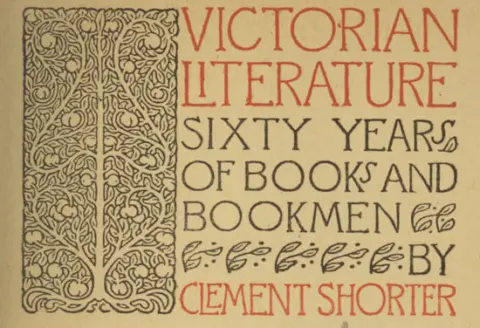
Victorian Literature: Sixty Years of Books and Bookmen
Clement King Shorter
THE CLASSIC COLLECTION · 1907
"Immortal Memories" by Clement King Shorter is a collection of literary addresses and essays, written in the early 20th century. The book consists of commemorative speeches delivered at various literary gatherings, focusing primarily on notable figures in literature such as Dr. Samuel Johnson and William Cowper, among others. Through these essays, Shorter reflects on the lives and legacies of these literary giants, engaging readers in a discourse on their contributions to the literary canon. The opening of "Immortal Memories" introduces the concept of the book, revealing that the initial addresses were presented at celebrations or gatherings dedicated to honoring esteemed writers and literary figures. Shorter expresses a personal connection to the subjects, sharing anecdotes that highlight the pivotal moments in their lives and the impact they had on literature. His tribute to Dr. Samuel Johnson sets the stage, acknowledging the significance of Johnson's enduring influence while invoking the spirit of camaraderie among literary enthusiasts as they commemorate the vital contributions made by the authors he discusses. Overall, the opening provides a glimpse into both the personal and historical context of Shorter's reflections on literary immortality.
Introduction adapted from the source catalogue; source summaries may be automatically generated.
Free to read · English · 55,309 words · No account needed
MAKE TIME FOR A GOOD BOOK
On by default. Untick to stop anonymous reading totals. Each page counts after 10 seconds in view. How this works.
Anonymous counting is on unless you have switched it off.
There is, I believe, a definite understanding among our members that we, the Brethren of the Johnson Club, have each and all of us read every line about Dr. Johnson that is in print, to say nothing of his works. It is particularly accepted that the thirteen volumes in which our late brother, Dr. Birkbeck Hill, enshrined his own appreciation of our Great Man, are as familiar to us all as are the Bible and the Book of Common Prayer. For my part, with a deep sense of the responsibility that must belong to any one who has rashly undertaken to read a paper before the Club, I admit to having supplemented these thirteen volumes by a reperusal of the little book entitled Johnson Club Papers, by Various Hands, issued in 1899 by Brother Fisher Unwin. I feel as I reread these addresses that there were indeed giants in those days, although my admiration was moderated a little when I came across the statement of one Brother that Johnson's proposal for an edition of Shakspere "came to nothing"; and the statement of another that "Goldsmith's failings were almost as great and as ridiculous as Boswell's;" while my bibliographical ire was awakened by the extraordinary declaration in an article on "Dr. Johnson's Library," that a first folio edition of Shakspere might have realized 250 pounds in the year 1785. Still, I recognize the talent that illuminated the Club in those closing years of the last century. Happily for us, who love good comradeship, most of the giants of those days are still in evidence with their polished armour and formidable spears.
What can I possibly say that has not already been said by one or other of the Brethren? Well, I have put together these few remarks in the hopes that no one of you has seen two books that are in my hands, the first, The Reades of Blackwood Hill, with Some Account of Dr. Johnson's Ancestry, by Aleyn Lyell Reade; the other, The Life and Letters of Dr. Birkbeck Hill, by his daughter Mrs. Crump. The first of these is privately printed, although it may be bought by any one of the Brethren for a couple of guineas. As far as I am able to learn, Brother Augustine Birrell is the only one of the Brethren who has as yet purchased a copy. The other book, our Brother Birkbeck Hill's biography, is to be issued next week by Mr. Edward Arnold, who has kindly placed an early copy at my disposal. In both these volumes there is much food for reflection for all good Johnsonians. Dr. Johnson's ancestry, it may be, makes little appeal to the crowd, but it will to the Brethren. There is no more favourite subject for satire than the tendency to minute study of an author and his antecedents. But the lover of that author knows the fascination of the topic. He can forgive any amount of zeal. I confess that personally I stand amazed at the variety and interest of Mr. Reade's researches. Let me take a sample case of his method before coming to the main issue. In the opening pages of Boswell's Johnson there is some account of Mr. Michael Johnson, the father. The most picturesque anecdote told of Johnson Senior is that concerning a young woman of Leek in Staffordshire, who while he served his apprenticeship there conceived a passion for him, which he did not return. She followed him to Lichfield, where she took lodgings opposite to the house in which he lived, and indulged her hopeless flame. Ultimately she died of love and was buried in the Cathedral at Lichfield, when Michael Johnson put a stone over her grave. This pathetic romance has gone unchallenged by all Boswell's editors, even including our prince of editors, Dr. Birkbeck Hill. Mr. Reade, it seems to me, has completely shattered the story, which, as all Johnsonian students know, was obtained by Boswell from Miss Anna Seward. Mr. Reade is able to show that Michael Johnson had been settled in Lichfield for at least eleven years before the death of Elizabeth Blaney, that for five years she had been the much appreciated domestic in a household in that city. Her will indicates moreover a great affection for her mistress and for that mistress's son; she leaves the boy a gold watch and his mother the rest of her belongings. The only connexion that Michael Johnson would seem to have had with the woman was that he and his brother were called in after her decease to make an inventory of her little property. I think that these little facts about Mistress Blaney, her five years' residence at Lichfield apparently in a most comfortable position, her omission of Michael Johnson from her will, and the fact that he had been in Lichfield at least six months before she arrived, are conclusive.
Your reading position is saved on this browser. Take it to another device with a library code. Reading pages adapt to text, rather than matching a printed edition.
BEHIND THE BOOK
This eBook is for the use of anyone anywhere in the United States and most other parts of the world at no cost and with almost no restrictions whatsoever. You may copy it, give it away or re-use it under the terms of the Project Gutenberg License included with this eBook or online at www.gutenberg.org. If you are not located in the United States, you will have to check the laws of the country where you are located before using this eBook. Read the source licence.
The original source file, including credits and licence, is retained by this library. Request an original-format copy at no charge. Please include the book title and Project Gutenberg identifier #21869.
KEEP YOUR CURIOSITY GOING

David Patterson (Spirit) Hatch

David Patterson (Spirit) Hatch

David Patterson (Spirit) Hatch

Ralph Waldo Emerson

Maurice Baring

Oscar Wilde & James McNeill Whistler