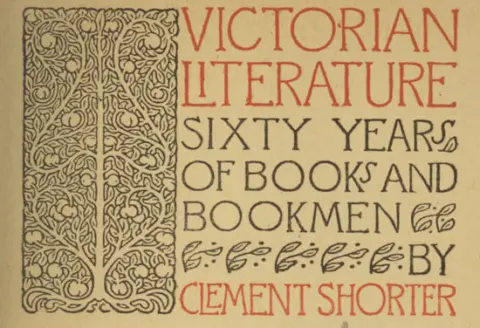
Victorian Literature: Sixty Years of Books and Bookmen
Clement King Shorter
THE CLASSIC COLLECTION · 1907
"Immortal Memories" by Clement King Shorter is a collection of literary addresses and essays, written in the early 20th century. The book consists of commemorative speeches delivered at various literary gatherings, focusing primarily on notable figures in literature such as Dr. Samuel Johnson and William Cowper, among others. Through these essays, Shorter reflects on the lives and legacies of these literary giants, engaging readers in a discourse on their contributions to the literary canon. The opening of "Immortal Memories" introduces the concept of the book, revealing that the initial addresses were presented at celebrations or gatherings dedicated to honoring esteemed writers and literary figures. Shorter expresses a personal connection to the subjects, sharing anecdotes that highlight the pivotal moments in their lives and the impact they had on literature. His tribute to Dr. Samuel Johnson sets the stage, acknowledging the significance of Johnson's enduring influence while invoking the spirit of camaraderie among literary enthusiasts as they commemorate the vital contributions made by the authors he discusses. Overall, the opening provides a glimpse into both the personal and historical context of Shorter's reflections on literary immortality.
Introduction adapted from the source catalogue; source summaries may be automatically generated.
Free to read · English · 55,309 words · No account needed
MAKE TIME FOR A GOOD BOOK
On by default. Untick to stop anonymous reading totals. Each page counts after 10 seconds in view. How this works.
Anonymous counting is on unless you have switched it off.
a story which Macaulay bluntly charges Robert Montgomery with stealing. Lord Tennyson, again, at a much later date, admitted that "Crabbe has a world of his own."
Not less impressive surely is the attitude of the two writers as far as the poles asunder in their outlook upon life and its mysteries--Cardinal Newman and Edward FitzGerald. The famous theologian, we learn from the Letters and Correspondence collected by Anne Mozley, writes in 1820 of his "excessive fondness" for The Tales of the Hall, and thirty years later in one of his Discourses he says of Crabbe's poems that they are among "the most touching in our language." Still another twenty years, and the aged cardinal reread Crabbe to find that he was more delighted than ever with our poet. That great nineteenth century pagan, on the other hand, that prince of letter-writers and wonderful poet of whom Suffolk has also reason to be proud, Edward FitzGerald, was even more ardent. Praise of Crabbe is scattered freely throughout the many volumes of his correspondence, and he edited, as we all know, a book of Selections, which I want to see reprinted. It contains a preface that, it may be admitted, is not really worthy of FitzGerald, so lacking is it in the force and vigour of his correspondence. But this also was in fact yet another death-bed tribute, for it was, I think, one of the last things FitzGerald wrote. FitzGerald, however, has done more for Crabbe among the moderns than any other man. His keen literary judgment must have brought new converts to that limited brotherhood of the elect, of which this gathering forms no inconsiderable portion.
We have one advantage in speaking about George Crabbe that does not obtain with any other poet of great eminence; that is to say, that his life story has not been hackneyed by repetition. With almost any other writer there is some standing biography which is widely familiar. The Life of George Crabbe, written by his son, although it is one of the very best biographies that I have ever read, is little known. It was quite out of print for years, and it has never been reprinted separately from the poems. It is an admirable biography, and it offers a contradiction of the view occasionally urged that a man's life should not be written by a member of his own family; for George Crabbe the second would seem not only to have been an exceedingly able man, but possessed of a frankness of disposition in criticizing his father which sons are often prone to show in real life, but which, I imagine, they rarely show in print. His book is a model of candid statement, treating of Crabbe's little weaknesses--and who of us has not his little weaknesses--in the most cheery possible manner. It is perhaps a small matter to tell us in one place of his father's want of "taste," his insensibility to the beauty of order in his composition--that had been done by the critics before him; but he even has something to say about the philandering which characterized the old gentleman in the last years of his life, his apparent anxiety to get married again. {106} The only thing that he all but ignores is Crabbe's opium habit--a habit that came to him as a sedative from a painful complaint and inspired, as was the case with Coleridge, his more melodious utterances. Taken altogether the picture is as pleasant as it is capable and exhaustive. We see his early boyhood at Aldeburgh, his schooldays: his first period of unhappiness at Slaughden Quay, his apprenticeship near Bury St. Edmunds, where we seem to hear his master's daughters, when he reached the door, exclaim with laughter, "La! Here's our new 'prentice." We follow him a little higher, to the house of the Woodbridge surgeon, then through his prolonged courtship of Sarah Elmy, then to those dreary, uncongenial duties of piling up butter casks on Slaughden Quay. A brief period of starvation in London, and we find him again in a chemist's shop in Aldeburgh. Lastly comes his most important journey to London upon the borrowed sum of 5 pounds, only three of which he carried in hard cash. His hand to mouth existence in London for some months is among the most interesting things in literature. Chatterton's tragic fate might have been his, but, more fortunate than Chatterton, he had friends at Beccles who helped him, and he was even able to publish a poem, The Candidate. Although this poem contained only thirty-four pages, one is not quite sure but that it helped to ruin its publisher. In any case that publisher went bankrupt soon after.
Your reading position is saved on this browser. Take it to another device with a library code. Reading pages adapt to text, rather than matching a printed edition.
BEHIND THE BOOK
This eBook is for the use of anyone anywhere in the United States and most other parts of the world at no cost and with almost no restrictions whatsoever. You may copy it, give it away or re-use it under the terms of the Project Gutenberg License included with this eBook or online at www.gutenberg.org. If you are not located in the United States, you will have to check the laws of the country where you are located before using this eBook. Read the source licence.
The original source file, including credits and licence, is retained by this library. Request an original-format copy at no charge. Please include the book title and Project Gutenberg identifier #21869.
KEEP YOUR CURIOSITY GOING

David Patterson (Spirit) Hatch

David Patterson (Spirit) Hatch

David Patterson (Spirit) Hatch

Ralph Waldo Emerson

Maurice Baring

Oscar Wilde & James McNeill Whistler