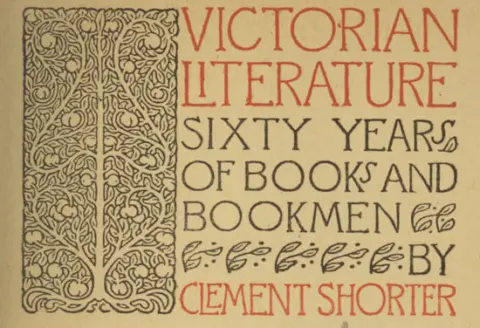
Victorian Literature: Sixty Years of Books and Bookmen
Clement King Shorter
THE CLASSIC COLLECTION · 1907
"Immortal Memories" by Clement King Shorter is a collection of literary addresses and essays, written in the early 20th century. The book consists of commemorative speeches delivered at various literary gatherings, focusing primarily on notable figures in literature such as Dr. Samuel Johnson and William Cowper, among others. Through these essays, Shorter reflects on the lives and legacies of these literary giants, engaging readers in a discourse on their contributions to the literary canon. The opening of "Immortal Memories" introduces the concept of the book, revealing that the initial addresses were presented at celebrations or gatherings dedicated to honoring esteemed writers and literary figures. Shorter expresses a personal connection to the subjects, sharing anecdotes that highlight the pivotal moments in their lives and the impact they had on literature. His tribute to Dr. Samuel Johnson sets the stage, acknowledging the significance of Johnson's enduring influence while invoking the spirit of camaraderie among literary enthusiasts as they commemorate the vital contributions made by the authors he discusses. Overall, the opening provides a glimpse into both the personal and historical context of Shorter's reflections on literary immortality.
Introduction adapted from the source catalogue; source summaries may be automatically generated.
Free to read · English · 55,309 words · No account needed
MAKE TIME FOR A GOOD BOOK
On by default. Untick to stop anonymous reading totals. Each page counts after 10 seconds in view. How this works.
Anonymous counting is on unless you have switched it off.
For whatever homage may have fallen to Borrow during the half-century or more since his name first came upon many tongues Norwich, it must be admitted, has given very little of it. No one associated with your city, I repeat, but has heard of the Gurneys and the Martineaus, of the Stanleys and the Austins, whose life stories have made so large a part of your literary and intellectual history during this very period. But I turn in vain to a number of books that I have in my library for any information concerning one who is indisputably the greatest among the intellectual children of Norwich. I turn to Mr. Prothero's Life of Dean Stanley--not one word about Borrow; to that pleasant Memoir of Sarah Austin and her mother, Mrs. Taylor, called Three Generations of a Norfolk Family--again not one word. I turn to Mr. Braithwaite's biography of Joseph John Gurney, and to Mr. Augustus Hare's book The Gurneys of Earlham--upon these worthy biographers Borrow made no impression whatever, although Joseph John Gurney was personally helpful to him and we read in Lavengro of that pleasant meeting between the pair on the river bank when Mr. Gurney chided the boy Borrow or Lavengro for angling. "From that day," he says, "I became less and less a practitioner of that cruel fishing." In Harriet Martineau's Autobiography, which enjoyed its hour of fame when it was published twenty-six years ago, there is a contemptuous reference to the disciple of William Taylor, "this polyglot gentleman, who went through Spain disseminating Bibles." If Miss Martineau were alive now she would hear the works of "this polyglot gentleman" praised on every hand, and would find that a cult had arisen which to her would certainly be quite incomprehensible. In that large, dismal book--the Life of James Martineau, again, there is but one mention of Dr. Martineau's famous schoolfellow whose name has been linked with him only by a silly story. Do not let it be thought that I am complaining of this neglect; the world will always treat its greatest writers in precisely this fashion. Borrow did not lack for fame of a kind, but he was, as I desire to show, praised in his lifetime for the wrong thing, where he was praised at all. Everyone in the fifties and sixties read The Bible in Spain, as they read a hundred other books of that period, now forgotten. Many read it who were deceived by its title. They expected a tract. Many read it as we to-day read the latest novel or biography of the hour. Then a new book arises and the momentary favourite is forgotten. We think for a whole week that we are in contact with a well-nigh immortal work. A little later we concern ourselves not at all whether the book is immortal or not. We go on to something else. The critic is as much to blame as the reader. Not one man in a hundred whose profession it is to come between the author and the public, and to guide the reader to the best in literature, has the least perception of what is good literature. It is easy when a writer has captured the suffrages of the crowd for the critic to tell the world that he is great. That happened to Carlyle, to Tennyson, to many a popular author whose earliest books commanded little attention: but, happily, these writers did not lose heart. They kept on writing. Borrow was otherwise made. He wrote The Bible in Spain--a book of travel of surprising merit. It sold largely on its title. Mr. Augustine Birrell has told us that he knew a boy in a very strict household who devoured the narrative on Sunday afternoons, the title being thought to cover a conventional missionary journey. Well, when I was a boy The Bible in Spain had gone out of fashion and the public had not taken up with the author's greater work, Lavengro. Borrow was naturally disappointed. He abused the critics and the public. Perhaps he grew somewhat soured. He did not hesitate in The Romany Rye to talk candidly about those "ill-favoured dogs . . . the newspaper editors," and he made the gentleman's gentleman of Lavengro describe how he was excluded from the Servants' Club in Park Lane because his master followed a profession "so mean as literature." In fact as a reaction from the unfriendly reception accorded to the Romany Rye--now one of the most costly of his books in a first edition--he lost heart, and he grew to despise the whole literary and writing class. Hence the various stories presenting him in not very sympathetic guise, the story of Thackeray being snubbed on asking Borrow if he had read the Snob Papers, of Miss Agnes Strickland receiving an even more forcible rebuff when she offered to send him her Queens of England. "For God's sake don't Madame; I should not know where to put them or what to do with them." These stories are in Gordon Hake's Memoirs of Eighty Years, but Mr. Francis Hindes Groome has shown us the other side of the picture, and others also to whom I shall refer a little later have done the same. Perhaps the literary class is never the worse for a little plain speaking. The real secret of Borrow is this--that he was a man of action turned into a writer by force of circumstances.
Your reading position is saved on this browser. Take it to another device with a library code. Reading pages adapt to text, rather than matching a printed edition.
BEHIND THE BOOK
This eBook is for the use of anyone anywhere in the United States and most other parts of the world at no cost and with almost no restrictions whatsoever. You may copy it, give it away or re-use it under the terms of the Project Gutenberg License included with this eBook or online at www.gutenberg.org. If you are not located in the United States, you will have to check the laws of the country where you are located before using this eBook. Read the source licence.
The original source file, including credits and licence, is retained by this library. Request an original-format copy at no charge. Please include the book title and Project Gutenberg identifier #21869.
KEEP YOUR CURIOSITY GOING

David Patterson (Spirit) Hatch

David Patterson (Spirit) Hatch

David Patterson (Spirit) Hatch

Ralph Waldo Emerson

Maurice Baring

Oscar Wilde & James McNeill Whistler