
The Writing of News A Handbook with Chapters on Newspaper Correspondence and Copy Reading
Charles G. (Charles Griffith) Ross
THE CLASSIC COLLECTION · 1919
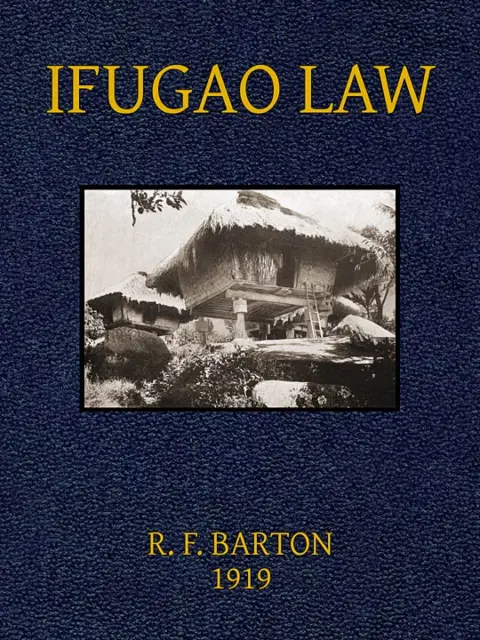
"Ifugao Law" by R. F. Barton is an ethnographic account written in the early 20th century. This publication delves into the legal system and customs of the Ifugao people, a group known for their intricate rice terraces in the Philippines. It examines the roots of Ifugao law, including its connection to customs and taboos, and explores topics ranging from family law and property rights to criminal law and social responsibilities. The opening of the work introduces the Ifugao culture, emphasizing its lack of formal political governance yet robust systems of customary law derived from taboos and social norms. It posits that, despite being labeled as "barbaric" by outsiders, the Ifugao people maintain relative peace and cohesion through their customary laws, which are crucial to their social fabric. Barton sets the stage for a thorough examination of the unique aspects of Ifugao law, including marriage contracts, property inheritance, and clan responsibilities, while situating these practices within a broader anthropological discourse on primitive societies.
Introduction adapted from the source catalogue; source summaries may be automatically generated.
Free to read · English · 54,145 words · No account needed
MAKE TIME FOR A GOOD BOOK
On by default. Untick to stop anonymous reading totals. Each page counts after 10 seconds in view. How this works.
Anonymous counting is on unless you have switched it off.
"I know it's the custom. But I think it's a poor one for you women who are so unfortunate as to be married to men who practice it."
"Why are we unfortunate? Their children can inherit none of his wealth. Our children get it all."
"Yes, but doesn't it hurt you to see your husband running after
other women?"
"I never see it. The other women never come here. Or if they do come to the house it is as if they were perfect strangers. They have their own house."
"But you must know that your husband does leave you to go to these
other women."
"Oh yes! But I don't see it. Besides their children are subject to my children. If my children suffer injury, they fight to avenge them. If my children demand, they stand back of them. It is good to have a large family."
The logic of concubinage is embraced in this last reply, I think. It is an institution to render the family "strong to demand, and strong to resist demands."
A strong healthy Kalinga chief has usually two, often more concubines. He gives them rather limited material support: now and then a suckling pig to rear, a little rice to help out the year, work at good wages, yarn to keep them busy at the loom, a little capital for trading trips, and the like. He may help them a great deal, but they rarely cost him much. As indicated above, their children have no inheritance rights.
adi, term of negation.
agamang, dormitory of the unmarried. In some sections of northern Ifugao a special building is constructed for this purpose. Among the Ifugaos generally a vacant house or the house of a widow is used.
agba, a magic stick used for the purpose of determining the cause of illness, or the answering of other difficult questions. The stick is believed to grow longer when it desires to make an affirmation.
aiyag, call, name. A ceremony to recall the soul of a sick or dead
person.
alaag, a cooking pot of Chinese origin.
alao, duel with lances.
alauwin, a gourd carried as a water jug by women working in the
rice fields.
alpud, runo stalks with blades tied in a loop. It is an "ethics lock," and denotes private property. Used by placing near or on whatever it is desired shall remain unmolested; as, for example, a sugar-cane thicket, cord of wood, house in the absence of owners, rice field in dispute, and so forth.
ama, father (see Appendix 1).
amana-on, father-in-law (see Appendix 1).
amaon, aunt's husband, etc. (see Appendix 1).
anak, son or daughter (see Appendix 1).
apo, grandparent (see Appendix 1).
Your reading position is saved on this browser. Take it to another device with a library code. Reading pages adapt to text, rather than matching a printed edition.
BEHIND THE BOOK
This eBook is for the use of anyone anywhere in the United States and most other parts of the world at no cost and with almost no restrictions whatsoever. You may copy it, give it away or re-use it under the terms of the Project Gutenberg License included with this eBook or online at www.gutenberg.org. If you are not located in the United States, you will have to check the laws of the country where you are located before using this eBook. Read the source licence.
The original source file, including credits and licence, is retained by this library. Request an original-format copy at no charge. Please include the book title and Project Gutenberg identifier #40807.
KEEP YOUR CURIOSITY GOING
Charles G. (Charles Griffith) Ross
Hannah Webster Foster

Emily Lawless
Edwin Hamlin Carr

Charles De Lano Hine
Andrew Ure