
Recollections The Reminiscences of the Busy Life of One Who Has Played the Varied Parts of Sailor, Author & Lecturer
Frank Thomas Bullen
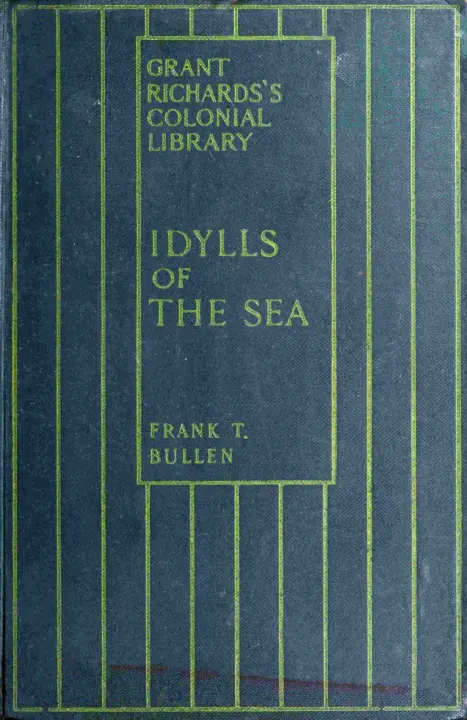
THE CLASSIC COLLECTION · 1899
"Idylls of the Sea and Other Marine Sketches" by Frank Thomas Bullen is a collection of marine sketches written in the late 19th century. It features vivid portrayals of the sea, its wonders, and the experiences of sailors, drawing upon Bullen's own adventures and insights from his time at sea. The sketches encapsulate a range of emotions, from awe to terror, highlighting the stark beauty and menace of the ocean. The opening of this collection introduces readers to a tense maritime scenario where a crew finds themselves adrift under grim circumstances, battling disease and despair amid a stagnant sea. As the crew grapples with a growing sense of foreboding, they are haunted by their environment's ominous change, from beautifully reflective waters to a sickly and foul surface. Central to this unfolding narrative is Peter Burn, an old mariner whose fading presence underscores the themes of mortality and sacrifice, culminating in his poignant passing, which ultimately seems to stir the sea back to life, instigating a change in their fortunes. This powerful beginning sets the tone for a series of maritime tales that promise both beauty and peril.
Introduction adapted from the source catalogue; source summaries may be automatically generated.
Free to read · English · 63,796 words · No account needed
MAKE TIME FOR A GOOD BOOK
On by default. Untick to stop anonymous reading totals. Each page counts after 10 seconds in view. How this works.
Anonymous counting is on unless you have switched it off.
One more “authority” and we will get to firsthand facts. Sir Hans Sloane, in a very particular account of the shark, remarkable in many respects for its accuracy, perpetrates the following:--“It has several ducts on the head filled with a sort of gelly, from which, being pressed by the water, issues an unctuous, viscid, slippery, and mucilaginous matter, very proper to make the fish very glib to sail the readier through the water. Most fish have something analagous to this.” That any fish should secrete a lubricant, at once unctuous and viscid, for the purpose of accelerating its progress through the limpid element in which it lives, would be curious indeed were such a contradictory fact possible, but that Sir Hans Sloane should say so, when the most cursory acquaintance with his subject would have shown him the absurdity of such a statement, would be far stranger were it not for the evidence afforded by the Phil. Trans. of the wildest flights of imagination on the part of savants even down to comparatively recent times. But probably enough space has been given to ancient fables about the shark.
The whole family of the Squalidæ, with the doubtful exceptions of the saw-fish (Pristiophoridæ) and the Raiidæ, or skates, are scavengers, eaters of offal. As such their functions, though humble, are exceedingly useful and important; for although the myriads of Crustacea are scavengers pure and simple, their united efforts would be ineffectual to keep the ocean breadths free from the pollution of putrefying matter, since the vast majority of them dwell upon the bottom of comparatively shallow waters. Now when the body of some immense sea-monster, such as a whale, is bereft of life and rapidly rots, it usually floats. Then the office of the sharks is at once apparent. The only large fish that feeds upon garbage, they are possessed of an enormous appetite, as well as a digestive apparatus that would put to shame that of the ostrich, who is popularly credited with a liking for such dainties as nails and broken glass for hors d’œuvres. The shark is ever hungry, and nothing, living or dead, comes amiss to his maw; but owing to the peculiar shape and position of his mouth it is only in rare instances that he is able to catch living prey, as, for instance, when the dog-fish of our coasts, a common species of shark hated by fishermen, gets among the nets enclosing a fine catch of herring or mackerel. Then the gluttonous rascal is in for a good time. Heedless of the flimsy barrier of twine, he gorges to bursting-point upon the impounded school, and usually concludes his banquet by tearing great gaps in the net, incidentally allowing the rest of the prisoners to escape. It is therefore hardly a matter for surprise that the despoiled and exasperated toilers of the sea, when they do succeed in capturing a dog-fish, should wreak summary vengeance upon him by such fantastic mutilation as their heated fancy suggests. They have also some curious ideas that the erratic antics performed by a blind, finless, and broken-jawed dog-fish will frighten away his congeners; and, as the shark is almost universally disdained as food, this practice of dismembering them and returning them alive to the sea, pour encourager les autres, seems to the fishermen an eminently satisfactory one. Unfortunately for their theory, the fact is, that supposing a sound and vigorous shark to meet with one of his kind incapable of flight or fight, the hapless flounderer would be promptly devoured by his relative, doubtless with the liveliest gratification. The shark has no scruples or preferences. Whatever he can get eatable (from his liberal point of view) he eats: of necessity, since he bears within him so fierce a craving for food that he will continue to devour even when disembowelled, until even his tremendous vitality yields to such a wound as that. Hence his bad name as a devourer of human flesh. An ordinary man in the water is, as a rule, the most defenceless of animals; and even a strong swimmer is apt to become paralysed with fear at the mere rumour of a shark being in his vicinity. If there be no shelter near, his nerveless limbs refuse their office, he floats or sinks with hardly a struggle, and the ravenous squalus finds in him not only an easy prey, but no doubt a most savoury morsel. This is no reason for suggesting that the shark prefers the flesh of homo sapiens to all other provender. As I have already said, his tastes are eclectic. Nay, it is highly doubtful whether he has any sense of taste at all. All experiences point to the contrary, for it is common knowledge that sharks will gobble up anything thrown overboard from a ship, from a corpse swathed in canvas to a lump of coal. This omnivorousness has been noticed in an able article published in Chambers’s Journal many years ago, the writer putting forward as a plausible reason for it the number of parasites that infest the stomachs of these fish. In this, however, they are by no means singular, all fish harbouring a goodly number of these self-invited boarders, the shark certainly entertaining no more than the average.
Your reading position is saved on this browser. Take it to another device with a library code. Reading pages adapt to text, rather than matching a printed edition.
Frank Thomas Bullen

Frank Thomas Bullen

Frank Thomas Bullen

Frank Thomas Bullen
BEHIND THE BOOK
This eBook is for the use of anyone anywhere in the United States and most other parts of the world at no cost and with almost no restrictions whatsoever. You may copy it, give it away or re-use it under the terms of the Project Gutenberg License included with this eBook or online at www.gutenberg.org. If you are not located in the United States, you will have to check the laws of the country where you are located before using this eBook. Read the source licence.
The original source file, including credits and licence, is retained by this library. Request an original-format copy at no charge. Please include the book title and Project Gutenberg identifier #64161.
KEEP YOUR CURIOSITY GOING
Coulson Kernahan

Maurice Baring
Frances Wright
Cécile Tormay

Frederic Jesup Stimson

W. H. P. (William Henry Pope) Jarvis