
Recollections The Reminiscences of the Busy Life of One Who Has Played the Varied Parts of Sailor, Author & Lecturer
Frank Thomas Bullen
THE CLASSIC COLLECTION · 1899
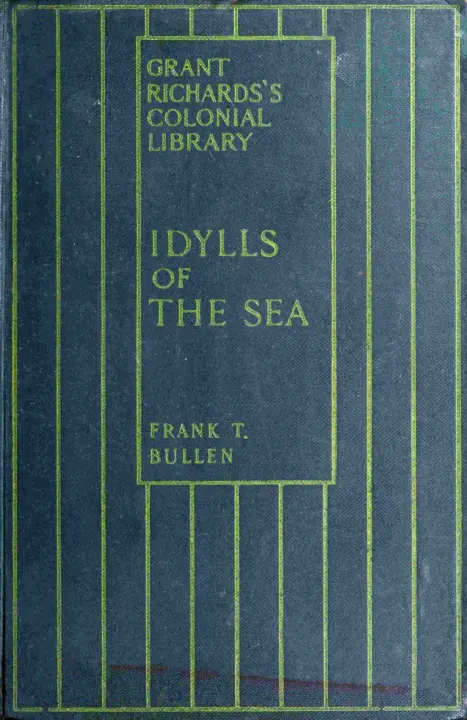
"Idylls of the Sea and Other Marine Sketches" by Frank Thomas Bullen is a collection of marine sketches written in the late 19th century. It features vivid portrayals of the sea, its wonders, and the experiences of sailors, drawing upon Bullen's own adventures and insights from his time at sea. The sketches encapsulate a range of emotions, from awe to terror, highlighting the stark beauty and menace of the ocean. The opening of this collection introduces readers to a tense maritime scenario where a crew finds themselves adrift under grim circumstances, battling disease and despair amid a stagnant sea. As the crew grapples with a growing sense of foreboding, they are haunted by their environment's ominous change, from beautifully reflective waters to a sickly and foul surface. Central to this unfolding narrative is Peter Burn, an old mariner whose fading presence underscores the themes of mortality and sacrifice, culminating in his poignant passing, which ultimately seems to stir the sea back to life, instigating a change in their fortunes. This powerful beginning sets the tone for a series of maritime tales that promise both beauty and peril.
Introduction adapted from the source catalogue; source summaries may be automatically generated.
Free to read · English · 63,796 words · No account needed
MAKE TIME FOR A GOOD BOOK
On by default. Untick to stop anonymous reading totals. Each page counts after 10 seconds in view. How this works.
Anonymous counting is on unless you have switched it off.
Of course no one is under any obligation to believe this most reliable relation. At the same time I may be allowed to remind the sceptical that in the present case their credibility is subjected to no such strain as half the respectable advertisements of the day place upon it. However, I won’t press the point; here is the story, fay ce que vouldras.
Doubtless you have all heard of waterspouts, many of you have seen them in full spin, and not a few, amateurs of meteorology, have got their pet theories as to the genesis, evolution, and dissolution of these mysterious meteors. With just a touch of perhaps pardonable vanity I may say that, for an important section of society, my theory holds the field--is, in fact, unassailable. But I refrain from exposing it publicly at present, principally because such exposition involves a large use of the higher mathematics, in which I am, to be candid, somewhat shaky; and secondly, because the editor would see me farther before he would let me do it. But an ounce of experience is worth a ton of theory, even such gilt-edged theory as mine--at least most of us work on the lines of this well-worn proverb. So my experience, which is herein set forth, must necessarily be considered as the most valuable contribution to our knowledge of waterspoutery or trombe-oonery that has ever yet appeared. I might claim more for it than this, but modesty was ever a failing of mine.
On 23rd August last, then, I was leaning over the taffrail of an ancient barque, of which I was “only” mate, homeward bound from Iquique to Falmouth for orders. We had reached the horse latitudes, those detestable regions embracing the debatable area between the limits of the north-east and south-east trade winds. Here you may have such an exhibition of what the skies are capable of in the matter of rain as nowhere else in the world. For days together the weather will consist of squalls--not much wind in them as a rule--from all points of the compass, but rain--well, one might almost as well be living beneath an ocean of which the bottom is given to falling out occasionally. And as all this tremendous rainfall comes from the sea, the replenishment of the supply upstairs keeps the pumping machinery going constantly. It is no uncommon sight to see forty or fifty waterspouts in various stages of their career at one time. On this particular afternoon there was quite a forest of them about, but as yet none of them had come within less than two or three miles of the ship. It was my watch below, and the air being stifling down in the murky little cabin, I was enjoying a pipe and a little cool breeze that had been blowing for about twenty minutes in the right direction. The old hooker was wriggling along about two or three knots--sufficiently fast to induce me to try whether some members of a sociable school of dolphins that were playing about us could be gulled into biting at a bit of white rag I was trailing, which concealed a formidable hook. The “old man” was below, seated at the cabin table, wrestling with his day’s reckoning not over-successfully, for his grumbling expletives were now and then audible through the wide-open skylight, the man at the wheel gazing skyward with a comical expression of innocence whenever he met my eye after an extra heavy blast from below. The antics of the fish beneath me so fully occupied my attention that the near approach of a waterspout along the starboard beam did not attract my notice. In any case, the weather was no affair of mine, the bo’sun being in charge, though, as usual in these undermanned vessels, up to his elbows in tar, away forward somewhere. But suddenly the gloom became so heavy and the chill in the air so evident, that I looked up wondering whence the squall had arrived at such short notice. At that moment a big dolphin who had been tantalising me for a long time seized my hook. I had only two or three fathoms of line out, and being balanced upon the taffrail, the jerk was sufficiently forceful to make me turn a back somersault overboard. The last thing I saw was the helmsman’s face blank with utter amazement at my sudden exit. I struck the water end-on, going pretty deep, but on returning to the surface was horrified to find myself the centre of a whirling, seething commotion, as if some unseen giant was stirring the sea with a mighty spoon. The gyrations I was compelled to perform made me quite giddy and sick, although my head kept so well above water that I was in no danger of drowning. Faster and faster yet I was whirled around, while a dense fog seemed to rise all round, shutting out everything from view behind an impenetrable white curtain.
Your reading position is saved on this browser. Take it to another device with a library code. Reading pages adapt to text, rather than matching a printed edition.
Frank Thomas Bullen

Frank Thomas Bullen

Frank Thomas Bullen

Frank Thomas Bullen
BEHIND THE BOOK
This eBook is for the use of anyone anywhere in the United States and most other parts of the world at no cost and with almost no restrictions whatsoever. You may copy it, give it away or re-use it under the terms of the Project Gutenberg License included with this eBook or online at www.gutenberg.org. If you are not located in the United States, you will have to check the laws of the country where you are located before using this eBook. Read the source licence.
The original source file, including credits and licence, is retained by this library. Request an original-format copy at no charge. Please include the book title and Project Gutenberg identifier #64161.
KEEP YOUR CURIOSITY GOING
Coulson Kernahan

Maurice Baring
Frances Wright
Cécile Tormay

Frederic Jesup Stimson

W. H. P. (William Henry Pope) Jarvis