
Recollections The Reminiscences of the Busy Life of One Who Has Played the Varied Parts of Sailor, Author & Lecturer
Frank Thomas Bullen
THE CLASSIC COLLECTION · 1899
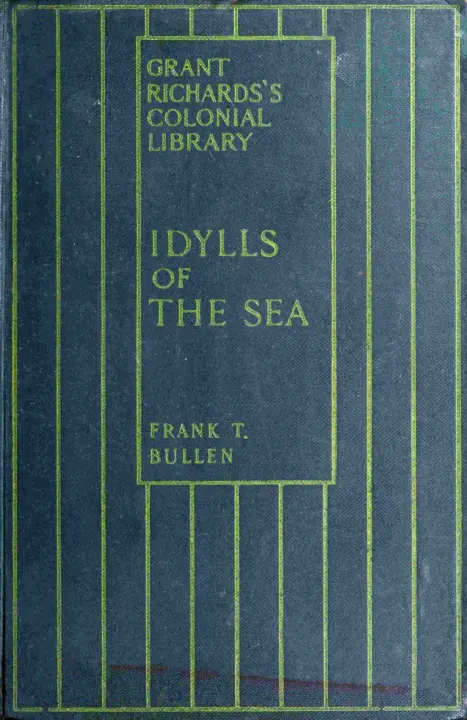
"Idylls of the Sea and Other Marine Sketches" by Frank Thomas Bullen is a collection of marine sketches written in the late 19th century. It features vivid portrayals of the sea, its wonders, and the experiences of sailors, drawing upon Bullen's own adventures and insights from his time at sea. The sketches encapsulate a range of emotions, from awe to terror, highlighting the stark beauty and menace of the ocean. The opening of this collection introduces readers to a tense maritime scenario where a crew finds themselves adrift under grim circumstances, battling disease and despair amid a stagnant sea. As the crew grapples with a growing sense of foreboding, they are haunted by their environment's ominous change, from beautifully reflective waters to a sickly and foul surface. Central to this unfolding narrative is Peter Burn, an old mariner whose fading presence underscores the themes of mortality and sacrifice, culminating in his poignant passing, which ultimately seems to stir the sea back to life, instigating a change in their fortunes. This powerful beginning sets the tone for a series of maritime tales that promise both beauty and peril.
Introduction adapted from the source catalogue; source summaries may be automatically generated.
Free to read · English · 63,796 words · No account needed
MAKE TIME FOR A GOOD BOOK
On by default. Untick to stop anonymous reading totals. Each page counts after 10 seconds in view. How this works.
Anonymous counting is on unless you have switched it off.
“’Seems ’bout’s high’s we want, anyway,” said Bill dreamily, while the poor mate ground his teeth but never said a word.
What puzzled them all greatly was the length of time the ship seemed to be getting into cold weather. From the time the cruiser spoke them, when they were in about 15 degrees N., was now more than a month, and with the winds they had carried they should have been running their easting down in about 40 degrees S. But they were still in tropical weather. At last the mate broke a long silence by saying: “I believe he’s making for Walvisch Bay. ’Shouldn’t wonder if there’s some German warships there or thereabouts. I only hope he is trying to get there, an’ one of our cruisers sights him. It’s about our only chance.”
Several days passed and still they were kept close prisoners in the black, stifling hole, starving on a trifle of hard tack and water, and sinking deeper every day into a very gulf of despair. At last, to the practised senses of the captives, it was evident that something was afoot. She had hove to. On deck the Deutschers were in trouble. As the mate had surmised, they were bound for Walvisch Bay, carrying every rag they could crowd on her, seeing that every hour they were out of port now on this unusual course was brimful of danger. The skipper scarcely ever left the deck, and his eyes were bleared and burning with constant glaring through his glasses for a possible pursuer.
H.M.S. Scourge, 22-knot cruiser, was on her passage to Simon’s Town with urgent stores for the squadron off that station. Her orders were--“All possible dispatch,” yet, when the look-out one afternoon reported a heavily-rigged four-master standing to the eastward in latitude twenty-three degrees south, her commander felt justified in altering her course sufficiently to bring him in touch with this phenomenon. The stranger was making grand headway under all canvas to a heavy south-east Trade, but the speed of the cruiser was fully two knots to her one. In about an hour, therefore, from sighting her, the Scourge ranged sufficiently near to inquire by signal for the usual information. But the merchantman was so slow with his answers that before two sets had been hoisted the vessels were within hail of each other. “Where are you bound to?” roared the commander of the cruiser. A dramatic pause succeeded, in which all eyes on board both ships were centred upon the skipper of the St. George. At last the reluctant answer came, “Walvisch Bay.” “The devil you are,” said the naval captain; “I must have a closer look at you.” A couple of abrupt orders, and a well-manned cutter, with the first-lieutenant in charge, was bounding across the few fathoms of sea towards the St. George, with instructions to ascertain the bottom facts of this mystery. Arriving alongside, the officer sprang on board, and, quickly mounting the poop, confronted Captain Schwartz, whose face was a study of conflicting emotions. Already the lieutenant had noticed the Teutonic appearance of everybody on deck, and the captain’s working face deepened the suspicions aroused. “I wish to examine your papers, sir,” said he quietly to the scowling skipper. “Vat for, sir?” was the almost expected reply. For all answer the lieutenant strode to the side and blew a small whistle, which brought six of his boat’s crew bounding on board in an instant. “Now, sir,” he said, turning again to the skipper, “my time is precious, and my orders precise. Kindly lead the way into your cabin, and produce your documents, or I must search for them without you.” The baffled Teuton still hesitating, the naval officer, with a slight gesture of impatience, beckoned his men aft. They came on the jump, but one of them stepping forward in advance of his fellows, saluted, and said, “Beg pardon, sir, but we just heard some voices forrard a-cryin’ ‘Help!’ and it sounded’s if they wus cooped up somewheres.” A dark frown settled upon the officer’s face as he replied, sternly, “Three of you go forrard and search; the others come below here with me.” But before he stepped into the companion-way he blew two sharp notes on his whistle, a signal which was immediately answered by the cruiser sending another cutter alongside with a fully-armed crew.
Your reading position is saved on this browser. Take it to another device with a library code. Reading pages adapt to text, rather than matching a printed edition.
Frank Thomas Bullen

Frank Thomas Bullen

Frank Thomas Bullen

Frank Thomas Bullen
BEHIND THE BOOK
This eBook is for the use of anyone anywhere in the United States and most other parts of the world at no cost and with almost no restrictions whatsoever. You may copy it, give it away or re-use it under the terms of the Project Gutenberg License included with this eBook or online at www.gutenberg.org. If you are not located in the United States, you will have to check the laws of the country where you are located before using this eBook. Read the source licence.
The original source file, including credits and licence, is retained by this library. Request an original-format copy at no charge. Please include the book title and Project Gutenberg identifier #64161.
KEEP YOUR CURIOSITY GOING
Coulson Kernahan

Maurice Baring
Frances Wright
Cécile Tormay

Frederic Jesup Stimson

W. H. P. (William Henry Pope) Jarvis