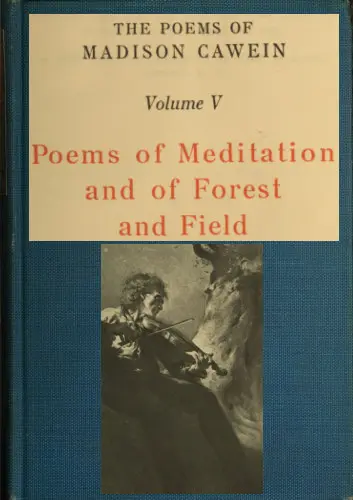
The Poems of Madison Cawein, Volume 5 (of 5) Poems of meditation and of forest and field
Madison Julius Cawein
THE CLASSIC COLLECTION · 1898
"Idyllic Monologues: Old and New World Verses" by Madison Julius Cawein is a collection of poems written in the late 19th century. The volume presents a range of lyrical pieces that explore themes of love, nature, memory, and human experience, with a particular focus on emotional depth and vivid imagery. Each poem captures a unique moment or sentiment, reflecting the author's romantic and pastoral style. The opening of the collection introduces readers to the poem "The Brothers," which sets a melancholic tone through a narrative steeped in personal tragedy and familial bonds. It tells the story of a man reflecting on the loss of his brother, Hamilton, during the Civil War and the complex emotions surrounding love and guilt involving Hamilton's widow, Margaret. As the narrator recounts their past together in the shadow of war, he grapples with feelings of regret for not interceding in a tragic fate that intertwined their lives, ultimately evoking a somber meditation on love, loss, and the burdens of the heart. The poem's vivid descriptions serve to enhance the emotional resonance, laying the groundwork for the thematic exploration that follows in the subsequent verses.
Introduction adapted from the source catalogue; source summaries may be automatically generated.
Free to read · English · 17,641 words · No account needed
MAKE TIME FOR A GOOD BOOK
On by default. Untick to stop anonymous reading totals. Each page counts after 10 seconds in view. How this works.
Anonymous counting is on unless you have switched it off.
Then in the night a trumpet; and the dull
Close thud of horse and clash of Puritan arms;
And glimmering helms swept by me. Sorrowful
I stood and waited till upon the storm's
Black breast, the Manse, a burning carbuncle,
Blazed like a battle-beacon, and alarms
Of onslaught clanged around it; then, like one
Who bears with him God's curse, I galloped on.
The Forester
I met him here at Ammendorf one Spring.
It was the end of April and the Harz,
Veined to their ruin-crested summits, seemed
One pulse of tender green and delicate gold,
Beneath a heaven that was like the face
Of girlhood waking into motherhood.
Along the furrowed meadow, freshly ploughed,
The patient oxen, loamy to the knees,
Plodded or lowed or snuffed the fragrant soil;
And in each thorntree hedge the wild bird sang
A song to Spring, made of its own wild heart
And soul, that heard the dairy-maiden May's
Heart beating like a star at break of day,
As, kissing ripe the blossoms, she drew near,
Her mouth's sweet rose all dew-drops and perfume.
Here at this inn and underneath this tree
We took our wine, the morning prismed in its
Flame-angled gold.--A goodly vintage that!
Tang with the ripeness of full twenty years.
Rare! I remember!--wine that spurred the blood,
That brought the heart glad to the limbered lip,
And made the eyes unlatticed casements where
A man's true soul you could not help but see.
As royal a Rhenish, I will vouch to say,
As that, old legends tell, which Necromance
And Magic keep, gnome-guarded, in huge casks
Of antique make deep in the Kyffhaeuser,
The Cellar of the Knights near Sittendorf.--
So solaced of that wine we sat an hour.
He told me his intent in coming here.
His name was Rudolf; and his native home,
Franconia; but no word of parentage:
Only his mind to don the buff and green
And live a forester with us and be
Enfellowed in the Duke of Brunswick's train,
And for the Duke's estate even now was bound.
Tall was he for his age and strong and brown,
And lithe of limb; and with a face that seemed
Hope's counterpart--but with the eyes of doubt;
Deep restless disks, instinct with gleaming night,
That seemed to say, "We're sure of earth, at least
For some short space, my friend; but afterward--
Nay! ransack not to-morrow till to-day,
Lest it engulf thy joy before it is!"--
And when he spoke, the fire in his eyes
Worked stealthy as a hunted animal's;
Or like the Count von Hackelnburg's that turn,
Feeling the unseen presence of a fiend.
Then, as it chanced, old Kurt had come that morn
With some six of his jerkined foresters
From the Thuringian forest; wet with dew,
And fresh as morn with early travel; bound
For Brunswick, Dummburg and the Hakel passed.
Chief huntsman he then to our lord the Duke,
And father of the loveliest maiden here
In Ammendorf, the sunny Ilsabe:
Her mother dead, the gray-haired father prized
His daughter more than all that men hold dear;
His only happiness, who was beloved
Of all as Lora of Thuringia was,
For gentle ways that spoke a noble soul,
Winning all hearts to love her and to praise,
As might a great and beautiful thought that holds
Us by the simplest words.--Her eyes were blue
As the high influence of a summer day.
Her hair,--serene and braided over brows
White as a Harz dove's wing,--was auburn brown,
And deep as mists the sun has drenched with gold.
And her young presence--well, 't was like a song,
A far Tyrolean melody of love,
Heard on an Alpine path at close of day
When shepherds homeward lead their tinkling flocks.
And when she left, being with you awhile,--
How shall I say it?--'t was as when one hath
Beheld an Undine by the moonlit Rhine,
Who, ere the mind adjusts a thought, is gone,
And in your soul you wonder if a dream.
Some thirty years ago it was;--and I,
Commissioner of the Duke--(no sinecure
I can assure you)--had scarce reached the age
Of thirty,--that we sat here at our wine;
And 't was through me that Rudolf,--whom at first,
From some rash words dropped then in argument,
The foresterhood was like to be denied,--
Was then enfellowed. "Yes," said I, "he's young.
Kurt, he is young; but see, a wiry frame;
A chamois footing and a face for deeds;
An eye that likes me not; too quick to turn;
But that may be the restless soul within;
A soul perhaps with virtues that have been
Severely tried and could not stand the test;
These be thy care, Kurt; and if not too deep
In vices of the flesh, discover them,
As divers bring lost riches up from ooze.
Thou hast a daughter; let him be thy son."
A year thereafter was it that I heard
Of Rudolf's passion for Kurt's Ilsabe;
Then their betrothal. And it was from this,--
Good Mother Mary! how she haunts me still!
Sweet Ilsabe! whose higher womanhood,
True as the touchstone which philosophers feign
Transmutes to gold base metals it may touch,
Had turned to good all evil in this man,--
Surmised I of the excellency which
Refinement of her purer company,
And contact with her innocence, had resolved
His fiery nature to, conditioning slave.
And so I came from Brunswick--as, you know,
Is custom of the Duke or, by his seal
Commissioned proxy, his commissioner--
To test the marksmanship of Rudolf, who
Succeeded Kurt with marriage of his child,
An heir of Kuno.--He?--Greatgrandfather
Of Kurt; and of this forestkeepership
The first possessor; thus established here--
Or this the tale they tell on winter nights:
Kuno, once in the Knight of Wippach's train,
Rode on a grand hunt with the Duke, who came,--
Grandfather of the father of our Duke,--
With much magnificence of knights and squires,
Great velvet-vestured nobles, cloaked and plumed,
To hunt Thuringian deer. Then morn,--too quick
To bid good-morrow,--was too slow for these,
And on the wind-trod hills recumbent yawned
Disturbed an hour too soon; all sleepy-eyed,
Like some young milkmaid whom the cock hath roused,
Who sits and rubs stiff eyes that still will close.
Horns sang and deer-hounds tugged a whimpering leash,
Or, loosened, bounded through the baying glens:
And ere the mountain mists, compact of white,
Broke wild before the azure spears of day,
The far-off hunt, that woke the woods to life,
Seemed but the heart-beat of the ancient hills.
And then, near noon, within a forest brake,
The ban-dogs roused a red gigantic stag,
Lashed to whose back with gnarly-knotted cords,
And borne along like some pale parasite,
A man shrieked: tangle-bearded, and wild hair
A mane of forest-burs. The man himself,
Emaciated and half-naked from
The stag's mad flight through headlong rocks and trees,
One bleeding bruise, with eyes like holes of fire.
For such the law then: when the peasant chased
Or slew the dun deer of his tyrant lords,
If seized, as punishment the withes and spine
Of some strong stag, a gift to him of game,
Enough till death--death in the antlered herd,
Or slow starvation in the haggard hills.
Then was the great Duke glad, and forthwith cried
To all his hunting train a rich reward
For him who slew the stag and saved the man,
But death for him who slew both man and stag.
So plunged the hunt after the hurrying slot,
A shout and glimmer through the sounding woods,--
Like some mad torrent that the hills have loosed
With death for goal.--'T was late; and none had risked
That shot as yet,--too desperate the risk
Beside the poor life and a little gold,--
When this young Kuno, with fierce eyes, wherein
Hunt and impatience kindled reckless flame,
Cried, "Has the dew then made our powder wet?
Or have we left our marksmanship at home?
Here's for its heart! the Fiend direct my ball!"--
And fired into a covert deeply packed,
An intertangled wall of matted night,
Wherein the eye might vainly strive and strive
To pierce one fathom, earn one foot beyond.
But, ha! the huge stag staggered from the brake
Hit full i' the heart. And that wan wretch, unbound,
Was ta'en and cared for. Then his grace, the Duke,
Charmed with the eagle aim, called Kuno up,
And there to him and his forever gave
The forestkeepership.
But envious tongues
Were soon at wag; and whispered went the tale
Of how the shot was free, and how the balls
Used by young Kuno were free bullets--which
To say is: Lead by magic moulded, in
The influence and directed, of the Fiend.
Of some effect these tales, and had some force
Even with the Duke, who lent an ear so far
As to ordain Kuno's descendants all
To proof of skill ere their succession to
The father's office. Kurt himself hath shot
The silver ring out o' the popinjay's beak--
A good shot he, you see, who would succeed.
Of these enchanted bullets let me speak:
There may be such; our Earth has things as strange,
Perhaps, and stranger, that we doubt not of,
While we behold, not only 'neath the thatch
Of Ignorance's hovel, but within
The pictured halls of Wisdom's palaces,
How Superstition sits an honored guest.
A cross-way let it be among the hills;
A cross-way in a solitude of pines;
And on the lonely cross-way you must draw
A blood-red circle with a bloody sword;
And round the circle, runic characters,
Gaunt and satanic; here a skull, and there
A scythe and cross-bones, and an hour-glass here;
And in the centre, fed with coffin-wood,
Stol'n from the grave of one, a murderer,
A smouldering fire. Eleven of the clock
The first ball leaves the mold--the sullen lead
Mixed with three bullets that have hit their mark,
And blood, the wounded Sacramental Host
Stolen, and hence unhallowed, oozed, when shot
Fixed to a riven pine. Ere twelve o'clock
With never a word until that hour sound,
Must all the balls be cast; and these must be
In number three and sixty; three of which
The Fiend's dark agent, demon Sammael,
Claims for his master and stamps for his own
To hit aside their mark, askew for harm.
The other sixty shall not miss their mark.
No cry, no word, no whisper, even though
Vague, gesturing shapes, that loom like moonlit mists,
Their faces human but with animal forms,
Rise thick around and threaten to destroy.
No cry, no word, no whisper should there come,
Weeping, a wandering shadow like the girl
You love, or loved, now lost to you, her eyes
Hollow with tears; all palely beckoning
With beautiful arms, or censuring; her face
Sad with a desolate love; who, if you speak
Or waver from that circle--hideous change!--
Shrinks to a wrinkled hag, whose harpy hands
Shall tear you limb from limb with horrible mirth.
Nor be deceived if some far midnight bell
Strike that anticipated hour; nor leave
By one short inch the circle, for, unseen
Though now they be, Hell's minions still are there,
Watching with flaming eyes to seize your soul.
But when the hour of midnight sounds, be sure
You have your bullets, neither more nor less;
For if through fear one more or less you have,
Your soul is forfeit to Hell's majesty.--
Then while the hour of midnight strikes, will come
A noise of galloping hoofs and outriders,
Shouting; six midnight steeds,--their nostrils, pits
Of burning blood,--postilioned, roll a stage,
Black and with groaning wheels of spinning fire:
"Room there!--ho! ho!--who bars the mountain-way?
On over him!"--But fear not, nor fare forth;
'T is but the last trick of your bounden slave.
And ere the red moon rushes through the clouds
And dives again, high the huge leaders leap,
Their fore-hoofs fire, and their eye-balls flame,
And, spun a spiral spark into the night,
Whistling the phantom flies and fades away.
Some say there comes no stage; that Hackelnburg,
Wild-huntsman of the Harz, comes dark as storm,
With rain and wind and demon dogs of Hell,
The terror of his hunting-horn, an owl,
And the dim deer he hunts, rush on before;
The forests crash, and whirlwinds are the leaves,
And all the skies a-thunder, as he hurls
Straight on the circle, horse and hounds and stag.
And at the last, plutonian-cloaked, there comes,
Upon a stallion gaunt and lurid black,
The minister of Satan, Sammael,
Who greets you, and informs you, and assures.
Enough! these wives'-tales told, to what I've seen:
To Ammendorf I came; and Rudolf here
With Kurt and his assembled men, I met.
The abundant year,--like some sweet wife,--a-smile
At her brown baby, Autumn, in her arms,
Stood 'mid the garnered harvests of her fields
Dreaming of days that pass like almoners
Scattering their alms in minted gold of flowers;
Of nights, that forest all the skies with stars,
Wherethrough the moon--bare-bosomed huntress--rides,
One cloud before her like a flying fawn.
Then I proposed the season's hunt; till eve
The test of Rudolf's skill postponed, at which
He seemed impatient. And 't was then I heard
How he an execrable marksman was;
And tales that told of near, incredible shots,
That missed their mark; or how his flint-lock oft
Flashed harmless powder, while the curious deer
Stood staring; as in pity of such aim
Bidding him try his marksmanship again.
Howbeit, he that day acquitted him
Of all this gossip; in that day's long hunt
Missing no shot, however rashly made
Or distant through the intercepting trees.
And the piled, various game brought down of all
Good marksmen of Kurt's train had not sufficed,
Doubled, nay, trebled, there to match his heap.
And marvelling the hunters saw, nor knew
How to excuse them. My indulgence giv'n,
Some told me that but yesterday old Kurt
Had made his daughter weep and Rudolf frown,
By vowing end to their betrothed love,
Unless that love developed better aim
Against the morrow's test; his ancestors'
High fame should not be tarnished. So he railed;
And bowed his gray head and sat moodily;
But looking up, forgave all when he saw
Tears in his daughter's eyes and Rudolf gone
Out in the night black with approaching storm.
Before this inn, yonder and here, they stood,
The holiday village come to view the trial:
Fair maidens and their comely mothers with
Their sweethearts and their husbands. And I marked
Kurt and his daughter here; his florid face
All jubilant at Rudolf's great success;
Hers, radiant with happiness; for this
Her marriage eve--so had her father said--
Should Rudolf come successful from the hunt.
So pleased was I with what I'd seen him do,
The trial of skill superfluous seemed, and so
Was on the bare brink of announcing, when
Out of the western heaven's deepening red,--
Like a white message dropped by rosy lips,--
A wild dove clove the luminous winds and there,
Upon that limb, a peaceful moment sat.
Then I, "Thy rifle, Rudolf! pierce its head!"
Cried pointing, "and chief-forester art thou!"--
Why did he falter with a face as strange
As a dark omen? did his soul foresee
What was to be with tragic prescience?--
What a bad dream it all seems now!--Again
I see him aim. Again I hear the cry,
"My dove! O Rudolf, do not kill my dove!"
And from the crowd, like some sweet dove herself,
A fluttering whiteness, came our Ilsabe--
Too late! the rifle cracked ... The unhurt dove
Rose, beating frightened wings--but Ilsabe!...
The sight! the sight!... lay smitten; a red stain,
Sullying the pureness of her bridal bodice,
Showed where the ball had pierced her through the heart.
And Rudolf?--Ah, of him you still would know?--
When he beheld this thing that he had done,
Why he went mad--I say--but others not.
An hour he raved of how her life had paid
For the unholy bullets he had used,
And how his soul was three times lost and damned.
I say that he went mad and fled forthwith
Into the haunted Harz.--Some say, to die
The prey of demons of the Dummburg ruin.
I, one of those less superstitious, say,
He in the Bode--from that blackened rock,--
Whereon were found his hunting-cap and gun,--
The Devil's Dancing Place, did leap and die.
Your reading position is saved on this browser. Take it to another device with a library code. Reading pages adapt to text, rather than matching a printed edition.
Madison Julius Cawein
Madison Julius Cawein
Madison Julius Cawein
Madison Julius Cawein
BEHIND THE BOOK
This eBook is for the use of anyone anywhere in the United States and most other parts of the world at no cost and with almost no restrictions whatsoever. You may copy it, give it away or re-use it under the terms of the Project Gutenberg License included with this eBook or online at www.gutenberg.org. If you are not located in the United States, you will have to check the laws of the country where you are located before using this eBook. Read the source licence.
The original source file, including credits and licence, is retained by this library. Request an original-format copy at no charge. Please include the book title and Project Gutenberg identifier #31896.
KEEP YOUR CURIOSITY GOING

Eric Mackay
Edmund Gosse
Sophia Margaretta Hensley
Gilbert Parker
George MacDonald

Elizabeth Bibesco