
The doctor looks at literature
Joseph Collins
THE CLASSIC COLLECTION · 1920
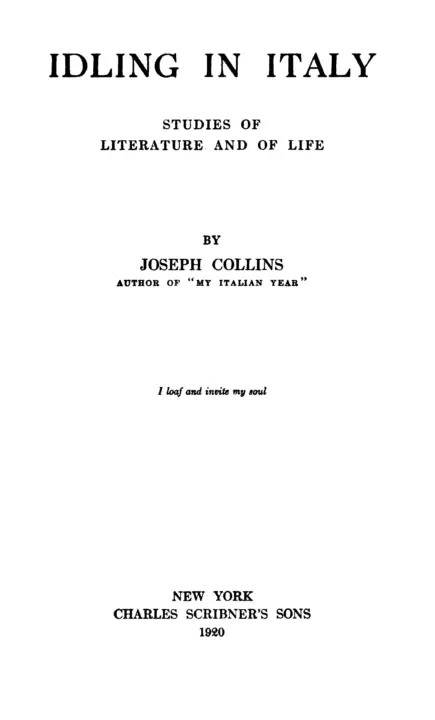
"Idling in Italy: Studies of Literature and of Life" by Joseph Collins is a collection of essays written in the early 20th century. The work provides a deep exploration of Italian literature and cultural experiences, reflecting on the emotional and intellectual growth one can achieve through familiarity with Italy’s rich literary heritage. Collins aims to encourage readers, particularly Americans, to engage more deeply with Italian authors and the context of their works. The opening of this volume introduces the profound emotional connection many Americans feel towards Italy, portraying it as a foundational culture for modern civilization. Collins emphasizes the importance of understanding Italian literature to truly appreciate the country's contributions to art and ideas, particularly in the wake of the First World War. He discusses the evolution of Italian literature from the Renaissance through the 19th century, touching on significant literary figures and movements, while stressing the potential for modern Italian writers to regain their former prominence. This exploration sets the stage for a broader examination of specific authors and themes in subsequent chapters, highlighting the interplay between life and literature during and after a tumultuous period in history.
Introduction adapted from the source catalogue; source summaries may be automatically generated.
Free to read · English · 87,977 words · No account needed
MAKE TIME FOR A GOOD BOOK
On by default. Untick to stop anonymous reading totals. Each page counts after 10 seconds in view. How this works.
Anonymous counting is on unless you have switched it off.
"Gli Uomini Rossi" ("The Red Men") is his best-known romance. He has read and still reads Cervantes and Rabelais. Had he the gift of artistic presentation he might become a great novelist, but until now he has confounded embellishment with natural beauty.
Among the fiction that has appeared in Italy during the past year a few books call for mention, not because of their intrinsic merit but because it is indicative of the change that is going on in the minds of the common people which reflects particularly the thought now being given to social and psychological questions.
The American reader of Italian fiction cannot fail to be impressed with the poverty of subject-matter which it displays. This is explained partly by the fact that it is sometimes biographical and very often autobiographical--moreover, the family and social and religious customs of Italy do not make for novelty or variety in individual life. The zone in which all the details of existence is predetermined by convention extends much farther with them both up and down the social scale than with us. If man is independent of it to some extent woman is not, and since there is no object in chronicling the obvious, popular Italian fiction is apt to deal with excursions of man beyond his own circle and class. Another thing that has to be kept in mind is the position of women. The important woman in the life of the majority of Italians is the mother, not the wife. She is on terms of equality with her son and she retains much of the authority of the Roman matron in her children's married life. This it need scarcely be said is changing with the eternal flux of things.
Italy of to-day is a very new country. Whenever we as a nation do something which the Italians consider gauche or raw, and they are obliged to dislocate an inherent politeness by mention of it, they excuse us because we are so young. So one excuses an infant for some verbal or conductual infraction. In reality we are about a century older than Italy of to-day, and we have spent that time developing a "manner" that reflects our protracted habituation to freedom. That it is sometimes masked by arrogance and self-satisfaction is to be regretted. Hence our indifference to convention which is often painful to the foreigner. It is a mistake to think that it is only the upper classes of Italy who are beholden to unwritten convention and customs. In truth, subscription to them is more mandatory amongst the Borghesia and Il Popolo. With the gradual dissemination and acceptation of the doctrines of socialism, the equal rights of women, and the widening sphere of culture through universal education, many of the shackling conventions of to-day will disappear. The younger workers are blazing the way. Of those who herald this change Mario Mariani must be heeded. In "La Casa dell' Uomo" ("The House of Man"), he makes a satiric onslaught against the amorous, avid of money and of pleasure, who are ready to sacrifice every basic virtue in order to obtain them. After presenting a picture of the present-day cages of human beings he tells his story through the mouth and diary of the janitress of a modern apartment-house, who being deprived by time of her pulchritude and sensuous appeal, has been obliged to forego her chosen profession, that of Mrs. Warren, and to gain her livelihood in the sweat of her brow. She has visions of a day when she can no longer even do that, and yet must needs have food, raiment, and shelter; so she keeps a diary which sets forth the flagrancies of the tenants, men, women, and children. She does not admit that the entries are the wythes of blackmail. She salves such conscience as has survived her life of sin by assuring herself that the entries in the book are to assuage literary growing pains. When Signor Mariani obtained the documents by fabrication or by stealth he found himself in possession of the "characters" of many individuals, young and old, who present a strange similarity to those we encounter in daily life. He has seen fit to publish them without saying whether it was art or bread that was the incentive, and they constitute a serious charge against society. The wonder is that if such things exist the social fabric conserves the appearance of well-being. In truth, life is not a mask behind which the wearer laughs, if this diary is to be believed. It is in reality a tragedy made up of a tissue of hypocrisies, banalities, sordid commonplaces, inimical to joy, subversive of pleasure, and destructive of happiness.
Your reading position is saved on this browser. Take it to another device with a library code. Reading pages adapt to text, rather than matching a printed edition.
Joseph Collins

Joseph Collins
BEHIND THE BOOK
This eBook is for the use of anyone anywhere in the United States and most other parts of the world at no cost and with almost no restrictions whatsoever. You may copy it, give it away or re-use it under the terms of the Project Gutenberg License included with this eBook or online at www.gutenberg.org. If you are not located in the United States, you will have to check the laws of the country where you are located before using this eBook. Read the source licence.
The original source file, including credits and licence, is retained by this library. Request an original-format copy at no charge. Please include the book title and Project Gutenberg identifier #41934.
KEEP YOUR CURIOSITY GOING
Wilfrid Scawen Blunt
Wilfrid Scawen Blunt

E. W. (Edgar Watson) Howe

David Patterson (Spirit) Hatch

David Patterson (Spirit) Hatch

David Patterson (Spirit) Hatch