The doctor looks at literature
Joseph Collins
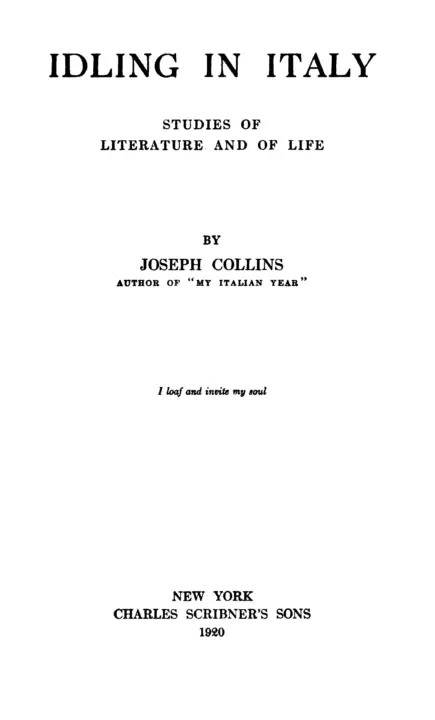
THE CLASSIC COLLECTION · 1920
"Idling in Italy: Studies of Literature and of Life" by Joseph Collins is a collection of essays written in the early 20th century. The work provides a deep exploration of Italian literature and cultural experiences, reflecting on the emotional and intellectual growth one can achieve through familiarity with Italy’s rich literary heritage. Collins aims to encourage readers, particularly Americans, to engage more deeply with Italian authors and the context of their works. The opening of this volume introduces the profound emotional connection many Americans feel towards Italy, portraying it as a foundational culture for modern civilization. Collins emphasizes the importance of understanding Italian literature to truly appreciate the country's contributions to art and ideas, particularly in the wake of the First World War. He discusses the evolution of Italian literature from the Renaissance through the 19th century, touching on significant literary figures and movements, while stressing the potential for modern Italian writers to regain their former prominence. This exploration sets the stage for a broader examination of specific authors and themes in subsequent chapters, highlighting the interplay between life and literature during and after a tumultuous period in history.
Introduction adapted from the source catalogue; source summaries may be automatically generated.
Free to read · English · 87,977 words · No account needed
MAKE TIME FOR A GOOD BOOK
On by default. Untick to stop anonymous reading totals. Each page counts after 10 seconds in view. How this works.
Anonymous counting is on unless you have switched it off.
It is a long time now that the belief has been generally accepted that God made man, and, contemplating his work, realized that it was a failure for the purpose for which man was created. He then made woman. The way in which this was accomplished is full of interest to the artificer, but it does not concern me, whose lifelong study has been of the finished species; nor does the object of the creation of man, alluring as it is, tempt me to digress from the subject of his sentimental endowment. Soon after his organism was endowed with sentient possession, man was made aware that he had imperious desires which not only demanded satisfaction but which insisted upon being satisfied. It pleased the Christian church to enshroud the most vital of these God-given desires in the mantle of sin, save when its appeasement was done in conformity with the restrictions laid upon it by the church. It may quite well be that such restrictions were founded in wisdom. For a long time England maintained that it was right to restrict the franchise to owners of property of a certain value, and for many centuries the world accepted slavery without a thought that it was wrong. Ruskin spoke truly when he said: "The basest thought about man is that he has no spiritual nature, and the foolishest that he has no animal nature."
The facts around which these remarks are spun are first: God reproduced his image, and, finding that the image was incomplete and useless for the purposes for which he was created, he made him whole, as it were, by creating the female; and second: that he endowed man and woman with mental and emotional qualities which were to aid them in living their lives happily for themselves, usefully for others, and acceptably to him. The moment this endowment was made known to them the fat was in the fire. "She tempted me and I fell" has been the subject of picture and poem, story and sermon, excuse or extenuation, since time immemorial. Learned tomes and ponderous volumes have set forth specifically the difference of the sexes, more or less uselessly too, for no one needs to be convinced that there are anatomical and physiological differences. The obvious is never interesting; the pleasurable quest is pursuit of the elusive, the intangible. There are differences between the sexes that defy specific designation, for I do not admit that specificity is given to these distinctions by saying that men differ from women emotionally, morally, spiritually, ethically, or that they react differently to the same stimulus under the same circumstances, or that there are soul differences of kind and degree. We do not have to decide whether these distinctions are inherent or acquired. We have only to admit that they exist. The plain fact is that tradition and experience teach us that both the male and the female of the genus homo have certain spiritual endowments, both on the emotional and the intellectual side, which have come to be looked upon as characteristic. Courage, valor, secrecy are universally considered to be characteristics of the male. On the other hand, patience, sentiment, vanity, and fickleness have become traditionally linked up with the opposite sex. Women are often braver than men, more continent, less vain, but to admit this does not diminish the acceptability of the general proposition. No one is likely to contend that either sex has a monopoly of any of these qualities, but I fancy it will readily be admitted that sentimentality, in its most flagrant display, is a more characteristic ancilla of woman than of man. Bulwer Lytton was a shrewd observer when he wrote: "There is sentiment in all women and sentiment gives delicacy to thought and tact to manner." But sentiment with men is generally acquired, an offspring of the intellectual quality, not as with the other sex, of the moral. A man considers it a term of reproach to be called sentimental; on the other hand, such designation in no way detracts from a woman's estimate of herself, nor does it derogate her in the esteem of others so long as she confines it within certain limits and so long as it does not condition her conduct. Many a man on reviewing his past recognizes that his ship of celibacy foundered upon the sandy shoals called "tender-minded." The tender-minded girl is one with a mind somewhat underdeveloped, saturated in sentimentality usually associated with a streak of obstinacy which is beyond parental influence.
Your reading position is saved on this browser. Take it to another device with a library code. Reading pages adapt to text, rather than matching a printed edition.
Joseph Collins
Joseph Collins
BEHIND THE BOOK
This eBook is for the use of anyone anywhere in the United States and most other parts of the world at no cost and with almost no restrictions whatsoever. You may copy it, give it away or re-use it under the terms of the Project Gutenberg License included with this eBook or online at www.gutenberg.org. If you are not located in the United States, you will have to check the laws of the country where you are located before using this eBook. Read the source licence.
The original source file, including credits and licence, is retained by this library. Request an original-format copy at no charge. Please include the book title and Project Gutenberg identifier #41934.
KEEP YOUR CURIOSITY GOING
Wilfrid Scawen Blunt
Wilfrid Scawen Blunt

E. W. (Edgar Watson) Howe

David Patterson (Spirit) Hatch

David Patterson (Spirit) Hatch

David Patterson (Spirit) Hatch