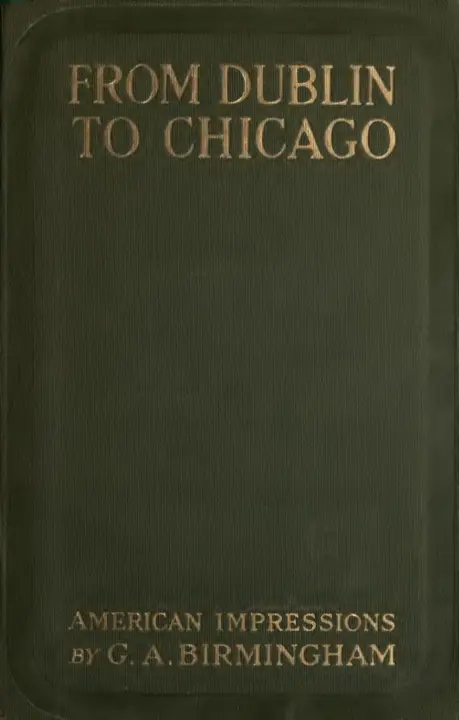
From Dublin to Chicago: Some Notes on a Tour in America
George A. Birmingham
THE CLASSIC COLLECTION · 1900
"Hyacinth" by George A. Birmingham is a novel written in the early 20th century. The story revolves around the life of Æneas Conneally, a young man trained as a clergyman who has undergone a transformation from an enthusiastic missionary to a more humanized figure struggling to connect with his community and family after great personal loss. Set against the backdrop of 19th-century Ireland, the narrative explores themes of faith, identity, and the complexities of society. The opening of the novel introduces the historical context of missionary efforts in Ireland aimed at converting Roman Catholics to Protestantism, particularly through the character of Æneas Conneally, who emerges as a dedicated figure of this movement. Following the loss of his mother and a series of disappointments, Æneas eventually finds meaning beyond his initial zeal as he marries and becomes a father to a son named Hyacinth. As the story progresses, it hints at Hyacinth's upcoming journey into education and the external changes in their village, alongside the personal tribulations of his father. The narrative uniquely combines the challenges of personal grief with the larger social and political scenarios of the time, setting the stage for intimate character development and societal commentary.
Introduction adapted from the source catalogue; source summaries may be automatically generated.
Free to read · English · 83,065 words · No account needed
MAKE TIME FOR A GOOD BOOK
On by default. Untick to stop anonymous reading totals. Each page counts after 10 seconds in view. How this works.
Anonymous counting is on unless you have switched it off.
Hyacinth had three months’ work to do before he actually left Mr. Quinn’s employment. He knew that at the end of that time he would be left absolutely without income, and that it was necessary for him to look out for some other situation. He reckoned up the remains of his original capital, and found himself with little more than a hundred pounds to fall back upon. Yet he did nothing. From time to time he bestirred himself, pondered the newspaper advertisements of vacant situations, and mentally resolved to commence his search at once. Always some excuse offered itself to justify putting the unpleasant business off, and he allowed himself to slip back into the quiet routine of life as if no catastrophe threatened him. He was, indeed, far more troubled about the Quinns’ future than his own, and when, at the end of April, Canon Beecher returned from Dublin with the news that he had secured the secretaryship of the Church of Ireland Scriptural Schools Society for Mr. Quinn, Hyacinth felt that his mind was relieved of a great anxiety. That no such post had been discovered for him did not cost him a thought. In spite of his spasmodic efforts to goad himself into a condition of reasonable anxiety for his future, there remained half consciously present in his mind a conviction that somehow a way of getting sufficient food and clothes would offer itself in due time.
The conviction was justified by the event. It was on Saturday evening that the Canon returned with his good news, and on Sunday morning Hyacinth received a letter from Miss Goold.
‘You have no doubt heard,’ she wrote, ‘that we have got a new editor for the Croppy--Patrick O’Dwyer, Mary’s brother. Of course, you remember Mary and her unpoetical hysterics the morning after the Rotunda meeting. The new editor is a splendid man. He has been on the staff of a New York paper for the last five years, and thoroughly understands the whole business. But that’s not the best of him. He hates England worse than I do. I’m only a child beside him, bursting out into fits of temper now and then, and cooling off again. He hates steadily, quietly, and intensely. But even that is not all that is to be said. He has got brains--brains enough, my dear Hyacinth, to make fools of you and me every day and all day long. He has devised a new policy for Ireland. The plan is simplicity itself, like all really great plans, and it must succeed. I won’t go into it now, because I want you to come up to Dublin and see O’Dwyer. He tells me that he needs somebody else besides himself on the staff of the Croppy, which, by the way, is to be enlarged and improved. He wants a man who can write a column a week in Irish, as well as an article now and then in good strong plain English. I suggested your name to him, and showed him some of the articles you had written. He was greatly pleased with the one about O’Dowd’s cheap patriotism, and liked one or two of the others. He just asked one question about you: “Does Mr. Conneally hate England and the Empire, and everything English, from the Parliament to the police barrack? It is this hatred which must animate the work.” I said I thought you did. I told him how you had volunteered to fight for the Boers, and about the day you nearly killed that blackguard Shea. He seemed to think that was good enough, and asked me to write to you on the subject. We can’t offer you a big salary. The editor himself is only to get a hundred pounds a year for the present, and I am guaranteeing another hundred for you. I am confident that I shan’t have to pay it for more than six months. The paper is sure to go as it never went before, and in a few years we shall be able to treble O’Dwyer’s salary and double yours. Nothing like such a chance has ever offered itself in Irish history before. Everything goes to show that this is our opportunity. England is weaker than she has been for centuries, is clinging desperately to the last tatters of her old prestige. She hasn’t a single statesman capable of thinking or acting vigorously. Her Parliament is the laughingstock of Europe. Her Irish policy may be summed up in four words--intrigue with the Vatican. In Ireland the power of the faithful garrison is gone. The Protestants in the North are sick of being fooled by one English party after another. The landlords, or what’s left of them, are beginning to discover that they have been bought and sold. The Bishops, England’s last line of defence, are overreaching themselves, and we are within measurable distance of the day when the Church will be put into her proper place. There is not so much as a shoneen publican in a country town left who believes in the ranting of O’Rourke and his litter of blind whelps. Ireland is simply crying out for light and leading, and the Croppy is going to give both. You always wanted to serve Ireland. Now I am offering you the chance. I don’t say you ought to thank me, though you will thank me to the day of your death. I don’t say that you have an opportunity of becoming a great man. I know you, and I know a better way of making sure of you than that. I say to you, Hyacinth Conneally, that we want you--just you and nobody else. Ireland wants you.’
Your reading position is saved on this browser. Take it to another device with a library code. Reading pages adapt to text, rather than matching a printed edition.
George A. Birmingham

George A. Birmingham
George A. Birmingham
George A. Birmingham
BEHIND THE BOOK
This eBook is for the use of anyone anywhere in the United States and most other parts of the world at no cost and with almost no restrictions whatsoever. You may copy it, give it away or re-use it under the terms of the Project Gutenberg License included with this eBook or online at www.gutenberg.org. If you are not located in the United States, you will have to check the laws of the country where you are located before using this eBook. Read the source licence.
The original source file, including credits and licence, is retained by this library. Request an original-format copy at no charge. Please include the book title and Project Gutenberg identifier #10538.
KEEP YOUR CURIOSITY GOING
Cécile Tormay

Moritz Busch
Coulson Kernahan
John L. Ransom

Maurice Baring
Frances Wright