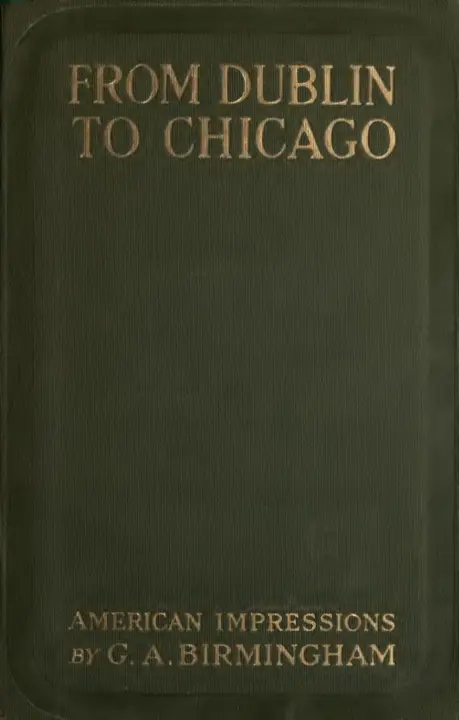
From Dublin to Chicago: Some Notes on a Tour in America
George A. Birmingham
THE CLASSIC COLLECTION · 1900
"Hyacinth" by George A. Birmingham is a novel written in the early 20th century. The story revolves around the life of Æneas Conneally, a young man trained as a clergyman who has undergone a transformation from an enthusiastic missionary to a more humanized figure struggling to connect with his community and family after great personal loss. Set against the backdrop of 19th-century Ireland, the narrative explores themes of faith, identity, and the complexities of society. The opening of the novel introduces the historical context of missionary efforts in Ireland aimed at converting Roman Catholics to Protestantism, particularly through the character of Æneas Conneally, who emerges as a dedicated figure of this movement. Following the loss of his mother and a series of disappointments, Æneas eventually finds meaning beyond his initial zeal as he marries and becomes a father to a son named Hyacinth. As the story progresses, it hints at Hyacinth's upcoming journey into education and the external changes in their village, alongside the personal tribulations of his father. The narrative uniquely combines the challenges of personal grief with the larger social and political scenarios of the time, setting the stage for intimate character development and societal commentary.
Introduction adapted from the source catalogue; source summaries may be automatically generated.
Free to read · English · 83,065 words · No account needed
MAKE TIME FOR A GOOD BOOK
On by default. Untick to stop anonymous reading totals. Each page counts after 10 seconds in view. How this works.
Anonymous counting is on unless you have switched it off.
The oratory of the grazier, who seconded the resolution, was not inferior. It filled his heart with a sense of shame, so he said, to think of his cattle, poor, innocent beasts of the field, being handled by a Protestant. They had been bred, these bullocks of his, by Catholics, fed by Catholics, were owned by a Catholic, bought with Catholic money at the fairs, and yet they were told that in all Ireland no Catholic could be discovered fit to put them into a train.
Neither the resolution itself nor the heart-rending appeal of the grazier produced the slightest effect on the railway company. John Crawford continued to sell tickets, even to Father Fahey himself, and appeared entirely unconcerned by the fuss.
About a fortnight after the meeting Hyacinth spent a night in Clogher. Mr. Holywell, the cigarette man, happened to be in the hotel, and, as usual, got through a good deal of desultory conversation while he drank his whisky-and-water. Quite unexpectedly, and apropos of nothing that had been said, he plumped out the question:
‘What religion are you, Conneally?’
The inquiry was such an unusual one, and came so strangely from Mr. Holywell, who had always seemed a Gallio in matters spiritual, that Hyacinth hesitated.
‘I’m a Baptist myself,’ he went on, apparently with a view to palliating his inquisitiveness by a show of candour. ‘I find it a very convenient sort of religion in Connaught. There isn’t a single place of worship belonging to my denomination in the whole province, so I’m always able to get my Sundays to myself. I don’t want to convert you to anything or to argue with you, but I have a fancy that you are a Church of Ireland Protestant.’
Hyacinth admitted the correctness of the guess, and wondered what was
coming next.
‘Ever spend a Sunday here?’
‘Never,’ said Hyacinth; ‘I always get back home for the end of the week
if I can.’
‘Ah! Well, do you know, if I were you, I should spend next Sunday here,
and go to Mass.’
‘I shall not do anything of the sort.’
‘Well, it’s your own affair, of course; only I just think I should do it if I were you. Good-night.’
‘Wait a minute,’ said Hyacinth. ‘I want to know what you mean.’
Mr. Holywell sat down again heavily.
‘Been round your customers here lately?’
‘No. I only arrived this evening, and have done nothing yet. I mean to go round them to-morrow.’
‘You may just as well go home by the early train for all the good you’ll
do.’
Your reading position is saved on this browser. Take it to another device with a library code. Reading pages adapt to text, rather than matching a printed edition.
George A. Birmingham
George A. Birmingham
George A. Birmingham
George A. Birmingham
BEHIND THE BOOK
This eBook is for the use of anyone anywhere in the United States and most other parts of the world at no cost and with almost no restrictions whatsoever. You may copy it, give it away or re-use it under the terms of the Project Gutenberg License included with this eBook or online at www.gutenberg.org. If you are not located in the United States, you will have to check the laws of the country where you are located before using this eBook. Read the source licence.
The original source file, including credits and licence, is retained by this library. Request an original-format copy at no charge. Please include the book title and Project Gutenberg identifier #10538.
KEEP YOUR CURIOSITY GOING
Cécile Tormay

Moritz Busch
Coulson Kernahan
John L. Ransom

Maurice Baring
Frances Wright