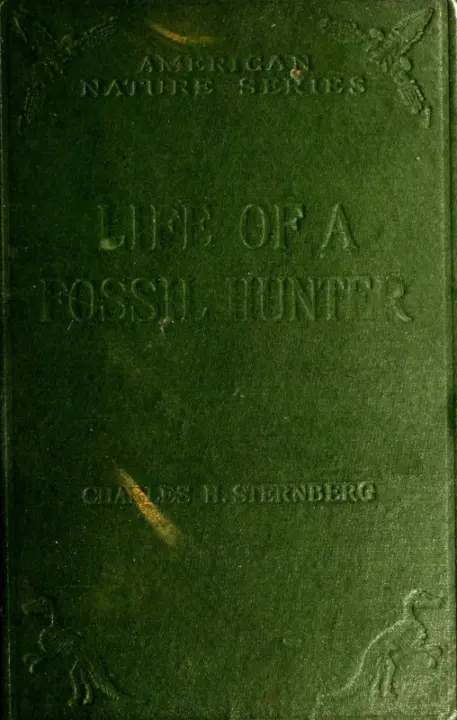
The life of a fossil hunter
Charles H. (Charles Hazelius) Sternberg
THE CLASSIC COLLECTION · 1917
"Hunting dinosaurs in the bad lands of the Red Deer River, Alberta, Canada" by Charles H. Sternberg is a field memoir and scientific account written in the early 20th century. It follows Sternberg and his sons as they hunt, extract, and prepare dinosaur fossils in Alberta’s badlands and across the American West, weaving adventure with hands-on methodology and museum work. Readers can expect specimen stories, practical collecting techniques, and vivid reconstructions of Cretaceous environments.
The opening of the book presents a sequel to Sternberg’s earlier autobiography, thanking colleagues and setting out his aim to recount recent, highly successful seasons in Canada. He recalls landmark finds—“mummified” duck-billed dinosaurs with preserved skin, superb Triceratops skulls, and giant Cretaceous fishes—while describing grueling quarry work, transport feats, and a cyclone that destroyed a major skull. Museum visits to Pittsburgh, Washington, New York, and Yale frame his evolving ideas, including a shift toward viewing hadrosaurs as swimmers. He details mounting a massive Titanotherium at Ottawa’s Victoria Memorial Museum and the improvised techniques that made it possible. Moving to Alberta, he sketches Drumheller’s geology, evokes bayous teeming with dinosaurs, and narrates the discovery and plaster-jacketing of a remarkably complete hadrosaur later mounted in Ottawa. A river run to Steveville leads to a notable Gorgosaurus with gastralia, whose “slab” presentation in matrix he chooses after consulting leading paleontologists. The section closes with additional crested duck-bill finds and a candid look at the painstaking lab work such fragile fossils demand.
Introduction adapted from the source catalogue; source summaries may be automatically generated.
Free to read · English · 56,892 words · No account needed
MAKE TIME FOR A GOOD BOOK
On by default. Untick to stop anonymous reading totals. Each page counts after 10 seconds in view. How this works.
Anonymous counting is on unless you have switched it off.
Like all noble scenes of nature the mind cannot at once grasp them
fully, if it ever does.
The south wind had sprung up, the tide was rising, the waves were curling as they rolled on the beach: higher and higher they came capped with white foam. As far as the eyes could reach, long lines of breakers heaped tons of water on the shore, lashed by the frowning tempest. The sublimity of the scene was heightened by the colors in the west, that flecked the horizon with bars of gold and crimson; while the sun, a globe of fire, sank to rest in old ocean. I was lying beneath the tree breathing the salted air, partly in a trance. Is this real? I asked myself. Is the wind really sighing among the branches of the trees, that sheltered me? sounding like music of an aeolian harp, the tracery of interwoven leaflets acting as if they were stretched invisible wires? Is this a dream or reality? How often in other days while searching the semi-arid fossil beds of the west, in my day dreams have I put life in the old dry bones; how often some stately dinosaur has passed before my mental vision. The forests, the rivers, the lakes and oceans of other days, have appeared as if they actually existed. Is it incredible then, that I should be transported across three million years, the distance between the living and the dead? “How fleet is a glance of the mind; compared to the speed of its flight, the lightning itself lags behind, and the swift winged arrows of light.” Yes! modern science claims that three million years have sped away since the end of the Age of Reptiles, since the Dinosaurs perished from the earth. Yet I was here. I could not doubt my own senses. I saw in the east the Queen of Night rise slowly from the bosom of old ocean, while to the west the last streak of departing day, glimmered once more and disappeared. Overhead the constellations of the temperate zone shone in undimmed splendor, as they did last night above the Albertian plains. Yes! there to the north was the Great Dipper; its pointers as of yore, still led my eyes to the North Star. Venus too, shone as the “Star of the evening, beautiful star.” Who knows but some tiger of the everglades, some huge Carniverous Dinosaur, may be prowling about for prey. A Fossil Hunter might prove a rare tidbit to him. It were better in my unprotected condition to seek a place of safety. I noticed that some of the bushes that lined the thick jungles around me had long powerful thorns, while running vines, had fibers as tough as hemp. I had my collection bag still with me, with its chisels, knives and small hand pick. So quickly cutting some long thorns and binding them to my shoes with the vines, I sought a small tree, the crown of which was hidden among the lower branches of the redwood. I climbed by forcing the thorns into the bark of the tree, around which my arms were clasped, and I ascended with the same ease that a linesman climbs a telegraph pole, driving the sharp steel spikes fastened to his boots into the wood. When I got among the lower branches of the huge tree one hundred feet above ground, I crawled down to its juncture with the trunk where I found an airy chamber, its floor covered with dried leaves. Stretching myself at full length upon this fragrant bed, I offered up my evening prayers to my Father in heaven, knowing that I was being guided by His hand. Ah! had he not led me through the wilderness for forty years in His cemeteries of Creation, among the countless creatures of His hand. My mind took me back to the many forms, I had recovered, and saved from the destroying agencies of time and the vandal hand of man. I remembered I had eighty-five distinct species of extinct life in Munich Bavaria where the late distinguished Paleontologist Dr. von Zittel had once written me that I “had erected in Munich an immemorial monument to my name.” I thought of the hundreds of species I had discovered that now helped form the great Cope Collection in the American Museum of Natural History, New York, that great storehouse of American fossil vertebrates. I thought too of my collection in the British Museum, and in the Museums of Berlin and Paris. Surely they prove that God has cared for me while I was “about my Father’s business.” I need not worry I thought, because forsooth He had carried me back to the close of the Cretaceous, that wonderful Age of Reptiles when land and air and sea were filled with, to us, strange forms of life; when great lizards shook the earth with their majestic tread, sea serpents and great bony fishes ruled the sea, while huge flying reptiles flapped their leathery wings over the deep. When I thought of all the creatures I had hunted for forty years, and dug their mouldering skeletons from an old ocean bed a thousand miles from the existing seas, from some great lake bottom, or the flood plain of an ancient river. I asked myself: Will He who brought me here leave me to suffer and to die? How often he had rescued me from sudden death. Shall I fear to lay me down to sleep alone with Him in this land never seen before by mortal eyes. Oh no! So peacefully I laid me down to rest humming Scott’s famous lines:
Your reading position is saved on this browser. Take it to another device with a library code. Reading pages adapt to text, rather than matching a printed edition.
Charles H. (Charles Hazelius) Sternberg
BEHIND THE BOOK
This eBook is for the use of anyone anywhere in the United States and most other parts of the world at no cost and with almost no restrictions whatsoever. You may copy it, give it away or re-use it under the terms of the Project Gutenberg License included with this eBook or online at www.gutenberg.org. If you are not located in the United States, you will have to check the laws of the country where you are located before using this eBook. Read the source licence.
The original source file, including credits and licence, is retained by this library. Request an original-format copy at no charge. Please include the book title and Project Gutenberg identifier #77814.
KEEP YOUR CURIOSITY GOING

Charles G. (Charles Griffith) Ross
Hannah Webster Foster

Emily Lawless
Edwin Hamlin Carr

Charles De Lano Hine
Andrew Ure