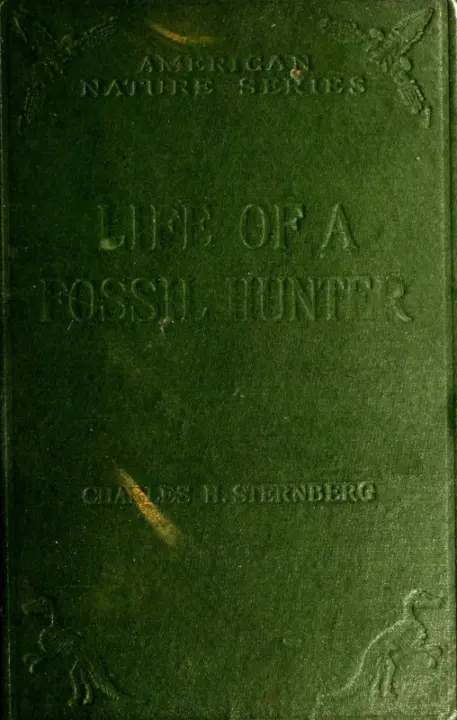
The life of a fossil hunter
Charles H. (Charles Hazelius) Sternberg
THE CLASSIC COLLECTION · 1917
"Hunting dinosaurs in the bad lands of the Red Deer River, Alberta, Canada" by Charles H. Sternberg is a field memoir and scientific account written in the early 20th century. It follows Sternberg and his sons as they hunt, extract, and prepare dinosaur fossils in Alberta’s badlands and across the American West, weaving adventure with hands-on methodology and museum work. Readers can expect specimen stories, practical collecting techniques, and vivid reconstructions of Cretaceous environments.
The opening of the book presents a sequel to Sternberg’s earlier autobiography, thanking colleagues and setting out his aim to recount recent, highly successful seasons in Canada. He recalls landmark finds—“mummified” duck-billed dinosaurs with preserved skin, superb Triceratops skulls, and giant Cretaceous fishes—while describing grueling quarry work, transport feats, and a cyclone that destroyed a major skull. Museum visits to Pittsburgh, Washington, New York, and Yale frame his evolving ideas, including a shift toward viewing hadrosaurs as swimmers. He details mounting a massive Titanotherium at Ottawa’s Victoria Memorial Museum and the improvised techniques that made it possible. Moving to Alberta, he sketches Drumheller’s geology, evokes bayous teeming with dinosaurs, and narrates the discovery and plaster-jacketing of a remarkably complete hadrosaur later mounted in Ottawa. A river run to Steveville leads to a notable Gorgosaurus with gastralia, whose “slab” presentation in matrix he chooses after consulting leading paleontologists. The section closes with additional crested duck-bill finds and a candid look at the painstaking lab work such fragile fossils demand.
Introduction adapted from the source catalogue; source summaries may be automatically generated.
Free to read · English · 56,892 words · No account needed
MAKE TIME FOR A GOOD BOOK
On by default. Untick to stop anonymous reading totals. Each page counts after 10 seconds in view. How this works.
Anonymous counting is on unless you have switched it off.
Leaving Charlie and his wife on their ranch, Levi and I returned to Lawrence, George and I prepared the material for sale. As I had sold a 20 foot Platecarpus, George had found during the summer, a 14 foot fish, and the Titanotherium skeleton to the Victoria Memorial Museum at Ottawa with the agreement that I was to mount them, I took my son George with me on a trip to the “Teeming East,” we left Lawrence on the 17th of March, 1912, by the Pennsylvania Route. After leaving St. Louis we passed through the level reaches of southern Illinois, crossed the Mississippi. The farms along the lowlands were covered with water. Farm houses with ornamental trees around them were pleasing to look upon. In places the land swelled into gentle curves with groves topping the rounded elevations. The less pretentious houses occupied by renters were sprinkled in among the nobler buildings. Snow was still lying on the open stretches. Great wood piles attested to the fact that they had not destroyed all the timber. Woods of black oak were still common. Straw stacks and corn shocks were not very common, showing the silos had gathered in all the green stuff, and the long winter had consumed the straw. Everything available for food had been fed to the cattle.
As we go farther east we get among hills with narrow valleys, we cross a river from the north, likely the Kaskaskia, with canal beside it, but both are beneath a flood of water making one great stream. Everywhere are old stump fields: showing the destruction of timber--that once covered all the land--is still in progress. In a decade all will disappear as there is no young timber to replace it. So man destroys his best friends. Not a single rock did I see across Illinois. East of Casey we passed the great oil fields of Indiana; in the field everywhere were the silent pumps at work, attached by wire to an engine, that drives a number at once. The oil is pumped into pipes that in turn carry it to the great tanks many miles away. They covered acres of ground, each tank holding many car loads of oil. At 10 a.m. we reached Terre Haute, where I noticed a huge Court House crowned with a high dome. The country roughens as we go eastward. There are many fine homes with elevated water tanks too, showing that the farm houses are provided with the modern improvements. What more can one ask, with daily mail and telephones in every home? So we swing merrily along through the great coal fields of Indiana. Everywhere we see the shaft and elevator with cars loading on the tracks, there are no storage buildings; if the miners stop work a week or more the consumer must suffer. Here too I noticed the ruthless hand of man among the trees. They are cut down to lie and rot on the ground. We pass through sand hills, and belts of timber, there are more rail fences than in Illinois, where the last ones are being cut for posts for wire fences. They always follow the destruction of timber. At 2:30 p.m. we are in Indianapolis. As we enter Ohio beyond Richmond, we observe the improved condition of farm houses and barns, and we see some fine residences of brick and wood. Even the posts along the roads are painted. They have quantities of drainage tiles scattered around preparing to drain off the water, as the ground is soaked from the melting snow. So we speed along, and when we wake in the morning we find ourselves in Pennsylvania among the Allegheny Mountains traveling down Monongahela river, towards Pittsburgh. Towering mountains on either side the rapid streams covered with second growth timber with but few houses. The rocks that have been metamorphised by heat, are tipped up at all angles, often on edge, or leaning against the mountains as if for support. At last we reach the Smoky City, at the head of the Ohio River a wonderfully rich city. But her millionaires never made their money out of the ground from which they were taken, but from the bowels of the earth. They have delved like Vulcan among the Black Diamonds, Iron-Ore, Gas and Oil.
Your reading position is saved on this browser. Take it to another device with a library code. Reading pages adapt to text, rather than matching a printed edition.
Charles H. (Charles Hazelius) Sternberg
BEHIND THE BOOK
This eBook is for the use of anyone anywhere in the United States and most other parts of the world at no cost and with almost no restrictions whatsoever. You may copy it, give it away or re-use it under the terms of the Project Gutenberg License included with this eBook or online at www.gutenberg.org. If you are not located in the United States, you will have to check the laws of the country where you are located before using this eBook. Read the source licence.
The original source file, including credits and licence, is retained by this library. Request an original-format copy at no charge. Please include the book title and Project Gutenberg identifier #77814.
KEEP YOUR CURIOSITY GOING

Charles G. (Charles Griffith) Ross
Hannah Webster Foster

Emily Lawless
Edwin Hamlin Carr

Charles De Lano Hine
Andrew Ure