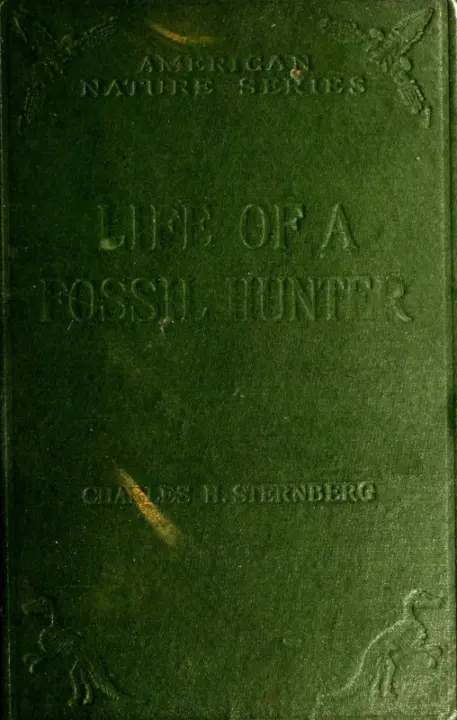
The life of a fossil hunter
Charles H. (Charles Hazelius) Sternberg
THE CLASSIC COLLECTION · 1917
"Hunting dinosaurs in the bad lands of the Red Deer River, Alberta, Canada" by Charles H. Sternberg is a field memoir and scientific account written in the early 20th century. It follows Sternberg and his sons as they hunt, extract, and prepare dinosaur fossils in Alberta’s badlands and across the American West, weaving adventure with hands-on methodology and museum work. Readers can expect specimen stories, practical collecting techniques, and vivid reconstructions of Cretaceous environments.
The opening of the book presents a sequel to Sternberg’s earlier autobiography, thanking colleagues and setting out his aim to recount recent, highly successful seasons in Canada. He recalls landmark finds—“mummified” duck-billed dinosaurs with preserved skin, superb Triceratops skulls, and giant Cretaceous fishes—while describing grueling quarry work, transport feats, and a cyclone that destroyed a major skull. Museum visits to Pittsburgh, Washington, New York, and Yale frame his evolving ideas, including a shift toward viewing hadrosaurs as swimmers. He details mounting a massive Titanotherium at Ottawa’s Victoria Memorial Museum and the improvised techniques that made it possible. Moving to Alberta, he sketches Drumheller’s geology, evokes bayous teeming with dinosaurs, and narrates the discovery and plaster-jacketing of a remarkably complete hadrosaur later mounted in Ottawa. A river run to Steveville leads to a notable Gorgosaurus with gastralia, whose “slab” presentation in matrix he chooses after consulting leading paleontologists. The section closes with additional crested duck-bill finds and a candid look at the painstaking lab work such fragile fossils demand.
Introduction adapted from the source catalogue; source summaries may be automatically generated.
Free to read · English · 56,892 words · No account needed
MAKE TIME FOR A GOOD BOOK
On by default. Untick to stop anonymous reading totals. Each page counts after 10 seconds in view. How this works.
Anonymous counting is on unless you have switched it off.
We walked up the steep slope to the divide between the breaks of The Missouri river and Dog Creek, this divide is nearly 600 feet above the river. Somewhat different from what my memory had told me of these great canyons. I speak of them as being over a thousand feet deep in “The Life of a Fossil Hunter.” In 1876 we had no barometer to take our altitude and my notes were lost in a fire in 1881, it is natural for the mind to exaggerate depth and height as well as level surfaces. However, as we made this trip by moonlight, and through the solemn silence, I was again overcome with awe when I gazed into the stupendous gorges and at the beetling crags that overlooked them. Hour after hour we passed slowly along the trail, often only the narrow ridge between two great canyons, and a balky team might have backed us off into the abyss filled with inky darkness. Only a journey under such conditions and in such a region of utter barrenness, can give the reader an idea of the emotions that overpowered me. We made camp about midnight, and the only sign of human habitations we saw, (except a deserted sheep ranch), were the fireworks thrown into the sky at Kendall, where the people were celebrating. We made a camp later, on an eastern branch of Dog Creek, called Taffy Creek. We made a thorough study of this region near camp. During our trip up Dog Creek we had made extensive collections of invertebrate fossils from all the different horizons, securing also Myledaphus, and other sharks teeth from the lower Eagle Creek sandstones which, with the Claggett shales, form the lower beds of the Belly River Series of Alberta. On the south side of Taffy below a large timbered hog back upheaval, I found a locality in the Judith river bed that is possibly the type locality from which Cope and I secured our collections on that memorable expedition of 1876, when we found the first of the horned dinosaurs (except loose teeth). A “blow out,” as they call it in the west, had exposed along a narrow slope of sandstone, many bones and teeth of horned, plated, duck-billed, carniverous dinosaurs, with the teeth of Myledaphus, and many broken turtle shells, as well as bones of Champsosaurus, scales of ganoid fishes. Exactly like the numberless bone-beds along Dead Dodge Canyon. What delighted me most of all was discovering the nearly complete pelvic girdle, including the footed ischia, proving that these bones belonged to a crested dinosaur like the one we found on Red Deer river and was called Stephanosaurus by Lambe and Corythosaurus by Brown. You will notice that we have two names usually for these Belly River species. I try to credit each student as best I may, leaving it with future scientists to decide which name should be retained in American Paleontology. The Edmonton bone-beds, are very different, resembling flotsam along the line of high tide, and are all deposited in brackish water. These beds like those in Dead Lodge Canyon, were laid down in fresh water. There were very few turtle shells in the Edmonton, here they strew every exposure. Everywhere in this region were two persistent layers of coal on top of the Judith river followed by the Bear Paw Shales. Above the upper vein of coal, is a layer of oyster shells from a few inches to four feet thick. In the Bear Paw shales south of camp a mile, Mr. Dowling with the aid of a sheep herder, found a new mosasaur, belonging evidently to the genus Clidastes, as the chevrons were anchylosed to the centra of the vertebrae, and the tail was expanded into a fin. The mandibles with teeth, some fifteen feet of the tail and many dorsal vertebrae were found. We also secured some very beautiful ammonites and baculites and bones of the plesiosaur Cimoliasaurus. But for the uplift, the stratigraphical record is quite simple, the puzzling strata tipped in all directions were easily identified under direction of the skilled observer Mr. Dowling. It would be impossible for any one on the ground to doubt the sequence of the rocks here, as laid down by Hatcher and Stanton.
Your reading position is saved on this browser. Take it to another device with a library code. Reading pages adapt to text, rather than matching a printed edition.
Charles H. (Charles Hazelius) Sternberg
BEHIND THE BOOK
This eBook is for the use of anyone anywhere in the United States and most other parts of the world at no cost and with almost no restrictions whatsoever. You may copy it, give it away or re-use it under the terms of the Project Gutenberg License included with this eBook or online at www.gutenberg.org. If you are not located in the United States, you will have to check the laws of the country where you are located before using this eBook. Read the source licence.
The original source file, including credits and licence, is retained by this library. Request an original-format copy at no charge. Please include the book title and Project Gutenberg identifier #77814.
KEEP YOUR CURIOSITY GOING

Charles G. (Charles Griffith) Ross
Hannah Webster Foster

Emily Lawless
Edwin Hamlin Carr

Charles De Lano Hine
Andrew Ure