THE CLASSIC COLLECTION✦Social processCLASSIC FREE BOOKS
Social process
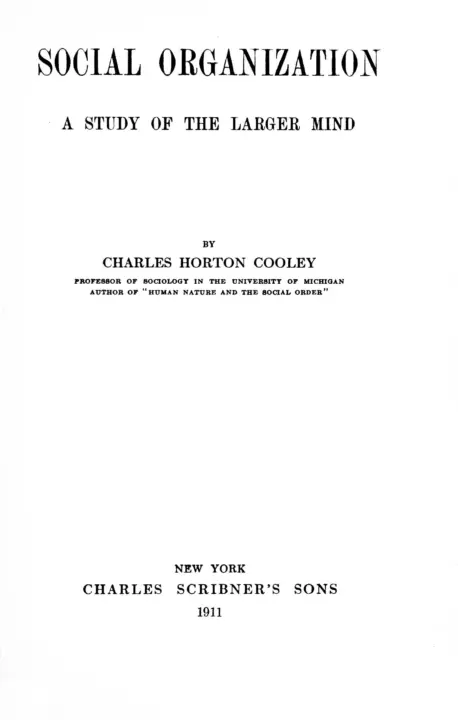
Charles Horton Cooley
THE CLASSIC COLLECTION · 1902
"Human Nature and the Social Order" by Charles Horton Cooley is a sociological treatise written in the early 20th century. The work interrogates the intricate relationship between individuals and society, aiming to dispel the common notion of their opposition, illustrating instead that they are interconnected components of the same reality. Cooley emphasizes the fundamental unity of human life, arguing that individuals cannot be fully understood without acknowledging their social contexts. At the start of the book, Cooley outlines his perspective on the relationship between society and the individual, positing that both are perspectives on a singular phenomenon. He critiques the fallacy of viewing them as separate or opposing forces, insisting that this misunderstanding arises from human perception rather than core realities. Through various examples, he illustrates how societal structures shape individual behaviors, and conversely, how individuals collectively influence the broader social order, setting the stage for a deeper exploration of themes such as choice, suggestion, and the role of personal ideas within social contexts in later chapters.
Introduction adapted from the source catalogue; source summaries may be automatically generated.
Free to read · English · 106,897 words · No account needed
MAKE TIME FOR A GOOD BOOK
On by default. Untick to stop anonymous reading totals. Each page counts after 10 seconds in view. How this works.
Anonymous counting is on unless you have switched it off.
Footnote 77:
Decline and Fall, vol. vii., p. 82; Milman-Smith edition.
Footnote 78:
Emerson, address on New England Reformers.
Footnote 79:
Psychology, vol. ii., p. 409.
Footnote 80:
See Darwin’s Life and Letters, by his son, vol. i., p. 47.
Footnote 81:
Emerson, New England Reformers.
Footnote 82:
Psychology, vol. ii., p. 314.
Footnote 83:
In Harper’s Magazine, vol. 78, p. 870.
Footnote 84:
Reminiscences quoted by Garland in McClure’s Magazine, April, 1897.
Footnote 85:
From a letter published in the newspapers at the time of the dedication of the Grant Monument, in April, 1897.
Footnote 86:
Mr. Howells remarks that “in Europe life is histrionic and dramatized, and that in America, except when it is trying to be European, it is direct and sincere.”—“Their Silver Wedding Journey,” Harper’s Magazine, September, 1899.
Footnote 87:
Related by W. H. Gibson, in Harper’s Magazine for May, 1897.
Footnote 88:
The fact that the Roman system meant organized ennui in thought, the impossibility of entertaining large and hopeful views of life, is strikingly brought out by the aid of contemporary documents in Dill’s Roman Society. Prisoners of a shrinking system, the later Romans had no outlook except toward the past. Anything onward and open in thought was inconceivable by them.
Footnote 89:
See Primitive Culture, by E. B. Tylor, chap. xiv.
Footnote 90:
J. A. Symonds, History of the Renaissance in Italy, The Fine Arts, p. 329. Hamerton has some interesting observations on mystery in art in his life of Turner, p. 352; also Ruskin in Modern Painters, part v., chaps. 4 and 5.
Footnote 91:
Tennyson, The Holy Grail.
Footnote 92:
See p. 248.
Footnote 93:
See his Instinct and Reason, p. 569.
Footnote 94:
M. J. Guyau, Esquisse d’une Morale sans Obligation ni Sanction,
English translation, p. 93.
Footnote 95:
Idem, p. 149.
Footnote 96:
Idem, p. 87.
Footnote 97:
Idem, p. 82.
Footnote 98:
Studies of Childhood, p. 284.
Footnote 99:
See his First Three Years of Childhood, p. 287.
Footnote 100:
Psychology, vol. i., p. 315.
Footnote 101:
Emerson, History.
Footnote 102:
Idem, Spiritual Laws.
Footnote 103:
Amer. Jour. of Psychology, vol. 7, p. 86.
Footnote 104:
See pp. 101, 210, 226.
Footnote 105:
The Pathology of Mind, p. 425.
Footnote 106:
Your reading position is saved on this browser. Take it to another device with a library code. Reading pages adapt to text, rather than matching a printed edition.
Charles Horton Cooley
Charles Horton Cooley
BEHIND THE BOOK
This eBook is for the use of anyone anywhere in the United States and most other parts of the world at no cost and with almost no restrictions whatsoever. You may copy it, give it away or re-use it under the terms of the Project Gutenberg License included with this eBook or online at www.gutenberg.org. If you are not located in the United States, you will have to check the laws of the country where you are located before using this eBook. Read the source licence.
The original source file, including credits and licence, is retained by this library. Request an original-format copy at no charge. Please include the book title and Project Gutenberg identifier #75145.
KEEP YOUR CURIOSITY GOING

Charles G. (Charles Griffith) Ross
Hannah Webster Foster

Emily Lawless
Edwin Hamlin Carr

Charles De Lano Hine
Andrew Ure