THE CLASSIC COLLECTION✦Social processCLASSIC FREE BOOKS
Social process
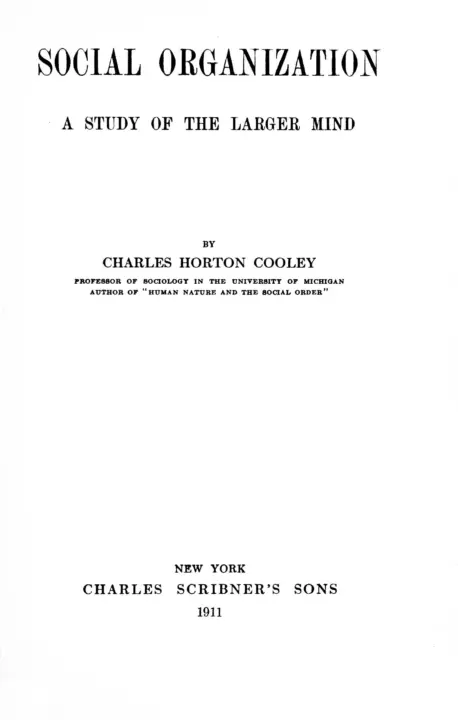
Charles Horton Cooley
THE CLASSIC COLLECTION · 1902
"Human Nature and the Social Order" by Charles Horton Cooley is a sociological treatise written in the early 20th century. The work interrogates the intricate relationship between individuals and society, aiming to dispel the common notion of their opposition, illustrating instead that they are interconnected components of the same reality. Cooley emphasizes the fundamental unity of human life, arguing that individuals cannot be fully understood without acknowledging their social contexts. At the start of the book, Cooley outlines his perspective on the relationship between society and the individual, positing that both are perspectives on a singular phenomenon. He critiques the fallacy of viewing them as separate or opposing forces, insisting that this misunderstanding arises from human perception rather than core realities. Through various examples, he illustrates how societal structures shape individual behaviors, and conversely, how individuals collectively influence the broader social order, setting the stage for a deeper exploration of themes such as choice, suggestion, and the role of personal ideas within social contexts in later chapters.
Introduction adapted from the source catalogue; source summaries may be automatically generated.
Free to read · English · 106,897 words · No account needed
MAKE TIME FOR A GOOD BOOK
On by default. Untick to stop anonymous reading totals. Each page counts after 10 seconds in view. How this works.
Anonymous counting is on unless you have switched it off.
Compare Stanley, The Evolutionary Psychology of Feeling, p. 271 et
seq.
Footnote 56:
Wilhelm Meister’s Travels, Chap. XII., Carlyle’s Translation.
Footnote 57:
Quoted by Gummere, Germanic Origins, p. 266.
Footnote 58:
Œnone.
Footnote 59:
Travels, chap. 10, in Carlyle’s translation.
Footnote 60:
Stanley, The Evolutionary Psychology of Feeling, p. 280.
Footnote 61:
“Strive manfully; habit is subdued by habit. If you know how to dismiss men, they also will dismiss you, to do your own things.”—De Imitatione Christi, book i., chap. 21, par. 2.
Footnote 62:
De Imitatione Christi, book iii., chap. 23, par. 1.
Footnote 63:
Tulloch’s Pascal, p. 100.
Footnote 64:
See his History of European Morals, vol. ii., p. 369.
Footnote 65:
Perez, The First Three Years of Childhood, p. 66.
Footnote 66:
Mind, new series, vol. iv., p. 365.
Footnote 67:
A Week on the Concord and Merrimack Rivers, pp. 303, 328.
Footnote 68:
See his essay on the Journal of the Brothers Goncourt.
Footnote 69:
See his Life and Letters, vol. ii., p. 192.
Footnote 70:
Compare Professor Simon N. Patten’s Theory of Social Forces, p. 135.
Footnote 71:
Thoreau, A Week, etc., p. 304.
Footnote 72:
Compare G. Stanley Hall’s study of Fear in the American Journal of Psychology, viii., p. 147.
Footnote 73:
The terrors of our dreams are caused largely by social imaginations. Thus Stevenson, in one of his letters, speaks of “my usual dreams of social miseries and misunderstandings and all sorts of crucifixions of the spirit.”—Letters of Robert Louis Stevenson, i., p. 79.
Footnote 74:
Maine, Ancient Law, p. 62.
Footnote 75:
Wilhelm Meister’s Apprenticeship, v., 16, Carlyle’s Translation.
Footnote 76:
In reading studies of a particular aspect of life, like M. Tarde’s brilliant work, Les Lois de l’Imitation, it is well to remember that there are many such aspects, any of which, if expounded at length and in an interesting manner, might appear for the time to be of more importance than any other. I think that other phases of social activity, such, for instance, as communication, competition, differentiation, adaptation, idealization, have as good claims as imitation to be regarded as the social process, and that a book similar in character to M. Tarde’s might, perhaps, be written upon any one of them. The truth is that the real process is a multiform thing of which these are glimpses. They are good so long as we recognize that they are glimpses and use them to help out our perception of that many-sided whole which life is; but if they become doctrines they are objectionable.
The Struggle for Existence is another of these glimpses of life which just now seems to many the dominating fact of the universe, chiefly because attention has been fixed upon it by copious and interesting exposition. As it has had many predecessors in this place of importance, so doubtless it will have many successors.
Your reading position is saved on this browser. Take it to another device with a library code. Reading pages adapt to text, rather than matching a printed edition.
Charles Horton Cooley
Charles Horton Cooley
BEHIND THE BOOK
This eBook is for the use of anyone anywhere in the United States and most other parts of the world at no cost and with almost no restrictions whatsoever. You may copy it, give it away or re-use it under the terms of the Project Gutenberg License included with this eBook or online at www.gutenberg.org. If you are not located in the United States, you will have to check the laws of the country where you are located before using this eBook. Read the source licence.
The original source file, including credits and licence, is retained by this library. Request an original-format copy at no charge. Please include the book title and Project Gutenberg identifier #75145.
KEEP YOUR CURIOSITY GOING

Charles G. (Charles Griffith) Ross
Hannah Webster Foster

Emily Lawless
Edwin Hamlin Carr

Charles De Lano Hine
Andrew Ure