THE CLASSIC COLLECTION✦Social processCLASSIC FREE BOOKS
Social process
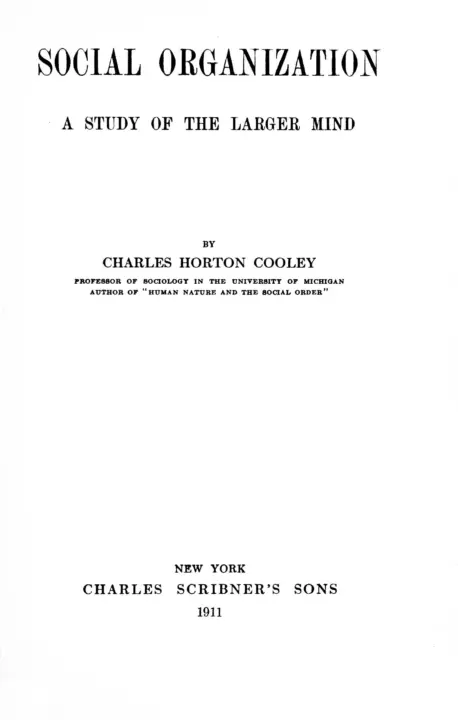
Charles Horton Cooley
THE CLASSIC COLLECTION · 1902
"Human Nature and the Social Order" by Charles Horton Cooley is a sociological treatise written in the early 20th century. The work interrogates the intricate relationship between individuals and society, aiming to dispel the common notion of their opposition, illustrating instead that they are interconnected components of the same reality. Cooley emphasizes the fundamental unity of human life, arguing that individuals cannot be fully understood without acknowledging their social contexts. At the start of the book, Cooley outlines his perspective on the relationship between society and the individual, positing that both are perspectives on a singular phenomenon. He critiques the fallacy of viewing them as separate or opposing forces, insisting that this misunderstanding arises from human perception rather than core realities. Through various examples, he illustrates how societal structures shape individual behaviors, and conversely, how individuals collectively influence the broader social order, setting the stage for a deeper exploration of themes such as choice, suggestion, and the role of personal ideas within social contexts in later chapters.
Introduction adapted from the source catalogue; source summaries may be automatically generated.
Free to read · English · 106,897 words · No account needed
MAKE TIME FOR A GOOD BOOK
On by default. Untick to stop anonymous reading totals. Each page counts after 10 seconds in view. How this works.
Anonymous counting is on unless you have switched it off.
Personal authority, influence upon sense of right, 353 ff
Personal character, interpretation of, 67, 70
Personal ideas, 62 ff;
sensuous nucleus of, 69 ff;
sentiment their chief content, 81 ff, 104;
compared to a system of lights, 97 f;
affect the physical organism, 99 f;
affect the sense of right, 348 ff
Personal symbols in art and literature, 71 ff
Persona, real and imaginary, inseparable, 60 f;
incorporeal, their social reality, 88;
social, interpenetrate one another, 90 ff;
ideal, as factors in conscience, 362 ff;
ideal, of religion, 280 ff, 368 ff
Philanthropy, motive of, 269 f
Pioneer, self-feeling of the, 268
Pity, is it altruism? 94 f;
relation to sympathy, 102 f; 238
Power, based on sympathy, 107 f;
idea of, 290;
advantage of visible forms of, 291 f.
See also Ascendency
Prayer, as personal intercourse, 357
Pretence, contempt of, in America, 300
Prevention of degeneracy, 390 f
Preyer, W., 27, 46
Pride, 199 ff
Primitive individualism, 10
Principle, moral, 338 f
Process, social, imitation, etc., as, 272;
vital, problem of, 333
Processes, social, reflected in sympathy, 119 ff
Progress, relation of, to freedom, 396
Publicity, moral effect of, 356 ff
Punishment, 252, 384, 390
R., a child of the author, 21 ff, 28, 49 f, 51, 53, 158 ff, 341, 351
Rational, right as the, 326 ff
Recapitulation theory of mental development, 21
Refinement, as affecting hostility, 237
Religion, suggestibility in, 42, 43;
self-feeling of founders of, 181;
self-discipline in, 214 f, 219 ff;
as hero-worship, 280 ff;
mediæval, 309;
mystery in, 317;
ideal persons of, 368 ff
Remorse, 253, 329, 368, 385 f
Repentance, 368
Resentment, 199, 212, 237 ff
Resistance, imaginative, 245 ff
Responsibility, in crime, etc., 388 f
Right, based on sympathy, 108 ff;
relation to egotism, 184;
to the
self in general, 189;
social standards of, as affecting hostility, 256 ff;
as the rational, 326 ff;
conscience the final test of, 333 f;
as the onward, 334 ff;
as habit, 337 ff, 348;
as a phase of the self, 342 f;
the social as opposed to the sensual, 347 f;
action of personal ideas in forming the sense of, 348 ff;
as a microcosm of character, 353;
reflects a social group, 360 ff;
and wrong, 372 ff;
idea of, 377;
freedom as, 393 ff
Riis, Jacob A., 361
Rivalry, 274 ff
Roget’s “Thesaurus,” 198
Roman Empire, 312, 399
Rousseau, 237, 260
Rule of conduct, Marshall’s, 331
Ruskin, 317
Russia, 399
Sanity, based on sympathy, 110
Savonarola, physiognomy of, 314
Schiller, 113, 121
Science, and faith, 308;
cant of, 320;
moral, limits of, 334;
physical, 402
Sculpture, personal symbols in, 72 f
Seclusion, moral effect of, 358
Secretiveness, 59, 196
“Seeing yourself,” 367 f
Selection, in sympathy, 122 ff
Selective method of nature, 373 f
Self, in relation to other personal ideas, 91 ff, 98;
antithesis with “other,” 115, 188 ff;
in morals, 365 f;
in relation to love, 129 ff, 155 ff, 195;
social, 136–231;
observation of in children, 157 ff;
the narrow or egotistical, 185;
every cherished idea is a, 185;
reflected or looking-glass, 152 f, 164 ff, 175, 178, 211, 216 f;
influence of upon conscience, 349 ff;
maladies of the social, 215 ff;
transformation of, 224 ff;
effect of uncongenial environment upon, 227 ff, 245, 320;
crescive, 335;
ethical, 342 f;
ideal social, 359, 366 ff
Self-control, 254
Self-feeling, 137 ff;
quotations illustrating, 141 f;
of reformers, etc., 181;
intense, essential to production, 193 ff;
control of, 217 ff;
in mental disorder, etc., 229 f;
in non-conformity, 267
Self-image as a work of art, 207
Self-neglecting, 195
Self-reliance, 294 ff
Your reading position is saved on this browser. Take it to another device with a library code. Reading pages adapt to text, rather than matching a printed edition.
Charles Horton Cooley
Charles Horton Cooley
BEHIND THE BOOK
This eBook is for the use of anyone anywhere in the United States and most other parts of the world at no cost and with almost no restrictions whatsoever. You may copy it, give it away or re-use it under the terms of the Project Gutenberg License included with this eBook or online at www.gutenberg.org. If you are not located in the United States, you will have to check the laws of the country where you are located before using this eBook. Read the source licence.
The original source file, including credits and licence, is retained by this library. Request an original-format copy at no charge. Please include the book title and Project Gutenberg identifier #75145.
KEEP YOUR CURIOSITY GOING

Charles G. (Charles Griffith) Ross
Hannah Webster Foster

Emily Lawless
Edwin Hamlin Carr

Charles De Lano Hine
Andrew Ure