THE CLASSIC COLLECTION✦Social processCLASSIC FREE BOOKS
Social process
Charles Horton Cooley
THE CLASSIC COLLECTION · 1902
"Human Nature and the Social Order" by Charles Horton Cooley is a sociological treatise written in the early 20th century. The work interrogates the intricate relationship between individuals and society, aiming to dispel the common notion of their opposition, illustrating instead that they are interconnected components of the same reality. Cooley emphasizes the fundamental unity of human life, arguing that individuals cannot be fully understood without acknowledging their social contexts. At the start of the book, Cooley outlines his perspective on the relationship between society and the individual, positing that both are perspectives on a singular phenomenon. He critiques the fallacy of viewing them as separate or opposing forces, insisting that this misunderstanding arises from human perception rather than core realities. Through various examples, he illustrates how societal structures shape individual behaviors, and conversely, how individuals collectively influence the broader social order, setting the stage for a deeper exploration of themes such as choice, suggestion, and the role of personal ideas within social contexts in later chapters.
Introduction adapted from the source catalogue; source summaries may be automatically generated.
Free to read · English · 106,897 words · No account needed
MAKE TIME FOR A GOOD BOOK
On by default. Untick to stop anonymous reading totals. Each page counts after 10 seconds in view. How this works.
Anonymous counting is on unless you have switched it off.
Individuality, Goethe’s view of, in art, 33
Industrial system, effect of upon the individual, 118 f
Insane, reverence for the, 314
Insanity, in relation to sympathy, 110;
the self in, 229 f;
and crime, 387 ff
Instincts, whether divisible into social and unsocial, 12 f
Institution, ideal persons may become an, 369
Institutions, in relation to sympathy, 133
Intercourse, relation to thought, 61
Interlocutor, imaginary, drawn from the environment, 59 f
Invention, 271 f, 337. See also Imitation
Involuntary, the, why ignored, 30 f. See also Will
Isolation of degenerates, 391
James, Henry, 183, 236, 314
James, Prof. William, on social persons, 90;
on the self, 138; 143, 276, 288, 359
Jerome, St., 154
Jowett, Prof., 279
Justice, the sentiment of, 91;
based on sympathy, 108;
relation to love, 127; 236, 352, 366
Kempis, Thomas à, 34, 128, 155, 214, 218, 220, 226
Lamb, Charles, 76, 192;
literary power of, 306
Language involves an interlocutor, 56.
See also Expression
Leader, mental traits of a, 293 ff;
does he really lead? 321
Leadership, 108, 175, 283–325
Learoyd, Mabel W., 366
Lecky, W. H., 223
Leonardo, mystery of, 316
Likeness and difference in sympathy, 120 f
Lincoln, 83
Literature, creative impulse in, 57;
personal symbols in, 73 ff;
self-feeling in, 194;
ascendency in, 303 ff;
mystery in, 315
Lombroso, Prof. Cesare, 229
Love, of the sexes, 121 f;
and sympathy, 124 ff;
scope of, 126 f;
nature of, 127 ff;
Thomas à Kempis and Emerson on, 128;
two kinds of, 129 ff;
and self, 129 ff;
155 ff, 195;
as a social ideal, 247 f;
of enemies, 251; 309, 312
Lowell, J. R., 141 f, 265, 269, 402
Luther, Martin, 180 f, 318
Lying, in relation to sympathy, 110, 358 f
M., a child of the author, 24, 27, 49, 62 ff, 157 ff, 166 f, 349 ff
Macaulay, physiognomy in his style, 77
Machinery, effect of, upon the workman, 118 f
Maine, Sir Henry, 264
Man of the world, traits of the contemporary, 255
Manners, conformity in, 263;
as an aid to ascendency, 319
Marshall, H. R., 331
Material bent of our civilization, 37, 402
Maudsley, Dr., on degeneracy, 381
Meredith, George, 182
Michelangelo, 76, 310, 353
Middle Ages, suggestibility in the, 36
Milieu, power of the, 34 ff
Milton, 73
Moltke, silence of, 315
Monasticism, in relation to the self, 222 f, 227 f
Montaigne, on the need to communicate, 56; 76, 191, 192
Moore, K. C., on the smiling of infants, 46
Morality, traditionary, 338 ff.
See also Conscience, Right
Motley, J. L., 73 f
Murder, 386
Music, sensuous mystery of, 317
Mystery, a factor in ascendency, 312 ff
Nansen, 269
Napoleon, how we know him, 86;
ascendency of, 296;
place in history, 324
New Testament, 142, 215, 245
Nirvana, the ideal of disinterested love, 130
Non-conformity, 262 ff
Non-resistance, doctrine of, 245 ff
Norsemen, motive of, 273
Norton, Prof. C. E., 37
“One,” use of, compared with “I,” 192 f
Onward, right as the, 334 ff
Opposition, personal, its nature, 95 f;
spirit of, 267 ff
Oratory, ascendency in, 301 ff
Organization, of personal thought, 51;
effect of upon the individual, 115 ff;
or vital process, problem of, 333
Originality, 322 ff.
See also Genius, Leadership, Invention
Other-worldism, 222
Painting, personal symbols in, 72.
See also Art, Expression
Papacy, symbolic character of, 308 f
Particularism, 4
Pascal, 218, 222
Passion, why a cause of pain, 253 f;
influence upon idea of right, 330 f
Pater, Walter, 304
Patten, Prof Simon N., 244
Paul, St., 218
Perez, Dr. B., 46;
on the eye, 62 f;
232, 350
Your reading position is saved on this browser. Take it to another device with a library code. Reading pages adapt to text, rather than matching a printed edition.
Charles Horton Cooley
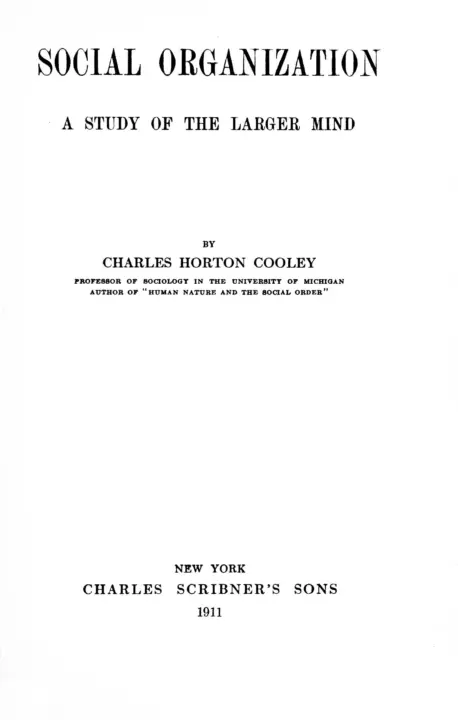
Charles Horton Cooley
BEHIND THE BOOK
This eBook is for the use of anyone anywhere in the United States and most other parts of the world at no cost and with almost no restrictions whatsoever. You may copy it, give it away or re-use it under the terms of the Project Gutenberg License included with this eBook or online at www.gutenberg.org. If you are not located in the United States, you will have to check the laws of the country where you are located before using this eBook. Read the source licence.
The original source file, including credits and licence, is retained by this library. Request an original-format copy at no charge. Please include the book title and Project Gutenberg identifier #75145.
KEEP YOUR CURIOSITY GOING

Charles G. (Charles Griffith) Ross
Hannah Webster Foster

Emily Lawless
Edwin Hamlin Carr

Charles De Lano Hine
Andrew Ure