THE CLASSIC COLLECTION✦Social processCLASSIC FREE BOOKS
Social process
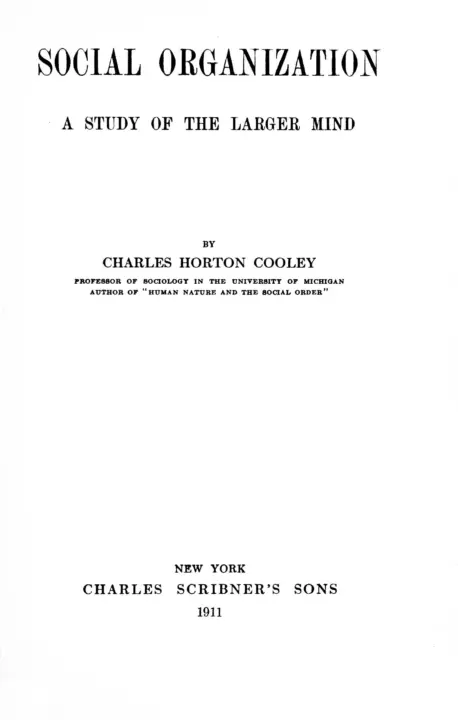
Charles Horton Cooley
THE CLASSIC COLLECTION · 1902
"Human Nature and the Social Order" by Charles Horton Cooley is a sociological treatise written in the early 20th century. The work interrogates the intricate relationship between individuals and society, aiming to dispel the common notion of their opposition, illustrating instead that they are interconnected components of the same reality. Cooley emphasizes the fundamental unity of human life, arguing that individuals cannot be fully understood without acknowledging their social contexts. At the start of the book, Cooley outlines his perspective on the relationship between society and the individual, positing that both are perspectives on a singular phenomenon. He critiques the fallacy of viewing them as separate or opposing forces, insisting that this misunderstanding arises from human perception rather than core realities. Through various examples, he illustrates how societal structures shape individual behaviors, and conversely, how individuals collectively influence the broader social order, setting the stage for a deeper exploration of themes such as choice, suggestion, and the role of personal ideas within social contexts in later chapters.
Introduction adapted from the source catalogue; source summaries may be automatically generated.
Free to read · English · 106,897 words · No account needed
MAKE TIME FOR A GOOD BOOK
On by default. Untick to stop anonymous reading totals. Each page counts after 10 seconds in view. How this works.
Anonymous counting is on unless you have switched it off.
Belief, ascendency of, 310 f, 317 f
Beowulf, on honor, 209 f
Bismarck, 254;
ascendency of, 298, 302
Blame, nature of, 289
Blowitz, M. de, 298
Body, relation of, to the self, 144 f, 163
Booth, Charles, 276
Brotherhood, extension of the sense of, 114 f
Brown, John, 377
Browning, 316
Bryant, Sophie, on antipathy, 235
Bryce, Prof. James, 38, 309
Burke, Edmund, 202, 302 f
Burroughs, John, on the physiognomy of works of genius, 74
Cæsar, as a personal idea, 99
Cant, 320
Casaubon, Mr., 224 f
Chagrin, 241
Charity, 238, 336. See also Altruism, Right
Chicago, aspect of the crowd in, 37
Child, Theodore, 355
Child, a, unlovable at birth, 45
Children, imitation in, 19 ff;
sociability of, 45 ff;
imaginary conversation of, 52 ff;
study of expression by, 62 ff;
growth of sentiment in, 79 ff;
development of self in, 142, 146;
use of “I” by, 157 ff;
reflected self in, 164 ff;
anger of, 232 f;
hero-worship of, 279;
ascendency over, 289 f;
habitual morality in, 340 f;
moral growth of, 349 ff;
causes of degeneracy in, 378 ff;
what constitutes freedom for, 393 f, 398, 401;
spoiled, 403
China, organization of, 399
Chinese, European lack of moral sense regarding, 362
Choice, in relation to suggestion, 14–44;
as an organization of social relations, 16 f;
practical limitations of, 31 ff;
is exhausting, 33 f
Christ, self-feeling of, 142;
indignation felt by, 247;
as leader, 323;
as moral authority, 353
“Christian’s Secret of a Happy Life,” 34
Church, inculcation of personal authority in the, 353;
freedom in the, 398, 403
City life, effect upon sympathy, 112 f
Classification of minds as stable or unstable, 186 f, 200 ff, 382 f
Collectivism, 4
Columbus, 269, 306
Communicate, the impulse to, 56 ff
Communication, of sentiment, 104 f;
effect of modern, 114;
influence of means of, 361, 365, 399
Communion, as an aspect of society, 102–135
Competition, 252, 256 f
Confession, 54, 356 f
Conformity, 262 ff
Conscience, 12, 180, 202, 239, 249, 258;
social aspect of, 326–371;
voice of, 328;
individual and social aspects of, 346 f;
in degeneracy, 383 ff;
is the test of freedom, etc., 396.
See also Right
Conservatism, 273
“Continued Stories,” 366 f
Controversy, 243
Conversation, imaginary, 52 ff, 359, 361
Country life, effect upon sympathy; 112
Creeds, the nature and use of, 370
Crime, 252;
as degeneracy, 379, 385 ff;
and insanity, 387 ff
Criminal impulses, nature of, 380 f
Cromwell, 302
Crowds, suggestibility of, 40
Crowd-feeling, 291 f
Culture, relation of, to social organization, 117 f
Dagnan, 355
Dante, 31 f, 188
Darwin, Charles, 66, 68, 165, 177, 190, 243, 279;
power as a writer, 304; 323, 374
“Das ewig Weibliche,” 171, 312
Degeneracy, from too much choice, 39, 125;
self-feeling in, 229 ff;
personal, 372–391;
incidental to freedom, 403 f
Delusions of greatness and of persecution, 229 f
Democracy of sentiment, 114
Descartes, seclusion of, 197
Determinism, 4
Dialogue, composing in, 55 f
Diaries, as intercourse, 57;
moral effect of, 356 f
Dill’s “Roman Society,” 312
Discipline, in relation to freedom, 396 f
Disraeli, B., 219, 315
Divorce, increase of, incidental to freedom, 403
Double causation theory of society, 9 f
Dreams, as imaginary conversation, 54
Duplicity, 234
Duty, sense of, 338 f, 343, 360
Education, culture in, 117 f;
as freedom, 398, 401.
See also Children
Ego, the empirical, 136;
the metaphysical, 136, 163;
and alter in morals, 343 ff
Egoism, 4;
and altruism, 92 ff, 188 ff, 344 ff
Egotism, 92, 179 ff;
as a mental trait, 186 ff;
varieties of, 186 ff;
as degeneracy, 382 f
Element of society, 134
Eliot, George, 178, 224, 263, 314, 354
Eloquence, 301 ff
Emerson, E. W., 367
Your reading position is saved on this browser. Take it to another device with a library code. Reading pages adapt to text, rather than matching a printed edition.
Charles Horton Cooley
Charles Horton Cooley
BEHIND THE BOOK
This eBook is for the use of anyone anywhere in the United States and most other parts of the world at no cost and with almost no restrictions whatsoever. You may copy it, give it away or re-use it under the terms of the Project Gutenberg License included with this eBook or online at www.gutenberg.org. If you are not located in the United States, you will have to check the laws of the country where you are located before using this eBook. Read the source licence.
The original source file, including credits and licence, is retained by this library. Request an original-format copy at no charge. Please include the book title and Project Gutenberg identifier #75145.
KEEP YOUR CURIOSITY GOING

Charles G. (Charles Griffith) Ross
Hannah Webster Foster

Emily Lawless
Edwin Hamlin Carr

Charles De Lano Hine
Andrew Ure