THE CLASSIC COLLECTION✦Social processCLASSIC FREE BOOKS
Social process
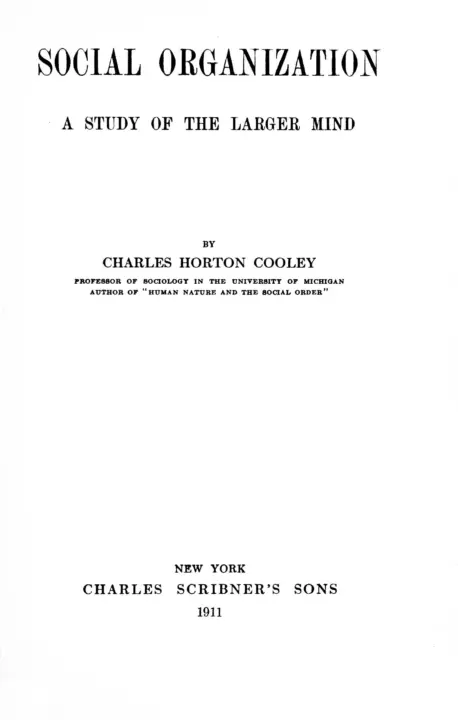
Charles Horton Cooley
THE CLASSIC COLLECTION · 1902
"Human Nature and the Social Order" by Charles Horton Cooley is a sociological treatise written in the early 20th century. The work interrogates the intricate relationship between individuals and society, aiming to dispel the common notion of their opposition, illustrating instead that they are interconnected components of the same reality. Cooley emphasizes the fundamental unity of human life, arguing that individuals cannot be fully understood without acknowledging their social contexts. At the start of the book, Cooley outlines his perspective on the relationship between society and the individual, positing that both are perspectives on a singular phenomenon. He critiques the fallacy of viewing them as separate or opposing forces, insisting that this misunderstanding arises from human perception rather than core realities. Through various examples, he illustrates how societal structures shape individual behaviors, and conversely, how individuals collectively influence the broader social order, setting the stage for a deeper exploration of themes such as choice, suggestion, and the role of personal ideas within social contexts in later chapters.
Introduction adapted from the source catalogue; source summaries may be automatically generated.
Free to read · English · 106,897 words · No account needed
MAKE TIME FOR A GOOD BOOK
On by default. Untick to stop anonymous reading totals. Each page counts after 10 seconds in view. How this works.
Anonymous counting is on unless you have switched it off.
The substitution of higher forms of control for lower, the offering more alternatives and trusting the mind to make a right selection, involves, of course, an increased moral strain upon individuals. Now this increase of moral strain is not in all cases exactly proportioned to the ability to bear it well; and when it is not well borne the effect upon character is more or less destructive, so that something in the way of degeneracy results.
Consequently every general increase of freedom is accompanied by some degeneracy, attributable to the same causes as the freedom. This is very plainly to be seen at the present time, which is one, on the whole, of rapid increase of freedom. Family life and the condition of women and children have been growing freer and better, but along with this we have the increase of divorce and of spoiled children. Democracy in the state has its own peculiar evils, as we all know; and in the church the decay of dogmatism and unreasoning faith, a moral advance on the whole, has nevertheless caused a good many moral failures. In much the same way the enfranchisement of the negroes is believed to have caused an increase of insanity among them, and the growth of suicide in all countries seems to be due in part to the strain of a more complex society. It is not true, exactly, that freedom itself causes degeneracy, because if one is subjected to more strain than is good for him his real freedom is rather contracted than enlarged, but it should rather be said that any movement which has increase of freedom for its general effect can never be so regulated as to have only this effect, but is sure to act upon some in an opposite manner.
Nor is it reasonable to sit back and say that this incidental demoralization is inevitable, a fixed price of progress. On the contrary, although it can never be altogether dispensed with, it can be indefinitely reduced, and every social institution or influence that tends to adapt the stress of civilization to the strength of the individual does reduce it in some measure.
Adolescence, the self in, 169
Affectation, 173 ff, 320
Altruism, 4, 90;
in relation to egoism, 92 ff, 115, 188 ff, 344 ff
Ambition, 275 f
Americanism, unconscious, 36
Anger, development of, 232 ff;
animal, 240
Anglo-Saxons, cantankerousness of, 268;
idealism of, 288
Antipathy, 233 ff
Appreciation, necessary to production, 59
Art, creative impulse in, 57;
personal symbols in, 71 ff;
mental life a work of, 123 f;
plastic, mystery in, 316 f;
as idealization, 363
Ascendency, personal, 283–325
Asceticism, 154, 223
Augustine, St., 218
Aurelius, Marcus, on freedom of thought, 35;
self-feeling of, 218
Author, an, as leader, 303 ff
Authority, personal, in morals, 353 ff, 384. See also Leadership
Baldwin, Prof. J. M., 15;
on social persons, 90; 176, 271, 286
Bastien-Lepage, 355
Your reading position is saved on this browser. Take it to another device with a library code. Reading pages adapt to text, rather than matching a printed edition.
Charles Horton Cooley
Charles Horton Cooley
BEHIND THE BOOK
This eBook is for the use of anyone anywhere in the United States and most other parts of the world at no cost and with almost no restrictions whatsoever. You may copy it, give it away or re-use it under the terms of the Project Gutenberg License included with this eBook or online at www.gutenberg.org. If you are not located in the United States, you will have to check the laws of the country where you are located before using this eBook. Read the source licence.
The original source file, including credits and licence, is retained by this library. Request an original-format copy at no charge. Please include the book title and Project Gutenberg identifier #75145.
KEEP YOUR CURIOSITY GOING

Charles G. (Charles Griffith) Ross
Hannah Webster Foster

Emily Lawless
Edwin Hamlin Carr

Charles De Lano Hine
Andrew Ure