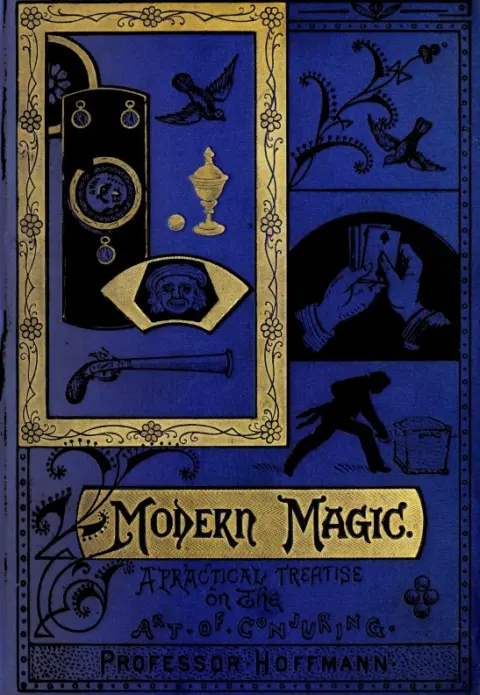
Modern Magic: A Practical Treatise on the Art of Conjuring
Professor Hoffmann
THE CLASSIC COLLECTION · 1907
"Hoyle's Games Modernized" by Professor Hoffmann and Edmond Hoyle is a comprehensive collection of card games and their rules, written in the early 20th century. This volume serves as a revised and updated follow-up to the original works of Edmond Hoyle, who laid down initial formal rules for various card games in the 18th century. The book covers a wide array of games including classic favorites like Whist, Cribbage, and Poker, as well as newer games such as Auction Bridge. It aims to both preserve Hoyle's teachings and provide modern players with clear, updated instructions. The opening of the book offers a brief history of Edmond Hoyle and the evolution of his gaming publications, highlighting the significance of his contributions to card play standards. It explains his transition from private lessons to published works, encapsulating the context in which his methodologies became widely accepted. The introduction sets up the actual content of the book, which includes detailed rules and strategies for various games, along with tips for improving play. The reader is invited to explore the structure and objectives of each game, making it an accessible guide for both novices and seasoned players looking to enhance their gaming experience.
Introduction adapted from the source catalogue; source summaries may be automatically generated.
Free to read · English · 116,848 words · No account needed
MAKE TIME FOR A GOOD BOOK
On by default. Untick to stop anonymous reading totals. Each page counts after 10 seconds in view. How this works.
Anonymous counting is on unless you have switched it off.
In some circles, after the cards are cut, the dealer is allowed to look at the bottom card, and if such card prove to be an ace or tenth card, he also looks at the top card. If the two form a "natural," he is entitled to receive double the minimum stake all round.
This privilege is known as the brulet, from the fact that it is dependent on the nature of the bottom card, which is always, in the French phrase, brule (literally, "burnt") i.e. thrown aside when reached in the course of the deal, and not dealt to any player.
The brulet has never been recognised as an essential part of the game, and is now generally abandoned.
[45] Some players risk the maximum stake on a seven, but we question the
expediency of doing so.
[46] This amount is the same as is paid for an ordinary Vingt-Un, i.e. one made with more than two cards. Sometimes, by agreement, a "natural" receives double the amount of an ordinary.
[47] Many players habitually stand at fifteen, and if the dealer is a reckless player, with a tendency to overdraw, it may be good policy to stand upon an even smaller figure. "Cavendish" is in favour of standing, as a rule, on fifteen.
[48] Pronounced like pony.
[49] Example. A three, two sixes, and a knave are drawn. The two sixes draw again, and the lower plays with the three. Suppose, at the second draw, the two sixes draw a king and a queen, the queen plays with the three.
If at the second draw, a lower card than the three is drawn, the three still retains its privileges as original low, and has the deal and choice of cards and seats.
[50] Example. Three aces and a two are drawn. The three aces draw again. The two is the original high, and plays with the highest of the next draw.
Suppose, at the second draw, two more twos and a king are drawn. The king plays with the original two, and the other pair of twos draw again for deal.
Suppose, instead, the second draw to consist of an ace and two knaves. The two knaves draw again, and the higher plays with the two.
[51] Vide Law 26.
[52] Vide Law 29.
[53] After the two packets have been re-united, Law 30 comes into
operation.
[54] Vide also Laws 36 and 41.
[55] Vide also Law 28.
[56] The pack being perfect. Vide Law 41.
[57] Except as provided in Law 36.
[58] It is not usual to call the trump card if left on the table.
[59] Vide Law 75.
[60] E.g., If a single is scored by mistake for a double or treble, or
vice versa.
[61] Vide also Law 40.
[62] Vide Law 81.
Your reading position is saved on this browser. Take it to another device with a library code. Reading pages adapt to text, rather than matching a printed edition.
Professor Hoffmann
Professor Hoffmann
BEHIND THE BOOK
This eBook is for the use of anyone anywhere in the United States and most other parts of the world at no cost and with almost no restrictions whatsoever. You may copy it, give it away or re-use it under the terms of the Project Gutenberg License included with this eBook or online at www.gutenberg.org. If you are not located in the United States, you will have to check the laws of the country where you are located before using this eBook. Read the source licence.
The original source file, including credits and licence, is retained by this library. Request an original-format copy at no charge. Please include the book title and Project Gutenberg identifier #39445.
KEEP YOUR CURIOSITY GOING

Charles G. (Charles Griffith) Ross
Hannah Webster Foster

Emily Lawless
Edwin Hamlin Carr

Charles De Lano Hine
Andrew Ure