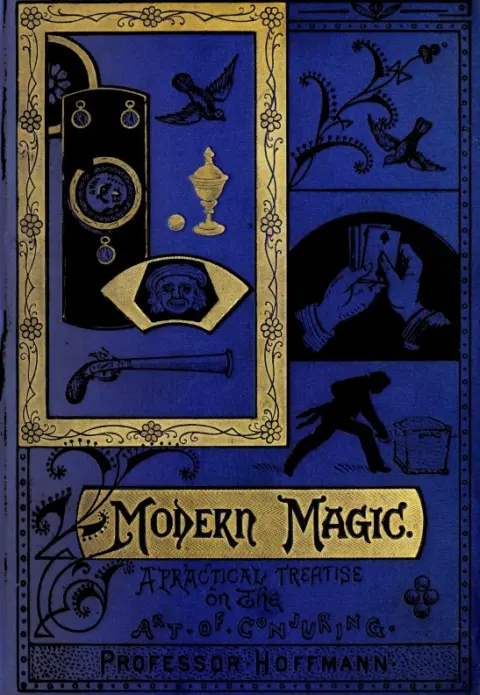
Modern Magic: A Practical Treatise on the Art of Conjuring
Professor Hoffmann
THE CLASSIC COLLECTION · 1907
"Hoyle's Games Modernized" by Professor Hoffmann and Edmond Hoyle is a comprehensive collection of card games and their rules, written in the early 20th century. This volume serves as a revised and updated follow-up to the original works of Edmond Hoyle, who laid down initial formal rules for various card games in the 18th century. The book covers a wide array of games including classic favorites like Whist, Cribbage, and Poker, as well as newer games such as Auction Bridge. It aims to both preserve Hoyle's teachings and provide modern players with clear, updated instructions. The opening of the book offers a brief history of Edmond Hoyle and the evolution of his gaming publications, highlighting the significance of his contributions to card play standards. It explains his transition from private lessons to published works, encapsulating the context in which his methodologies became widely accepted. The introduction sets up the actual content of the book, which includes detailed rules and strategies for various games, along with tips for improving play. The reader is invited to explore the structure and objectives of each game, making it an accessible guide for both novices and seasoned players looking to enhance their gaming experience.
Introduction adapted from the source catalogue; source summaries may be automatically generated.
Free to read · English · 116,848 words · No account needed
MAKE TIME FOR A GOOD BOOK
On by default. Untick to stop anonymous reading totals. Each page counts after 10 seconds in view. How this works.
Anonymous counting is on unless you have switched it off.
[30] The words between brackets apply of course to three-card loo. Sometimes the dealer is allowed, after dealing one card to each player, to deal three together for a miss, but the practice is irregular.
At five-card Loo the Ecarte method of dealing (first by threes, and then by twos, or vice versa) is sometimes adopted.
[31] For an instructive series of illustrative hands at Napoleon, see the Book of Card and Table Games.
[32] A having made seven out of twelve.
[33] See in particular the excellent treatise on the game by "Cavendish," published by Messrs. De La Rue & Co.
[34] For the authorised Laws of the Game, in its modern form, see The Book of Card and Table Games, or the treatise of "Cavendish" before mentioned.
[35] As the game is sometimes played, the dealer, and not the Age, puts up the ante, but the contrary is the more usual practice.
[36] This being a compulsory stake on an unknown hand, it is prudent to make it as small as possible.
[37] The Age, as a rule, goes in, even with poor cards; if he passes, he is bound to lose the half stake already put up, and it is, therefore, generally worth his while to risk the other half.
[38] Should B have already thrown up his cards, the privilege does not pass to C. There is a maxim on this point, "The Age never passes."
[39] Some players on a second round only allow the jack-pot to be opened by a pair of queens, or better; on a third, only by a pair of kings, or better; and on a fourth, only by a pair of aces, or better; but the practice is not recommended.
No player, even though holding the needful cards, is bound to open the jack-pot unless he pleases.
[40] Strictly speaking, each dealer in rotation should himself dress the board, but it will be found more convenient to depute some one player to do so throughout the game.
[41] By some players the dealer is allowed the privilege of looking at the extra cards (sometimes, but incorrectly, themselves spoken of as "the stops"), and to act as a kind of referee as to whether a given card is a stop or otherwise, but the practice is not recommended.
[42] The Misere is now introduced into Napoleon. See p. 96.
[43] For more minute information, and for a number of illustrative hands, see The Book of Card and Table Games.
[44] The right to deal is usually decided by a preliminary deal of faced cards, the first ace, or first knave, as may be agreed, having the preference.
Your reading position is saved on this browser. Take it to another device with a library code. Reading pages adapt to text, rather than matching a printed edition.
Professor Hoffmann
Professor Hoffmann
BEHIND THE BOOK
This eBook is for the use of anyone anywhere in the United States and most other parts of the world at no cost and with almost no restrictions whatsoever. You may copy it, give it away or re-use it under the terms of the Project Gutenberg License included with this eBook or online at www.gutenberg.org. If you are not located in the United States, you will have to check the laws of the country where you are located before using this eBook. Read the source licence.
The original source file, including credits and licence, is retained by this library. Request an original-format copy at no charge. Please include the book title and Project Gutenberg identifier #39445.
KEEP YOUR CURIOSITY GOING

Charles G. (Charles Griffith) Ross
Hannah Webster Foster

Emily Lawless
Edwin Hamlin Carr

Charles De Lano Hine
Andrew Ure