
The Writing of News A Handbook with Chapters on Newspaper Correspondence and Copy Reading
Charles G. (Charles Griffith) Ross
THE CLASSIC COLLECTION · 1898
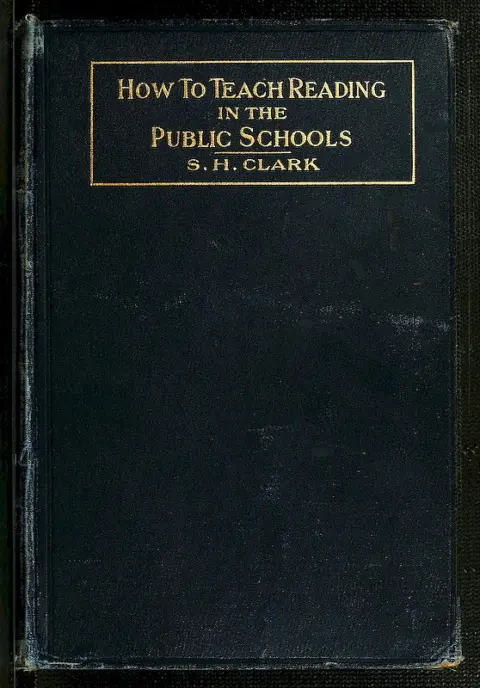
"How to Teach Reading in the Public Schools" by S. H. Clark is an instructional manual aimed at educators, written in the late 19th century. This work provides insights and methodologies for teaching reading effectively in public schools, stressing the importance of understanding vocal expression and its various components. The book appears to focus on improving both the teachers’ and students’ abilities to extract meaning from text, thereby elevating the standard of reading instruction. The opening of this manual establishes its purpose by addressing the inadequacies of reading education in public schools. The author outlines common remedial approaches, such as mechanical methods of teaching vocal expression and comprehension techniques, explaining why they often fall short in fostering a true understanding of literature. Clark emphasizes the need for teachers to appreciate great literature, to understand the psychology behind vocal expression, and to implement a structured, methodical approach to instruction that prioritizes clarity and comprehension, rather than rote learning.
Introduction adapted from the source catalogue; source summaries may be automatically generated.
Free to read · English · 80,383 words · No account needed
MAKE TIME FOR A GOOD BOOK
On by default. Untick to stop anonymous reading totals. Each page counts after 10 seconds in view. How this works.
Anonymous counting is on unless you have switched it off.
Most of all, fellow-citizens, if your sons ask whose example they shall imitate, what will you say? For you know well it is not music, nor the gymnasiums, nor the schools, that mold young men; it is much more the public proclamations, the public example. If you take one whose life has no high purpose, one who mocks at morals, and crown him in the theater, every boy who sees it is corrupted. When a bad man suffers his deserts, the people learn; on the contrary, when a man VOTES AGAINST WHAT IS NOBLE AND JUST, and then comes home to teach his son, the boy will very promptly say, “Your lesson is impertinent and a bore.” Beware, therefore, Athenians, remembering posterity will rejudge your judgment, and that the character of a city is determined by the character of the men it crowns.
Right forever on the scaffold, Wrong forever on the throne; But that scaffold sways the future, and behind the dim unknown Standeth God within the shadow, keeping watch above his own.
Thou, too, sail on, O Ship of State!
Sail on, O UNION, strong and great!
Humanity, with all its fears,
With all the hopes of future years
Is hanging breathless on thy fate!
We know what Master laid thy keel,
What workmen wrought thy ribs of steel,
Who made each mast, and sail, and rope,
What anvils rang, what hammers beat,
In what a forge, and what a heat,
Were shaped the anchors of thy hope!
Fear not each sudden sound and shock;
’Tis of the wave, and not the rock;
’Tis but the flapping of the sail,
And not a rent made by the gale!
In spite of rock and tempest’s roar,
In spite of false lights on the shore,
Sail on, nor fear to breast the sea!
Our hearts, our hopes, are all with thee:
Our hearts, our hopes, our prayers, our tears,
Our faith triumphant o’er our fears,
Are all with thee,--are all with thee!
--The Ship of State. LONGFELLOW.
See what a grace was seated on this brow;
Hyperion’s curls; the front of Jove himself;
An eye like Mars, to threaten and command;
A station like the herald Mercury
New-lighted on a heaven-kissing hill;
A combination and a form indeed,
Where every god did seem to set his seal,
To give the world assurance of a man.
--Hamlet, Act iii., Sc. 4.
Awake, my soul! Not only passive praise
Thou owest; not alone these swelling tears,
Mute thanks, and secret ecstasy. Awake,
Voice of sweet song! Awake my heart, Awake!
Green vales and icy cliffs, all join my hymn!
Your reading position is saved on this browser. Take it to another device with a library code. Reading pages adapt to text, rather than matching a printed edition.
BEHIND THE BOOK
This eBook is for the use of anyone anywhere in the United States and most other parts of the world at no cost and with almost no restrictions whatsoever. You may copy it, give it away or re-use it under the terms of the Project Gutenberg License included with this eBook or online at www.gutenberg.org. If you are not located in the United States, you will have to check the laws of the country where you are located before using this eBook. Read the source licence.
The original source file, including credits and licence, is retained by this library. Request an original-format copy at no charge. Please include the book title and Project Gutenberg identifier #61727.
KEEP YOUR CURIOSITY GOING
Charles G. (Charles Griffith) Ross
Hannah Webster Foster

Emily Lawless
Edwin Hamlin Carr

Charles De Lano Hine
Andrew Ure