
The Writing of News A Handbook with Chapters on Newspaper Correspondence and Copy Reading
Charles G. (Charles Griffith) Ross
THE CLASSIC COLLECTION · 1898
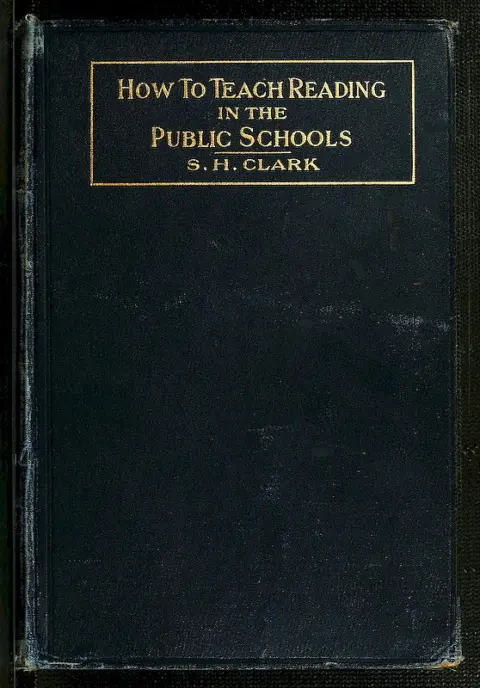
"How to Teach Reading in the Public Schools" by S. H. Clark is an instructional manual aimed at educators, written in the late 19th century. This work provides insights and methodologies for teaching reading effectively in public schools, stressing the importance of understanding vocal expression and its various components. The book appears to focus on improving both the teachers’ and students’ abilities to extract meaning from text, thereby elevating the standard of reading instruction. The opening of this manual establishes its purpose by addressing the inadequacies of reading education in public schools. The author outlines common remedial approaches, such as mechanical methods of teaching vocal expression and comprehension techniques, explaining why they often fall short in fostering a true understanding of literature. Clark emphasizes the need for teachers to appreciate great literature, to understand the psychology behind vocal expression, and to implement a structured, methodical approach to instruction that prioritizes clarity and comprehension, rather than rote learning.
Introduction adapted from the source catalogue; source summaries may be automatically generated.
Free to read · English · 80,383 words · No account needed
MAKE TIME FOR A GOOD BOOK
On by default. Untick to stop anonymous reading totals. Each page counts after 10 seconds in view. How this works.
Anonymous counting is on unless you have switched it off.
The purpose of the following drills is not to train the student in the manner of making inflections, but rather to impress upon his mind the fact that rhetorically a sentence may be complete even though the point of completion be not marked by a full stop. In other words, the drill is one in mental, rather than vocal, technique.
The student must determine the purpose in every case, and then trust his voice to manifest that purpose.
Hence! home,[4] you idle creatures, get you home.
Speak, what trade art thou?
Where is thy leather apron, and thy rule?
You blocks, you stones, you worse than senseless things.
Many a time and oft
Have you climb’d up to walls and battlements,
To towers and windows, yea, to chimney-tops.
Your infants in your arms, and there have sat
To see great Pompey pass the streets of Rome.
Be gone!
Run to your houses, fall upon your knees,
Pray to the gods to intermit the plague
That needs must light on this ingratitude.
Then, Brutus, I have much mistook your passion; By means whereof this breast of mine hath buried Thoughts of great value, worthy cogitations.
I was born free as Caesar, so were you;
We both have fed as well, and we can both
Endure the winter’s cold as well as he.
His coward lips did from their color fly,
And that same eye whose bend doth awe the world
Did lose his lustre.
Ye gods, it doth amaze me,
A man of such a feeble temper should
... bear the palm alone.
Why, man, he doth bestride the narrow world
Like a Colossus, and we petty men
Walk under his huge legs and peep about
To find ourselves dishonorable graves.
Let me have men about me that are fat, Sleek-headed men, and such as sleep o’ nights.
Seldom he smiles, and smiles in such a sort,
As if he mocked himself.
Such men as he be never at heart’s ease
Whiles they behold a greater than themselves,
And therefore are they very dangerous.
Come on my right hand, for this ear is deaf, And tell me truly what thou think’st of him.
Why, there was a crown offered him; and, being offered him, he put it by with the back of his hand, thus.
I can as well be hanged as tell the manner of it; it was mere
foolery, I did not mark it.
You look pale, and gaze,
And put on fear, and case yourself in wonder,
To see the strange impatience of the heavens.
Stand close awhile, for here comes one in haste.
How that might change his nature, there’s the question.
Your reading position is saved on this browser. Take it to another device with a library code. Reading pages adapt to text, rather than matching a printed edition.
BEHIND THE BOOK
This eBook is for the use of anyone anywhere in the United States and most other parts of the world at no cost and with almost no restrictions whatsoever. You may copy it, give it away or re-use it under the terms of the Project Gutenberg License included with this eBook or online at www.gutenberg.org. If you are not located in the United States, you will have to check the laws of the country where you are located before using this eBook. Read the source licence.
The original source file, including credits and licence, is retained by this library. Request an original-format copy at no charge. Please include the book title and Project Gutenberg identifier #61727.
KEEP YOUR CURIOSITY GOING
Charles G. (Charles Griffith) Ross
Hannah Webster Foster

Emily Lawless
Edwin Hamlin Carr

Charles De Lano Hine
Andrew Ure