
The Writing of News A Handbook with Chapters on Newspaper Correspondence and Copy Reading
Charles G. (Charles Griffith) Ross
THE CLASSIC COLLECTION · 1898
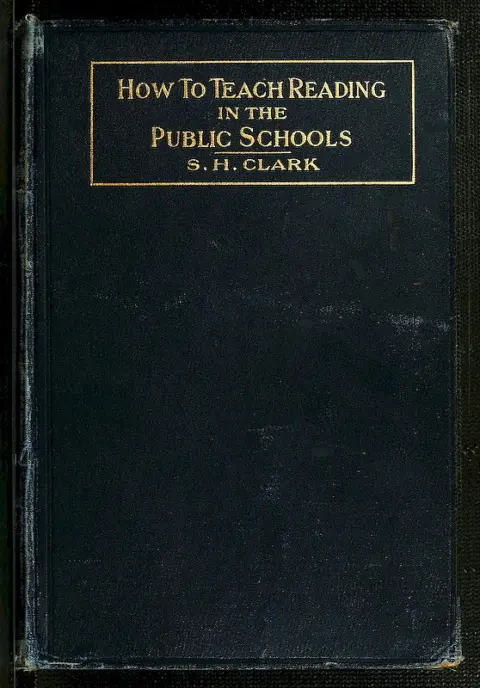
"How to Teach Reading in the Public Schools" by S. H. Clark is an instructional manual aimed at educators, written in the late 19th century. This work provides insights and methodologies for teaching reading effectively in public schools, stressing the importance of understanding vocal expression and its various components. The book appears to focus on improving both the teachers’ and students’ abilities to extract meaning from text, thereby elevating the standard of reading instruction. The opening of this manual establishes its purpose by addressing the inadequacies of reading education in public schools. The author outlines common remedial approaches, such as mechanical methods of teaching vocal expression and comprehension techniques, explaining why they often fall short in fostering a true understanding of literature. Clark emphasizes the need for teachers to appreciate great literature, to understand the psychology behind vocal expression, and to implement a structured, methodical approach to instruction that prioritizes clarity and comprehension, rather than rote learning.
Introduction adapted from the source catalogue; source summaries may be automatically generated.
Free to read · English · 80,383 words · No account needed
MAKE TIME FOR A GOOD BOOK
On by default. Untick to stop anonymous reading totals. Each page counts after 10 seconds in view. How this works.
Anonymous counting is on unless you have switched it off.
--The Vision of Sir Launfal. LOWELL.
It is but a legend, I know,--
A fable, a phantom, a show,
Of the ancient Rabbinical lore;
Yet the old mediæval tradition,
The beautiful, strange superstition,
But haunts me and holds me the more.
When I look from my window at night,
And the welkin above is all white,
All throbbing and panting with stars,
Among them majestic is standing
Sandalphon the angel, expanding
His pinions in nebulous bars.
And the legend, I feel, is a part
Of the hunger and thirst of the heart,
The frenzy and fire of the brain,
That grasps at the fruitage forbidden,
The golden pomegranates of Eden,
To quiet its fever and pain.
--Sandalphon. LONGFELLOW.
I had a dream, which was not all a dream. The bright sun was extinguished; and the stars Did wander darkling in the eternal space, Rayless, and pathless; and the icy earth Swung blind and blackening in the moonless air; Morn came, and went,--and came, and brought no day.
The world was void; The populous and the powerful was a lump,-- Seasonless, herbless, treeless, manless, lifeless,-- A lump of death--a chaos of hard clay. The rivers, lakes, and ocean, all stood still; And nothing stirred within their silent depths: Ships, sailorless, lay rotting on the sea; And their masts fell down piecemeal: as they dropped, They slept on the abyss without a surge;-- The waves were dead; the tides were in their grave; The moon, their mistress, had expired before; The winds were withered in the stagnant air; And the clouds perished: Darkness had no need Of aid from them, She--was the universe.
--Darkness. BYRON.
A fool, a fool!--I met a fool i’ th’ forest, A motley fool;--a miserable world!-- As I do live by food, I met a fool; Who laid him down, and bask’d him in the sun, And rail’d on lady Fortune in good terms, In good set terms,--and yet a motley fool. “Good morrow, fool,” quoth I; “No, sir,” quoth he, “Call me not fool, till heav’n hath sent me fortune;” And then he drew a dial from his poke: And looking on it with lack-lustre eye, Says, very wisely, “It is ten o’clock; Thus may we see,” quoth he, “how the world wags; ’Tis but an hour ago, since it was nine; And after one hour more ’twill be eleven; And so, from hour to hour, we ripe and ripe, And then, from hour to hour, we rot and rot, And thereby hangs a tale.” When I did hear The motley fool thus moral on the time, My lungs began to crow like chanticleer, That fools should be so deep contemplative. And I did laugh, sans intermission An hour by his dial. O noble fool! A worthy fool! Motley’s the only wear.
Your reading position is saved on this browser. Take it to another device with a library code. Reading pages adapt to text, rather than matching a printed edition.
BEHIND THE BOOK
This eBook is for the use of anyone anywhere in the United States and most other parts of the world at no cost and with almost no restrictions whatsoever. You may copy it, give it away or re-use it under the terms of the Project Gutenberg License included with this eBook or online at www.gutenberg.org. If you are not located in the United States, you will have to check the laws of the country where you are located before using this eBook. Read the source licence.
The original source file, including credits and licence, is retained by this library. Request an original-format copy at no charge. Please include the book title and Project Gutenberg identifier #61727.
KEEP YOUR CURIOSITY GOING
Charles G. (Charles Griffith) Ross
Hannah Webster Foster

Emily Lawless
Edwin Hamlin Carr

Charles De Lano Hine
Andrew Ure