
The Writing of News A Handbook with Chapters on Newspaper Correspondence and Copy Reading
Charles G. (Charles Griffith) Ross
THE CLASSIC COLLECTION · 1898
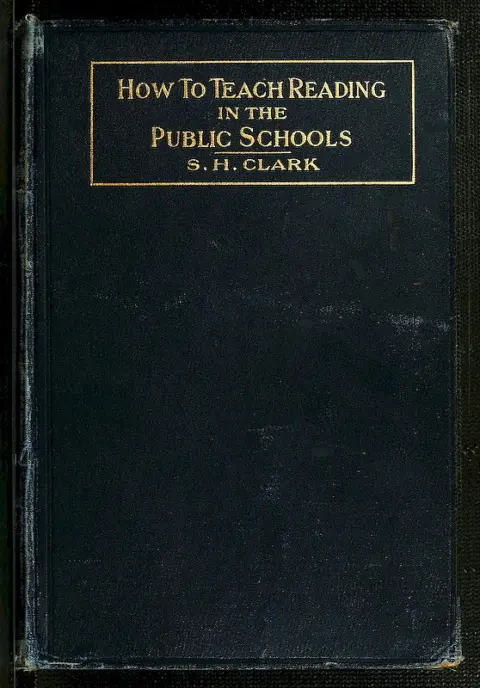
"How to Teach Reading in the Public Schools" by S. H. Clark is an instructional manual aimed at educators, written in the late 19th century. This work provides insights and methodologies for teaching reading effectively in public schools, stressing the importance of understanding vocal expression and its various components. The book appears to focus on improving both the teachers’ and students’ abilities to extract meaning from text, thereby elevating the standard of reading instruction. The opening of this manual establishes its purpose by addressing the inadequacies of reading education in public schools. The author outlines common remedial approaches, such as mechanical methods of teaching vocal expression and comprehension techniques, explaining why they often fall short in fostering a true understanding of literature. Clark emphasizes the need for teachers to appreciate great literature, to understand the psychology behind vocal expression, and to implement a structured, methodical approach to instruction that prioritizes clarity and comprehension, rather than rote learning.
Introduction adapted from the source catalogue; source summaries may be automatically generated.
Free to read · English · 80,383 words · No account needed
MAKE TIME FOR A GOOD BOOK
On by default. Untick to stop anonymous reading totals. Each page counts after 10 seconds in view. How this works.
Anonymous counting is on unless you have switched it off.
In his early manhood, at the bidding of conscience, against the advice of his dearest friends, in opposition to stern paternal commands, against every dictate of worldly wisdom and human prudence, in spite of all the dazzling temptations of ambition so alluring to the heart of a young man, he turned away from the broad fair highway to wealth, position, and distinction, that the hands of a king opened before him, and, casting his lot with the sect weakest and most unpopular in England, through paths that were tangled with trouble, and lined with pitiless thorns of persecution, he walked into honor and fame, and the reverence of the world, such as royalty could not promise and could not give him.
No one venerates the Peerage more than I do; but, my Lords, I must say that the Peerage solicited me,--not I the Peerage. Nay, more,--I can say, and will say, that, as a Peer of Parliament, as Speaker of this right honorable House, as keeper of the great seal, as guardian of his Majesty’s conscience, as Lord High Chancellor of England,--nay, even in that character alone in which the noble Duke would think it an affront to be considered, but which character none can deny me, as a MAN,--I am at this moment as respectable--I beg leave to add--I am as much respected,--as the proudest Peer I now look down upon.
Fresh as the flower, whose modest worth
He sang, his genius “glinted” forth,
Rose like a star that touching earth,
For so it seems,
Doth glorify its humble birth
With matchless beams.
The piercing eye, the thoughtful brow,
The struggling heart, where be they now?
Full soon the aspirant of the plow,
The prompt, the brave,
Slept, with the obscurest, in the low
And silent grave.
True friends though diversely inclined;
But heart with heart and mind with mind,
Where the main fibers are entwined,
Through Nature’s skill,
May even by contraries be joined
More closely still.
Sighing I turned away; but ere
Night fell, I heard, or seemed to hear,
Music that sorrow comes not near,
A ritual hymn,
Chanted in love that casts out fear
By Seraphim.
Too frail to keep the lofty vow
That must have followed when his brow
Was wreathed--“The Vision” tells us how--
With holly spray,
He faltered, drifted to and fro,
And passed away.
The five preceding stanzas are from Wordsworth’s poem, At the
Grave of Burns.
Your reading position is saved on this browser. Take it to another device with a library code. Reading pages adapt to text, rather than matching a printed edition.
BEHIND THE BOOK
This eBook is for the use of anyone anywhere in the United States and most other parts of the world at no cost and with almost no restrictions whatsoever. You may copy it, give it away or re-use it under the terms of the Project Gutenberg License included with this eBook or online at www.gutenberg.org. If you are not located in the United States, you will have to check the laws of the country where you are located before using this eBook. Read the source licence.
The original source file, including credits and licence, is retained by this library. Request an original-format copy at no charge. Please include the book title and Project Gutenberg identifier #61727.
KEEP YOUR CURIOSITY GOING
Charles G. (Charles Griffith) Ross
Hannah Webster Foster

Emily Lawless
Edwin Hamlin Carr

Charles De Lano Hine
Andrew Ure