
How They Succeeded: Life Stories of Successful Men Told by Themselves
Orison Swett Marden
THE CLASSIC COLLECTION · 1896
"How to Succeed; Or, Stepping-Stones to Fame and Fortune" by Orison Swett Marden is a motivational guide to personal success written in the late 19th century. The book emphasizes the importance of character, determination, and the ability to seize opportunities to achieve fame and fortune. Marden serves as a mentor to readers, providing insights and advice on how to become a competent and self-reliant individual. At the start of the book, Marden calls for readers to recognize their own potential and the necessity of being a "man" in character and action. He cites various historical figures and provides anecdotes illustrating the value of hard work, perseverance, and self-improvement. He also critiques the superficiality in society and stresses the importance of developing individual talents and taking initiative in the pursuit of success. The introductory chapters set a foundation for the reader's journey, exploring themes of opportunity, personal growth, and the mindset needed to navigate the challenges of life.
Introduction adapted from the source catalogue; source summaries may be automatically generated.
Free to read · English · 75,386 words · No account needed
MAKE TIME FOR A GOOD BOOK
On by default. Untick to stop anonymous reading totals. Each page counts after 10 seconds in view. How this works.
Anonymous counting is on unless you have switched it off.
It is the live coal that kindles others, not the dead. What made Demosthenes the greatest of all orators was that he appeared the most entirely possessed by the feelings he wished to inspire. The effect produced by Charles Fox, who by the exaggerations of party spirit, was often compared to Demosthenes, seems to have arisen wholly from this earnestness, which made up for the want of almost every grace, both of manner and style. --ANON.
Twelve poor men taken out of boats and creeks, without any help
of learning, should conquer the world to the cross.
--STEPHEN CARNOCK.
For his heart was in his work, and the heart
Giveth grace unto every art.
--LONGFELLOW.
He did it with all his heart and prospered.
--II. CHRONICLES.
The only conclusive evidence of a man's sincerity is that he gives himself for a principle. Words, money, all things else are comparatively easy to give away; but when a man makes a gift of his daily life and practice, it is plain that the truth, whatever it may be, has taken possession of him. --LOWELL.
"The emotions," says Whipple, "may all be included in the single word 'enthusiasm,' or that impulsive force which liberates the mental power from the ice of timidity as spring loosens the streams from the grasp of winter, and sends them forth in a rejoicing rush. The mind of youth, when impelled by this original strength and enthusiasm of Nature, is keen, eager, inquisitive, intense, audacious, rapidly assimilating facts into faculties and knowledge into power, and above all teeming with that joyous fullness of creative life which radiates thoughts as inspirations, and magnetizes as well as informs."
"Columbus, my hero," exclaims Carlyle, "royalist sea-king of all! It is no friendly environment this of thine, in the waste, deep waters; around thee mutinous discouraged souls, behind thee disgrace and ruin, before thee the unpenetrated veil of night. Brother, these wild water-mountains, bounding from their deep bases (ten miles deep, I am told), are not there on thy behalf! Meseems they have other work than floating thee forward:--and the huge winds, that sweep from Ursa Major to the tropics and equator, dancing their giant-waltz through the kingdoms of chaos and immensity, they care little about filling rightly or filling wrongly the small shoulder-of-mutton sails in this cockle skiff of thine! Thou art not among articulate-speaking friends, my brother; thou art among immeasurable dumb monsters, tumbling, howling wide as the world here. Secret, far-off, invisible to all hearts but thine, there lies a help in them: see how thou wilt get at that. Patiently thou wilt wait till the mad southwester spend itself, saving thyself by dexterous science of defence the while: valiantly, with swift decision, wilt thou strike in, when the favoring east wind, the possible, springs up. Mutiny of men thou wilt sternly repress; weakness, despondency, thou wilt cheerily encourage: thou wilt swallow down complaint, unreason, weariness, weakness of others and thyself;--how much wilt thou swallow down? There shall be a depth of silence in thee, deeper than this sea, which is but ten miles deep: a silence unsoundable; known to God only. Thou shalt be a great man. Yes, my world-soldier, thou of the world marine-service,--thou wilt have to be greater than this tumultuous unmeasured world here round thee is: thou, in thy strong soul, as with wrestler's arms, shall embrace it, harness it down; and make it bear thee on,--to new Americas, or whither God wills!"
Your reading position is saved on this browser. Take it to another device with a library code. Reading pages adapt to text, rather than matching a printed edition.
Orison Swett Marden

Orison Swett Marden
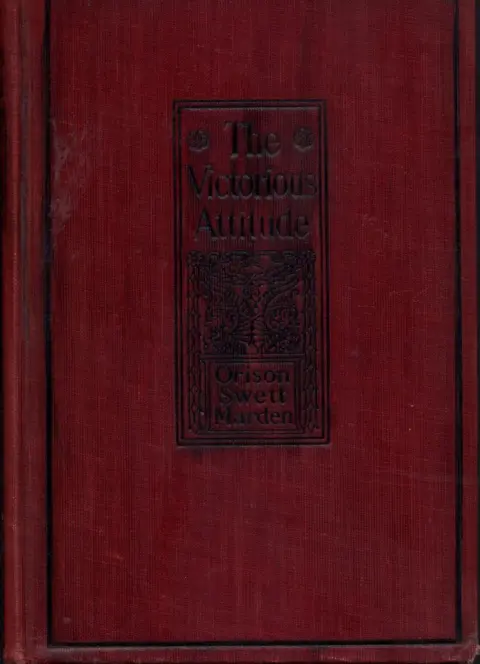
Orison Swett Marden
Orison Swett Marden
BEHIND THE BOOK
This eBook is for the use of anyone anywhere in the United States and most other parts of the world at no cost and with almost no restrictions whatsoever. You may copy it, give it away or re-use it under the terms of the Project Gutenberg License included with this eBook or online at www.gutenberg.org. If you are not located in the United States, you will have to check the laws of the country where you are located before using this eBook. Read the source licence.
The original source file, including credits and licence, is retained by this library. Request an original-format copy at no charge. Please include the book title and Project Gutenberg identifier #20513.
KEEP YOUR CURIOSITY GOING

Charles G. (Charles Griffith) Ross
Hannah Webster Foster

Emily Lawless
Edwin Hamlin Carr

Charles De Lano Hine
Andrew Ure