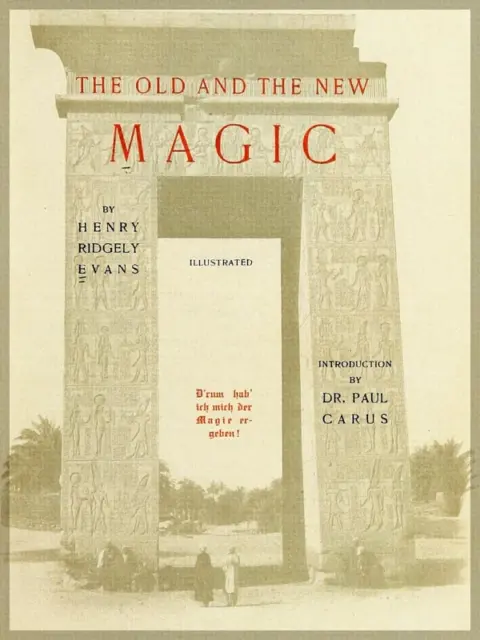
The Old and the New Magic
Henry Ridgely Evans
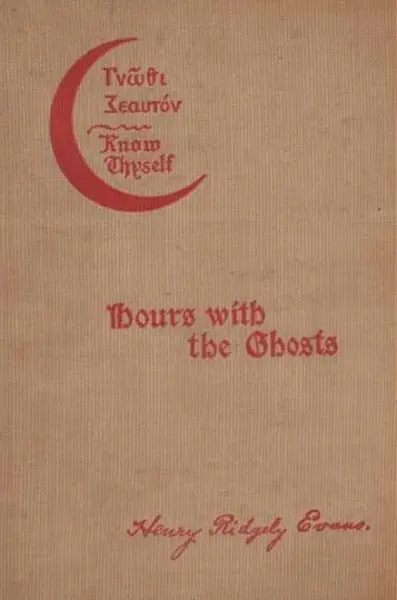
THE CLASSIC COLLECTION · 1897
"Hours with the Ghosts; Or Nineteenth Century Witchcraft" by Henry Ridgely Evans is an illustrated investigative work written in the late 19th century. The book delves into the phenomena of Spiritualism and Theosophy, exploring claims of spiritual communication, mediumship, and the various practices associated with these beliefs. Evans seems intent on providing a thorough examination of the practitioners and phenomena within these movements, critiquing their validity while also acknowledging their impact on society. The opening of the work sets the stage for a critical exploration of Spiritualism and Theosophy through a philosophical lens, pondering the age-old question of life after death. Evans draws upon historical references and personal observations, admitting his skepticism towards many supposedly supernatural events, particularly highlighting experiences with well-known mediums. He intends to dissect the phenomena associated with these practices, such as telepathy, table tilting, and spirit writing, suggesting that many of these can be explained through psychological or physical principles, rather than supernatural intervention.
Introduction adapted from the source catalogue; source summaries may be automatically generated.
Free to read · English · 53,105 words · No account needed
MAKE TIME FOR A GOOD BOOK
On by default. Untick to stop anonymous reading totals. Each page counts after 10 seconds in view. How this works.
Anonymous counting is on unless you have switched it off.
One of the most remarkable personalities serving as an exponent of Spiritualism was Daniel Dunglas Home, the Napoleon of necromancy, and the Past Grand Master of Mediums. His career reads like a romance. He lived in a sort of twilight land, and hob-nobbed with kings, queens and other people of noble blood.
"Something unsubstantial, ghostly,
Seems this Theurgist,
In deep meditation mostly
Wrapped, as in a mist.
Vague, phantasmal and unreal,
To our thoughts he seems,
Walking in a world ideal,
In a land of dreams."
He wound his serpentine way into the best society of London, Paris, Berlin, Rome, and St. Petersburg--"always despising filthy lucre," as Maskelyn remarks, "but never refusing a diamond worth ten times the amount he would have received in cash, or some present, which the host of the house at which he happened to be manifesting always felt constrained to offer."
This thaumaturgist of the Nineteenth Century was born near Edinburg, Scotland, on March 20, 1833, and came of a family reported to be gifted with "second sight." His father, William Home, was a natural son of Alexander, tenth Earl of Home. Strange phenomena occurred during the medium's childhood. At the age of nine he was adopted by his aunt, Mrs. McNeill Cook, who brought him to America. He began giving séances about the year 1852. Among the notable men who attended these early "sittings" were William Cullen Bryant, Professors Wells and Hare, and Judge Edmonds.
Home had a tall, slight figure, a fair and freckled face--before disease made it the color of yellow wax--keen, slaty-blue eyes, thin bloodless lips, a rather snub nose, and curly auburn hair. His manners, though forward, were agreeable, and he recited such poetry as Poe's "Raven" and "Ulalume" with powerful effect. He was altogether a weird sort of personage. His principal mediumistic manifestations were rappings, table-tipping, ghostly materializations, playing on sealed musical instruments, levitation, and handling fire with impunity.
In 1855 he launched his necromantic bark on European waters. No man since Cagliostro ever created so profound a sensation in the Old World. He wrote his reminiscences in two large volumes, but little credence can be given them, as they are full of extravagant statements and wild fantasies.
The London Punch (May 9th, 1868), printed the following effusion on the medium, a sort of parody on "Home, Sweet Home:"
Through realms Thaumaturgic the student may roam,
And not light on a worker of wonders like Home.
Cagliostro himself might descend from his chair,
And set up our Daniel as Grand-Cophta there--
Home, Home, Dan. Home,
No medium like Home.
Your reading position is saved on this browser. Take it to another device with a library code. Reading pages adapt to text, rather than matching a printed edition.
Henry Ridgely Evans
BEHIND THE BOOK
This eBook is for the use of anyone anywhere in the United States and most other parts of the world at no cost and with almost no restrictions whatsoever. You may copy it, give it away or re-use it under the terms of the Project Gutenberg License included with this eBook or online at www.gutenberg.org. If you are not located in the United States, you will have to check the laws of the country where you are located before using this eBook. Read the source licence.
The original source file, including credits and licence, is retained by this library. Request an original-format copy at no charge. Please include the book title and Project Gutenberg identifier #44349.
KEEP YOUR CURIOSITY GOING

David Patterson (Spirit) Hatch

David Patterson (Spirit) Hatch

David Patterson (Spirit) Hatch
Cécile Tormay

Moritz Busch
Coulson Kernahan