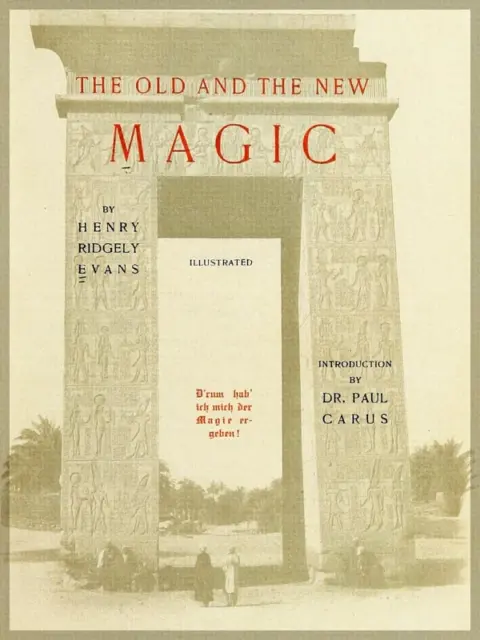
The Old and the New Magic
Henry Ridgely Evans
THE CLASSIC COLLECTION · 1897
"Hours with the Ghosts; Or Nineteenth Century Witchcraft" by Henry Ridgely Evans is an illustrated investigative work written in the late 19th century. The book delves into the phenomena of Spiritualism and Theosophy, exploring claims of spiritual communication, mediumship, and the various practices associated with these beliefs. Evans seems intent on providing a thorough examination of the practitioners and phenomena within these movements, critiquing their validity while also acknowledging their impact on society. The opening of the work sets the stage for a critical exploration of Spiritualism and Theosophy through a philosophical lens, pondering the age-old question of life after death. Evans draws upon historical references and personal observations, admitting his skepticism towards many supposedly supernatural events, particularly highlighting experiences with well-known mediums. He intends to dissect the phenomena associated with these practices, such as telepathy, table tilting, and spirit writing, suggesting that many of these can be explained through psychological or physical principles, rather than supernatural intervention.
Introduction adapted from the source catalogue; source summaries may be automatically generated.
Free to read · English · 53,105 words · No account needed
MAKE TIME FOR A GOOD BOOK
On by default. Untick to stop anonymous reading totals. Each page counts after 10 seconds in view. How this works.
Anonymous counting is on unless you have switched it off.
The author has had sittings with many famous mediums of this country and Europe, but has seen little to convince him of the fact of spirit communication. The slate tests and so-called materializations have invariably been frauds. Some experiments along the line of automatic writing and psychometry, however, have demonstrated to the writer the truth of telepathy or thought-transference. The theory of telepathy explains many of the marvels ascribed to spirit intervention in things mundane.
In this work the author has endeavored to give an accurate account of the lives and adventures of celebrated mediums and occultists, which will prove of interest to the reader. The rise and growth of the Theosophical cult in this country and Europe is of historical interest. Theosophy pretends to a deeper metaphysics than Spiritualism, and numbers its adherents by the thousands; it is, therefore, intensely interesting to study it in its origin, its founder and its present leaders.
"If a man die, shall he live again?"--this is the question of the ages, the Sphinx riddle that Humanity has been trying to solve since time began. The great minds of antiquity, Socrates, Pythagoras, Plato and Aristotle were firm in their belief in the immortality of the soul. The writings of Plato are luminous on the subject. The Mysteries of Isis and Osiris, as practiced in Egypt, and those of Eleusis, in Greece, taught the doctrine of the immortality of the individual being. The Divine Master of Arcane knowledge, Christ, proclaimed the same. In latter times, we have had such metaphysical and scientific thinkers as Leibnitz, Fichte, Schelling, Hegel and Schleiermacher advocating individual existence beyond the grave.
It is a strange fact that the more materialistic the age, the deeper the interest in spiritual questions. The vitality and persistence of the belief in the reality of the spiritual world is evidence of that hunger for the ideal, for God, of which the Psalmist speaks--"As the heart panteth after water brooks so panteth my soul after Thee, O God!" Through the passing centuries, we have come into a larger, nobler conception of the Universal Life, and our relations to that Life, in which we live, move, and have our being. Granting the existence of an "Eternal and Infinite Spirit, the Intellectual Organizer of the mathematical laws which the physical forces obey," and conceiving ourselves as individualized points of life in the Greater Life, we are constrained to believe that we bear within us the undying spark of divinity and immortality. Evolution points to eternal life as the final goal of self-conscious spirit, else this mighty earth-travail, the long ages of struggle to produce man are utterly without meaning. Speaking of a future life, John Fiske, a leading American exponent of the doctrine of evolution, says ("The Destiny of Man"): "The doctrine of evolution does not allow us to take the atheistic view of the position of man. It is true that modern astronomy shows us giant balls of vapor condensing into fiery suns, cooling down into planets fit for the support of life, and at last growing cold and rigid in death, like the moon. And there are indications of a time when systems of dead planets shall fall in upon their central ember that was once a sun, and the whole lifeless mass, thus regaining heat, shall expand into a nebulous cloud like that with which we started, that the work of condensation and evolution may begin over again. These Titanic events must doubtless seem to our limited vision like an endless and aimless series of cosmical changes. From the first dawning of life we see all things working together toward one mighty goal, the evolution of the most exalted spiritual qualities which characterize Humanity. The body is cast aside and returns to the dust of which it was made. The earth, so marvelously wrought to man's uses, will also be cast aside. So small is the value which Nature sets upon the perishable forms of matter! The question, then, is reduced to this: Are man's highest spiritual qualities, into the production of which all this creative energy has gone, to disappear with the rest? Are we to regard the Creator's work as like that of a child, who builds houses out of blocks, just for the pleasure of knocking them down? For aught that science can tell us, it may be so, but I can see no good reason for believing any such thing."
Your reading position is saved on this browser. Take it to another device with a library code. Reading pages adapt to text, rather than matching a printed edition.
Henry Ridgely Evans
BEHIND THE BOOK
This eBook is for the use of anyone anywhere in the United States and most other parts of the world at no cost and with almost no restrictions whatsoever. You may copy it, give it away or re-use it under the terms of the Project Gutenberg License included with this eBook or online at www.gutenberg.org. If you are not located in the United States, you will have to check the laws of the country where you are located before using this eBook. Read the source licence.
The original source file, including credits and licence, is retained by this library. Request an original-format copy at no charge. Please include the book title and Project Gutenberg identifier #44349.
KEEP YOUR CURIOSITY GOING

David Patterson (Spirit) Hatch

David Patterson (Spirit) Hatch

David Patterson (Spirit) Hatch
Cécile Tormay

Moritz Busch
Coulson Kernahan