THE CLASSIC COLLECTION✦A dead man’s diaryCLASSIC FREE BOOKS
A dead man’s diary
Coulson Kernahan
THE CLASSIC COLLECTION · 1894
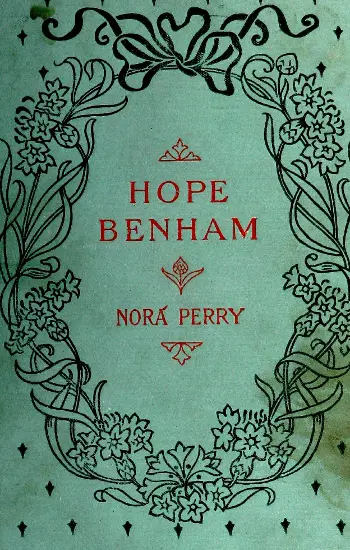
"Hope Benham: A Story for Girls" by Nora Perry is a novel written in the late 19th century. The story centers around Hope Benham, a determined young girl who sells flowers to earn money for a violin she longs to own. Exploring themes of class distinction and personal ambition, the narrative also delves into the complexities of Hope's character as she navigates her relationships with both her loving family and the social expectations around her. At the start of the book, readers meet Hope as she successfully sells arbutus flowers at the Brookside station, revealing her entrepreneurial spirit and her dreams of music. Hope's joy in her sales is soon contrasted with the disdainful attitude she encounters from well-off peers like Dolly Dering, who struggles to understand Hope's choices. This initial interaction exposes the class divide and sets the stage for Hope's journey, highlighting her resilience and her desire to be seen as more than her economic circumstances. The chapter establishes a narrative rich with character dynamics and social commentary within the context of a coming-of-age story.
Introduction adapted from the source catalogue; source summaries may be automatically generated.
Free to read · English · 65,216 words · No account needed
MAKE TIME FOR A GOOD BOOK
On by default. Untick to stop anonymous reading totals. Each page counts after 10 seconds in view. How this works.
Anonymous counting is on unless you have switched it off.
It was Jimmy's ring at the door-bell that had interrupted that gusty little conversation in the hall. He was the first guest; and as he came into the drawing-room quite alone, and heralded portentously by the solemn butler's loudly spoken "Mr. James Dering," he might have been expected to flinch a little, especially under the battery of all those girls' glances; but Jimmy was not a self-conscious youth, and he had a happy knack of always adjusting himself to circumstances, and making the best of a trying situation. So now he came forward in his own modest, pleasant way, without a bit of awkwardness; and though he blushed a little, it was with such a confiding sort of manner,--a manner that seemed to say, "Now do be friendly to me,"--that every girl there, including Miss Marr herself, was his friend at once.
"He is charming," thought Miss Marr, "so modest and well-mannered, and with such a bright merry boyishness about him."
Even Dolly couldn't spoil the impression he made, as she put up her head and looked about her with a self-congratulatory air, that said plainly,--
"Now, this is my guest and my cousin!"
No, even Dolly couldn't spoil Jimmy Dering's popularity. People liked him in spite of Dolly, and oftentimes they softened towards Dolly herself, and forgave her her blundering, domineering tactlessness, because she was Jimmy's cousin, as these girls did on this occasion, before the evening was over.
Kate Van der Berg, who had been very wroth at the start, very much disgusted with Miss Dolly, who had felt as if she never wanted to have anything more to do with her, before the evening was over began to say to herself,--
"Dorothea must have some good in her, and must belong to nice people--really nice, well-bred people--to have such a cousin."
And then when the other boy visitors appeared,--when Schuyler Van der Berg, Raymond Armitage, Peter Van Loon, and others of the New York youngsters were in full force,--it was found that they too were taken captive by Jimmy's pleasant ways.
"Nice little chap!" said Schuyler to his great friend, Peter Van Loon.
"Yes," responded Peter; "nicest Boston fellow I've ever seen. Don't like Boston fellows generally, they're so cocky."
"And this little chap might be cocky, easy. What do you think,--he's the quarter-back in the Puritan eleven!"
"No!" and Peter looked up with greater animation than he had shown since
he came into the house.
"And he's coxswain in the Charlesgate boat-crew."
"I say now!" ejaculated Peter, with increased animation.
"Yes, and he plays the fiddle too,--knows all about music."
Your reading position is saved on this browser. Take it to another device with a library code. Reading pages adapt to text, rather than matching a printed edition.
BEHIND THE BOOK
This eBook is for the use of anyone anywhere in the United States and most other parts of the world at no cost and with almost no restrictions whatsoever. You may copy it, give it away or re-use it under the terms of the Project Gutenberg License included with this eBook or online at www.gutenberg.org. If you are not located in the United States, you will have to check the laws of the country where you are located before using this eBook. Read the source licence.
The original source file, including credits and licence, is retained by this library. Request an original-format copy at no charge. Please include the book title and Project Gutenberg identifier #36105.
KEEP YOUR CURIOSITY GOING
Coulson Kernahan

Maurice Baring
Frances Wright
Cécile Tormay

Frederic Jesup Stimson

W. H. P. (William Henry Pope) Jarvis