THE CLASSIC COLLECTION✦A dead man’s diaryCLASSIC FREE BOOKS
A dead man’s diary
Coulson Kernahan
THE CLASSIC COLLECTION · 1894
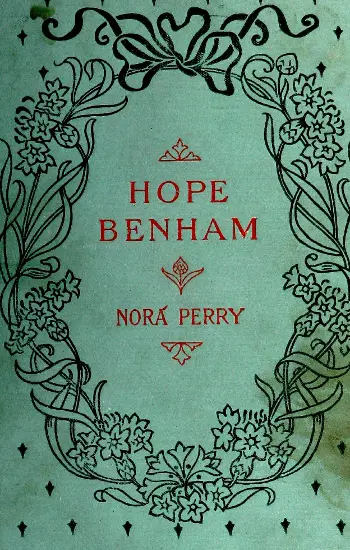
"Hope Benham: A Story for Girls" by Nora Perry is a novel written in the late 19th century. The story centers around Hope Benham, a determined young girl who sells flowers to earn money for a violin she longs to own. Exploring themes of class distinction and personal ambition, the narrative also delves into the complexities of Hope's character as she navigates her relationships with both her loving family and the social expectations around her. At the start of the book, readers meet Hope as she successfully sells arbutus flowers at the Brookside station, revealing her entrepreneurial spirit and her dreams of music. Hope's joy in her sales is soon contrasted with the disdainful attitude she encounters from well-off peers like Dolly Dering, who struggles to understand Hope's choices. This initial interaction exposes the class divide and sets the stage for Hope's journey, highlighting her resilience and her desire to be seen as more than her economic circumstances. The chapter establishes a narrative rich with character dynamics and social commentary within the context of a coming-of-age story.
Introduction adapted from the source catalogue; source summaries may be automatically generated.
Free to read · English · 65,216 words · No account needed
MAKE TIME FOR A GOOD BOOK
On by default. Untick to stop anonymous reading totals. Each page counts after 10 seconds in view. How this works.
Anonymous counting is on unless you have switched it off.
"And she didn't make any objection to going with you?"
"No, not the slightest. Indeed she seemed glad to go with us."
Hope flushed a little, as she said this in answer to Kate's question that night, as the two sat talking over the day and its exciting events. The flush was the result of that pang of tender conscience that springs up in revolt at even a momentary want of candor.
"And Ray Armitage,--how did he take it?"
"Oh, quite easily!"
"And you didn't have--either you or Mrs. Sibley--to argue with her; you didn't have to tell her that the only thing to save her from the consequences of her silliness was to go home in a proper way under proper chaperonage?"
"No, we didn't have to knock her down with that bludgeon," laughed Hope.
"Well, I suppose she had begun to think! I'm glad she had so much sense. Schuyler made all manner of fun of me after you and Mrs. Sibley left. He said, in the first place, that he didn't believe you'd be in time to see them before they entered the theatre, and if you did, you wouldn't stop them."
"Mrs. Sibley was of the same opinion exactly."
"How clever it was of her to do the next thing,--take you into the theatre, and then manage the whole thing so perfectly!"
"Yes, wasn't it clever, and so kind."
"When you drove up did you see any of the teachers?"
"We met Miss Stephens as we entered the hall."
"You don't mean it? What did she say at seeing Dorothea with you?"
"Mrs. Sibley came in with us for a moment, and Miss Stephens looked at the three of us with some surprise, and then said,--
"'I thought Dorothea was coming home long ago under the escort of Bessie Armitage and her brother.'
"At that, Mrs. Sibley answered at once, 'We met Dorothea, and took her
with us.'
"Oh! and when Miss Stephens saw Mrs. Sibley and heard her say that, she felt that everything was all right, I suppose. She ought to have been sure of that before, and then you wouldn't have lost your afternoon's skating, and had such a lot of bother."
"Oh, well, it's all turned out satisfactorily."
Hope couldn't tell Kate how satisfactorily,--couldn't tell her that if Miss Stephens had been sure that everything was right at an earlier hour and Dorothea had thus been hindered from doing what she did, she would also have missed that mortifying experience, that might do more to shake her unlimited confidence in her own estimates and opinions than anything else could possibly do.
Your reading position is saved on this browser. Take it to another device with a library code. Reading pages adapt to text, rather than matching a printed edition.
BEHIND THE BOOK
This eBook is for the use of anyone anywhere in the United States and most other parts of the world at no cost and with almost no restrictions whatsoever. You may copy it, give it away or re-use it under the terms of the Project Gutenberg License included with this eBook or online at www.gutenberg.org. If you are not located in the United States, you will have to check the laws of the country where you are located before using this eBook. Read the source licence.
The original source file, including credits and licence, is retained by this library. Request an original-format copy at no charge. Please include the book title and Project Gutenberg identifier #36105.
KEEP YOUR CURIOSITY GOING
Coulson Kernahan

Maurice Baring
Frances Wright
Cécile Tormay

Frederic Jesup Stimson

W. H. P. (William Henry Pope) Jarvis