THE CLASSIC COLLECTION✦A dead man’s diaryCLASSIC FREE BOOKS
A dead man’s diary
Coulson Kernahan
THE CLASSIC COLLECTION · 1894
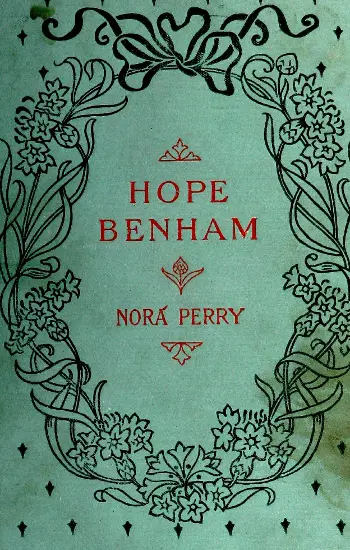
"Hope Benham: A Story for Girls" by Nora Perry is a novel written in the late 19th century. The story centers around Hope Benham, a determined young girl who sells flowers to earn money for a violin she longs to own. Exploring themes of class distinction and personal ambition, the narrative also delves into the complexities of Hope's character as she navigates her relationships with both her loving family and the social expectations around her. At the start of the book, readers meet Hope as she successfully sells arbutus flowers at the Brookside station, revealing her entrepreneurial spirit and her dreams of music. Hope's joy in her sales is soon contrasted with the disdainful attitude she encounters from well-off peers like Dolly Dering, who struggles to understand Hope's choices. This initial interaction exposes the class divide and sets the stage for Hope's journey, highlighting her resilience and her desire to be seen as more than her economic circumstances. The chapter establishes a narrative rich with character dynamics and social commentary within the context of a coming-of-age story.
Introduction adapted from the source catalogue; source summaries may be automatically generated.
Free to read · English · 65,216 words · No account needed
MAKE TIME FOR A GOOD BOOK
On by default. Untick to stop anonymous reading totals. Each page counts after 10 seconds in view. How this works.
Anonymous counting is on unless you have switched it off.
"This Mr. Benham was a distinguished scientific man of some sort, I believe. He was distinguished for something, I know, and he was with scientific men. I met him at Professor Hervey's, and he came into the room, I remember, with two or three English gentlemen of note. I recollect it, because I know I felt quite proud at the time that he was an American,--he looked so manly and earnest,--and some one told me he had just had a fortune come to him."
"Well, Hope's father must have a lot of money, for she's got a violin that cost enough. It's a regular Cremona."
"No!" exclaimed Jimmy, incredulously.
"Yes; she told me it was made by an Italian who was a pupil of
Stradivari and lived in Cremona."
"You don't say so!" cried Jimmy, excitedly. "How I should like to see it, for I tell you to see a real old Cremona would be worth while. Lots of people think they've got a Cremona, when it's only an imitation. Karl Myerwitz, who makes violins, and knows all about them, told me that if everybody who claims to have a Cremona violin, really had one, the number of them would count up to twice as many as had ever been made."
"Well, all I know is that Hope told me that her violin was made in seventeen hundred and something by a pupil of Stradivari."
"Where did her father get it, do you know,--did she tell you that?"
"An old teacher of hers got it,--a German who has a brother who deals in
rare violins in Paris."
"How soon did she begin to take lessons?"
"Oh, when she was quite a little girl."
"What kind of music--whose compositions, I mean, does she play?"
Dolly rattled off what she knew of Hope's repertoire.
"Well, she must have been at it from a small youngster," ejaculated Jimmy, emphatically, at the list Dolly gave. "And she must have a great--a great taste for music. The idea of your thinking I would play with any one who was up to what she is!"
"But you play very well,--you play better than I do."
"What's that to do with it? You don't mean to say that you think--that you propose--" But Jimmy stopped short, remembering the recent outbreak of sniffles and tears. But he had gone far enough for Dolly to understand, and she took up his words, not tearfully, but indignantly, as she replied,--
"I do mean to say that I propose to play a duet with Hope at school this
very winter."
Your reading position is saved on this browser. Take it to another device with a library code. Reading pages adapt to text, rather than matching a printed edition.
BEHIND THE BOOK
This eBook is for the use of anyone anywhere in the United States and most other parts of the world at no cost and with almost no restrictions whatsoever. You may copy it, give it away or re-use it under the terms of the Project Gutenberg License included with this eBook or online at www.gutenberg.org. If you are not located in the United States, you will have to check the laws of the country where you are located before using this eBook. Read the source licence.
The original source file, including credits and licence, is retained by this library. Request an original-format copy at no charge. Please include the book title and Project Gutenberg identifier #36105.
KEEP YOUR CURIOSITY GOING
Coulson Kernahan

Maurice Baring
Frances Wright
Cécile Tormay

Frederic Jesup Stimson

W. H. P. (William Henry Pope) Jarvis