THE CLASSIC COLLECTION✦A dead man’s diaryCLASSIC FREE BOOKS
A dead man’s diary
Coulson Kernahan
THE CLASSIC COLLECTION · 1894
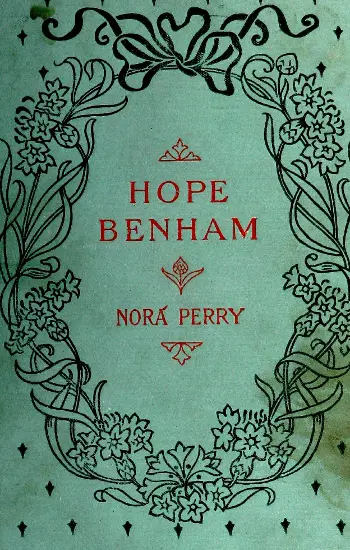
"Hope Benham: A Story for Girls" by Nora Perry is a novel written in the late 19th century. The story centers around Hope Benham, a determined young girl who sells flowers to earn money for a violin she longs to own. Exploring themes of class distinction and personal ambition, the narrative also delves into the complexities of Hope's character as she navigates her relationships with both her loving family and the social expectations around her. At the start of the book, readers meet Hope as she successfully sells arbutus flowers at the Brookside station, revealing her entrepreneurial spirit and her dreams of music. Hope's joy in her sales is soon contrasted with the disdainful attitude she encounters from well-off peers like Dolly Dering, who struggles to understand Hope's choices. This initial interaction exposes the class divide and sets the stage for Hope's journey, highlighting her resilience and her desire to be seen as more than her economic circumstances. The chapter establishes a narrative rich with character dynamics and social commentary within the context of a coming-of-age story.
Introduction adapted from the source catalogue; source summaries may be automatically generated.
Free to read · English · 65,216 words · No account needed
MAKE TIME FOR A GOOD BOOK
On by default. Untick to stop anonymous reading totals. Each page counts after 10 seconds in view. How this works.
Anonymous counting is on unless you have switched it off.
"My school!" Jimmy groaned again when he heard this; and as he observed Hope's sudden stiffening and coolness, he inwardly exclaimed: "I shall never hear this girl play if Dolly goes on like this, with 'my school,' and that my-everything-way of hers!"
But when Mrs. Dering came up with that pretty manner, and said that she was always glad to meet one of Miss Marr's girls, Jimmy breathed easier; and when she asked Hope if she was fond of music, and Dolly burst out, "Fond? You wouldn't ask that question if you could hear Hope play the violin," Jimmy took courage and said,--
"Mother, if Miss Benham would only come to our Monday night musicale!"
"Yes, to be sure," cried Mrs. Dering, delighted at the suggestion. If Hope was a musical genius, she might perhaps be interested to help them, for the musicale was for a charity. That she was one of Miss Marr's girls spoke for her desirability in all other ways. It had got to be a sort of voucher to be one of Miss Marr's girls.
"And if you have your violin with you--she's got a wonderful violin, auntie--and will bring it, and play something for us--it's for a charity, you know--"
"Yes, if you would, it would be so kind of you; the charity is such a worthy one,--a little kindergarten bed at the children's hospital," took up Mrs. Dering, persuasively.
"I haven't my violin with me; and--"
"Oh, well, that needn't make any difference. I have two, and you can have one of mine," interrupted Dolly, with perfect confidence.
"And I have an engagement on Wednesday to another musicale, or rather a concert," said Hope, finishing the answer that Dolly had so confidently interrupted.
"But can't you come and see me some day and--if you'll tell me where you're staying I'll call on you--I'll call and fetch you any day you'll say, and Jimmy'll come, and we'll all play together--Jimmy plays very well."
Dolly, with this, pulled out a little tablet, and fixing her eyes on it in a business-like way, said, "Now, then, give me your address; and--"
"It would be of no use, I cannot come to you, for I return to New York
Thursday morning."
"But it's only Saturday now--there's four days to Thursday--if you'd say
Monday or Tuesday."
"I am engaged Monday and Tuesday,--you must excuse me--Ah!" with an air of relief, "there's Mr. Kolb, I must bid you good-by;" and with a very polite bow, including the three,--Mrs. Dering, her son, and Dolly,--and with a very small smile, Hope made her escape, and hastened towards Mr. Kolb.
Your reading position is saved on this browser. Take it to another device with a library code. Reading pages adapt to text, rather than matching a printed edition.
BEHIND THE BOOK
This eBook is for the use of anyone anywhere in the United States and most other parts of the world at no cost and with almost no restrictions whatsoever. You may copy it, give it away or re-use it under the terms of the Project Gutenberg License included with this eBook or online at www.gutenberg.org. If you are not located in the United States, you will have to check the laws of the country where you are located before using this eBook. Read the source licence.
The original source file, including credits and licence, is retained by this library. Request an original-format copy at no charge. Please include the book title and Project Gutenberg identifier #36105.
KEEP YOUR CURIOSITY GOING
Coulson Kernahan

Maurice Baring
Frances Wright
Cécile Tormay

Frederic Jesup Stimson

W. H. P. (William Henry Pope) Jarvis