THE CLASSIC COLLECTION✦A dead man’s diaryCLASSIC FREE BOOKS
A dead man’s diary
Coulson Kernahan
THE CLASSIC COLLECTION · 1894
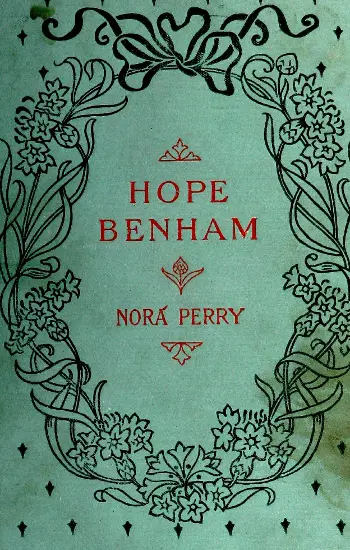
"Hope Benham: A Story for Girls" by Nora Perry is a novel written in the late 19th century. The story centers around Hope Benham, a determined young girl who sells flowers to earn money for a violin she longs to own. Exploring themes of class distinction and personal ambition, the narrative also delves into the complexities of Hope's character as she navigates her relationships with both her loving family and the social expectations around her. At the start of the book, readers meet Hope as she successfully sells arbutus flowers at the Brookside station, revealing her entrepreneurial spirit and her dreams of music. Hope's joy in her sales is soon contrasted with the disdainful attitude she encounters from well-off peers like Dolly Dering, who struggles to understand Hope's choices. This initial interaction exposes the class divide and sets the stage for Hope's journey, highlighting her resilience and her desire to be seen as more than her economic circumstances. The chapter establishes a narrative rich with character dynamics and social commentary within the context of a coming-of-age story.
Introduction adapted from the source catalogue; source summaries may be automatically generated.
Free to read · English · 65,216 words · No account needed
MAKE TIME FOR A GOOD BOOK
On by default. Untick to stop anonymous reading totals. Each page counts after 10 seconds in view. How this works.
Anonymous counting is on unless you have switched it off.
"I shouldn't think it would be such great fun, just to dance with
girls."
"You are not obliged to dance with girls."
"What! You don't mean--that there are young fellows--men?"
"There are boys,--that's what I call them,--boys like my brother Schuyler. Schuyler is seventeen."
Dolly gave a long drawn "Oh!" It was evidently an "Oh" of relief; but directly she asked, with demure mischief,--
"Can't you have 'em over seventeen?"
Kate laughed. "Well, we can't have regular grown-ups, you know, and we don't want them. But we can have them all the way from fifteen to eighteen, I believe."
"How odd! Doesn't Miss Marr think we are up to conversation with
grown-up young gentlemen?"
"She thinks probably that 'grown-up gentlemen,' as you call them,--gentlemen out in society,--wouldn't care to come to a school-girl party, and that it is much more suitable to have boys of our own age,--boys we all know, or most of us know, at any rate, and who have something the same interests that we have,--school interests, and things of that kind. For my part, I shouldn't know what to say to gentlemen so much older than myself."
"Oh, wouldn't you?" cried Dolly, with an air--a knowing sort of air--that exasperated Kate. "I have a grown-up sister, and I've seen a good many of her gentlemen visitors. I never found it hard to talk to them," went on Dolly, with a still more knowing air.
"And I have a grown-up brother," retorted Kate, "and I've heard him tell how men go on about half-grown girls and their forwardness and boldness and pertness, and how they--the young men--disliked that kind of thing, or else amused themselves with it for a little while, and then made fun of it."
Dolly's face had flushed scarlet at these words, and at the end she
burst forth angrily,--
"I suppose you mean that when I talked with my sister's, I must have been forward and bold and pert."
It was Kate's turn now to flush. She saw that in her irritation--Dolly was apt to irritate her--she had been unwarrantably rude, and swallowing her mortification, she at once made haste to say,--
"I beg your pardon, I--I shouldn't have spoken as I did. I am very
sorry."
Dolly gave a quick glance at the speaker, hesitated a moment, as if waiting for something further, then jumped up and flounced out of the room with an angry impetus that there was no mistaking.
"Well, that is interesting, I must confess," ejaculated Kate. "I begged her pardon; what more did she want?"
Your reading position is saved on this browser. Take it to another device with a library code. Reading pages adapt to text, rather than matching a printed edition.
BEHIND THE BOOK
This eBook is for the use of anyone anywhere in the United States and most other parts of the world at no cost and with almost no restrictions whatsoever. You may copy it, give it away or re-use it under the terms of the Project Gutenberg License included with this eBook or online at www.gutenberg.org. If you are not located in the United States, you will have to check the laws of the country where you are located before using this eBook. Read the source licence.
The original source file, including credits and licence, is retained by this library. Request an original-format copy at no charge. Please include the book title and Project Gutenberg identifier #36105.
KEEP YOUR CURIOSITY GOING
Coulson Kernahan

Maurice Baring
Frances Wright
Cécile Tormay

Frederic Jesup Stimson

W. H. P. (William Henry Pope) Jarvis