THE CLASSIC COLLECTION✦A dead man’s diaryCLASSIC FREE BOOKS
A dead man’s diary
Coulson Kernahan
THE CLASSIC COLLECTION · 1894
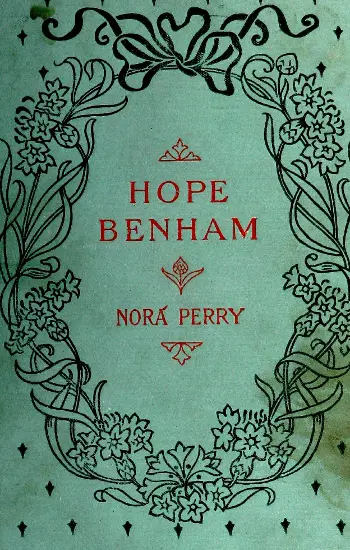
"Hope Benham: A Story for Girls" by Nora Perry is a novel written in the late 19th century. The story centers around Hope Benham, a determined young girl who sells flowers to earn money for a violin she longs to own. Exploring themes of class distinction and personal ambition, the narrative also delves into the complexities of Hope's character as she navigates her relationships with both her loving family and the social expectations around her. At the start of the book, readers meet Hope as she successfully sells arbutus flowers at the Brookside station, revealing her entrepreneurial spirit and her dreams of music. Hope's joy in her sales is soon contrasted with the disdainful attitude she encounters from well-off peers like Dolly Dering, who struggles to understand Hope's choices. This initial interaction exposes the class divide and sets the stage for Hope's journey, highlighting her resilience and her desire to be seen as more than her economic circumstances. The chapter establishes a narrative rich with character dynamics and social commentary within the context of a coming-of-age story.
Introduction adapted from the source catalogue; source summaries may be automatically generated.
Free to read · English · 65,216 words · No account needed
MAKE TIME FOR A GOOD BOOK
On by default. Untick to stop anonymous reading totals. Each page counts after 10 seconds in view. How this works.
Anonymous counting is on unless you have switched it off.
"No, no, you mustn't think as you do, that there's anything very bad that I'm holding back. I mustn't let you think so; it would be wicked in me. It is only just about myself,--something that she said to me long ago,--five years ago. She's forgotten it; she's forgotten me. I only met her for a few minutes, two or three times."
"The disagreeable thing! I shall hate her!" Kate cried impulsively.
"No, no, don't say so. I dare say you would have liked her if I--if I could have kept what I felt to myself, and I thought I did, I thought I did. Oh, dear!" and Hope stopped abruptly, as she realized that her own excitement was making matters worse.
"Liked her! Not if she could have said anything bad enough to hurt you like this,--to have hurt you for five years."
"It doesn't hurt me as it did then, but I remember it."
"Well, that shows what a hurt it must have been."
"What she said was out of ignorance. She didn't know any better," Hope went on, determined to do the honorable thing by her childish enemy.
"I don't believe she knows much better now. Oh, you needn't try to
smooth it all over to me, you little conscientious thing; it's of no
use."
"But, Kate, promise me one thing,--that you won't--you won't talk to the
other girls about it."
"Yes, I'll promise you that I'll be as mum as an oyster."
"And you won't--you won't be--"
"Disagreeable to her?" interrupted Kate, laughing. "Well, I'll try not to be; I'll take pattern by you, and be so politely fascinating that she'll ask me to play duets with her."
Hope could not help laughing at this, but all the time she felt disturbed and troubled. Kate Van der Berg had playfully jibed at her for her conscientiousness. Kate thought she was over-conscientious, and she might have been sometimes, for she was a sensitive creature, with high notions and ideas of truth and justice and honor, and her father had developed these ideas by his advice and counsel. One of the things that he had impressed upon her was never to take advantage of any one, especially any one that you had had a quarrel with. "Fair play, my dear, always; remember that, and so you must remember to be open and above board after you've had any differences with people, and never let yourself say or hint damaging things about them, to prejudice others," was one of his favorite pieces of counsel, put in one form and another, at various times. Hope thought of these words even when she joined in Kate Van der Berg's laughter. She thought of them after Kate had left her, and all through the rest of the day they would start up to torment her. At last she said to herself: "This is over-conscientious, for I didn't mean to prejudice any one against Dolly Dering. I tried not to show how I felt, and if I didn't succeed, it isn't my fault; but I'm a great goose to fuss so. Kate will keep her promise, I know, and Miss Dorothea Dering won't be unpopular because of anything I have said."
Your reading position is saved on this browser. Take it to another device with a library code. Reading pages adapt to text, rather than matching a printed edition.
BEHIND THE BOOK
This eBook is for the use of anyone anywhere in the United States and most other parts of the world at no cost and with almost no restrictions whatsoever. You may copy it, give it away or re-use it under the terms of the Project Gutenberg License included with this eBook or online at www.gutenberg.org. If you are not located in the United States, you will have to check the laws of the country where you are located before using this eBook. Read the source licence.
The original source file, including credits and licence, is retained by this library. Request an original-format copy at no charge. Please include the book title and Project Gutenberg identifier #36105.
KEEP YOUR CURIOSITY GOING
Coulson Kernahan

Maurice Baring
Frances Wright
Cécile Tormay

Frederic Jesup Stimson

W. H. P. (William Henry Pope) Jarvis