THE CLASSIC COLLECTION✦A dead man’s diaryCLASSIC FREE BOOKS
A dead man’s diary
Coulson Kernahan
THE CLASSIC COLLECTION · 1894
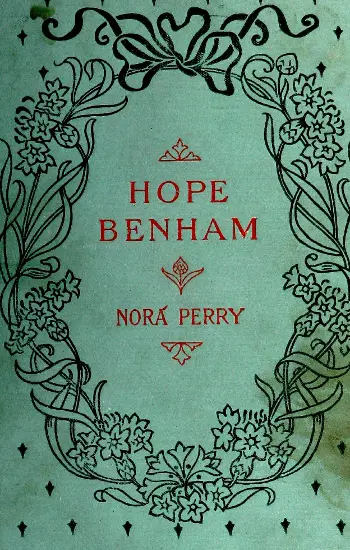
"Hope Benham: A Story for Girls" by Nora Perry is a novel written in the late 19th century. The story centers around Hope Benham, a determined young girl who sells flowers to earn money for a violin she longs to own. Exploring themes of class distinction and personal ambition, the narrative also delves into the complexities of Hope's character as she navigates her relationships with both her loving family and the social expectations around her. At the start of the book, readers meet Hope as she successfully sells arbutus flowers at the Brookside station, revealing her entrepreneurial spirit and her dreams of music. Hope's joy in her sales is soon contrasted with the disdainful attitude she encounters from well-off peers like Dolly Dering, who struggles to understand Hope's choices. This initial interaction exposes the class divide and sets the stage for Hope's journey, highlighting her resilience and her desire to be seen as more than her economic circumstances. The chapter establishes a narrative rich with character dynamics and social commentary within the context of a coming-of-age story.
Introduction adapted from the source catalogue; source summaries may be automatically generated.
Free to read · English · 65,216 words · No account needed
MAKE TIME FOR A GOOD BOOK
On by default. Untick to stop anonymous reading totals. Each page counts after 10 seconds in view. How this works.
Anonymous counting is on unless you have switched it off.
"Oh!" breathed Hope, faintly; and "Oh!" echoed Kate, in the same tone.
"No, it was meant that she shouldn't have one; but I had written one, and I was going to send it if--if my mother hadn't stopped it."
"Your mother?"
"Yes, my mother. I had already sent out quite a number of invitations, and had just got another lot ready, when my mother came in and saw Dorothea's name on one of the notes. The moment she saw it, she forbade me to send it. Mother was at the New Year's party,--perhaps you remember,--just at the last of it, when Dorothea was going on so, and she took a great dislike to Dorothea then. Dorothea was noisy, you know. Mother thought she was very loud and underbred. But that--that wasn't all. A little while ago some acquaintances of ours from Philadelphia--the Cargills--were staying at the Waldorf. The next day after they arrived, they went to a matinee at the Madison Square Theatre, and saw there my brother Raymond, and with him a young girl. Of course they thought the girl was some member of our family; and when he went to speak to them, they asked him if that was another sister he had with him, and he told them no; that it was only an acquaintance,--a girl who was in a boarding-school in the city. Mrs. Cargill thought this was very odd; and as Raymond was so young, she spoke about it to mamma. Mamma was astonished, and she went straight to Raymond and asked him what it all meant, and who the girl was; and Raymond had to tell the whole story then,--that it was Dorothea Dering, from Miss Marr's school; that he had invited her to go to the matinee with him, and that she had accepted the invitation; and then that he had met her at the skating-pond in Central Park, and had gone from there with her to the theatre, unsuspected by any of the teachers. The minute mamma heard the name, 'Dorothea Dering,' she recalled the New Year's party and Dorothea's behavior there; and so, and so, don't you see, when she saw Dorothea's name on the envelope, the other day, she thought of all these things, and--and forbade my sending the note. I tried my best to get her to let me send it; I told her what Anna Fleming had said to me,--that Dorothea came from one of the first families of Massachusetts; that her father was the Hon. James Dering, and all her people were in the very best society. But the more I tried to talk Dorothea up in this way, the more decided mamma grew; until, at last, she said that there had been too much of this falling back upon one's family nowadays; that bad, loud manners and rude behavior were not to be overlooked and excused on that account, and that she didn't propose to overlook Dorothea's by having her invited to her house. And when I said I thought that Raymond was as much to blame, in asking her to go to the matinee, as Dorothea was in going, mamma said that that didn't help her case at all; that Raymond's invitation was only the result of her own loud, free ways; that he would never have thought of inviting her like that, if she had been a different kind of girl. Oh,"--with a quick look at Hope and Kate,--"mamma didn't altogether exonerate Raymond; she didn't think he was altogether right, by any means; but then she does think--and so do I, girls--that boys and young men are apt to treat a girl a good deal as the girl treats them; and--and--Dorothea was too forward with Raymond. I saw it myself from the first; and she led him on,--she encouraged him to treat her as he wouldn't have treated either of you two. She thought he admired just those free, foolish ways of hers; but he didn't,--he was only amused by them. Oh, I know Raymond; and I know if he had seen me going on with any one as Dorothea did, he would have scolded me well. It wouldn't have amused him to have seen his sister going on so, to have seen me amusing any one like that. But, Hope, Kate, all the same, I felt dreadfully at leaving Dorothea out,--dreadfully, for there I'd sent off almost all the school invitations; there was no getting them back. If I could have got them back, I would; and--yes, truly, I wouldn't have sent any invitations to any one at Miss Marr's, if I had known I had got to cut Dorothea. No; I wouldn't have sent one, and then I could have explained it to the rest of you privately, or I could have said I couldn't make so large a party this year. Yes, I would certainly have done this if it hadn't been too late,--if mamma had only seen and stopped Dorothea's invitation before the other school notes had been sent. Yes, I would have done just that; and not because I'm at all fond of Dorothea, but because I hate to hurt anybody's feelings, and to--to make such a time. I should have gone back to school this week if it hadn't been for this happening; but I'm not going now until after the party, and I may not go until next term if my father will take me away with him to Florida, where he is going next month; and I hope, oh, I hope he will!" And here suddenly, to Hope and Kate's astonishment, this quiet, self-contained Bessie Armitage covered her face with her hands and burst into tears.
Your reading position is saved on this browser. Take it to another device with a library code. Reading pages adapt to text, rather than matching a printed edition.
BEHIND THE BOOK
This eBook is for the use of anyone anywhere in the United States and most other parts of the world at no cost and with almost no restrictions whatsoever. You may copy it, give it away or re-use it under the terms of the Project Gutenberg License included with this eBook or online at www.gutenberg.org. If you are not located in the United States, you will have to check the laws of the country where you are located before using this eBook. Read the source licence.
The original source file, including credits and licence, is retained by this library. Request an original-format copy at no charge. Please include the book title and Project Gutenberg identifier #36105.
KEEP YOUR CURIOSITY GOING
Coulson Kernahan

Maurice Baring
Frances Wright
Cécile Tormay

Frederic Jesup Stimson

W. H. P. (William Henry Pope) Jarvis