
The lost dirigible
Ralph Henry Barbour
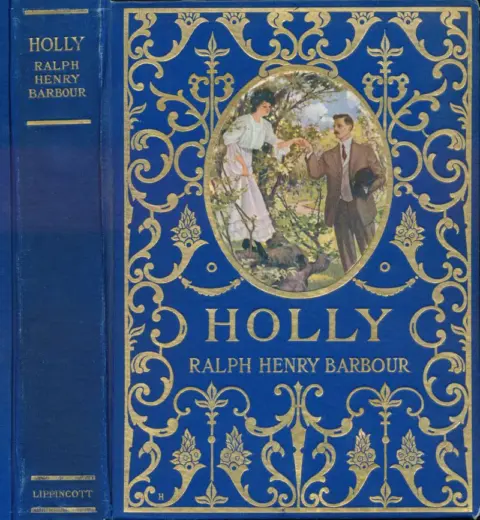
THE CLASSIC COLLECTION · 1907
"Holly: The Romance of a Southern Girl" by Ralph Henry Barbour is a novel written in the early 20th century. It centers around Holly Wayne, an 18-year-old girl living in the South, who faces the transition from childhood to adulthood just as her mundane world is disrupted by the arrival of new circumstances and a stranger. The story unfolds in a rich Southern setting filled with descriptions of nature and family dynamics, capturing Holly's complex emotions as she navigates loss, affection, and societal expectations. The opening of the book introduces us to Holly, who is grappling with the loss of her father while living with her Aunt India at Waynewood, their family estate. As the narrative progresses, we learn that Holly is about to undergo significant changes in her life—her sheltered existence is primed for disruption. The arrival of Robert Winthrop, the new owner of Waynewood, brings both mystery and excitement. Holly's initial responses intertwine curiosity and caution, setting the stage for deepening relationships and the possibilities of romance. Through stylish prose, the author hints at Holly’s youthful innocence and her evolving understanding of love and life against a backdrop of Southern culture and charm.
Introduction adapted from the source catalogue; source summaries may be automatically generated.
Free to read · English · 45,478 words · No account needed
MAKE TIME FOR A GOOD BOOK
On by default. Untick to stop anonymous reading totals. Each page counts after 10 seconds in view. How this works.
Anonymous counting is on unless you have switched it off.
“Uncle Major,” she continued, “used to argue with him, but father always had the best of it. I reckon, though, you Northerners are sorry now, aren’t you?”
“Sorry that there was war, yes,” answered Winthrop, smilingly; “but not sorry for what we did.”
“But if it was wrong?” argued Holly. “’Pears to me you ought to be sorry! Just see the heaps and heaps of trouble you made for the South! Julian says that you ought to have paid us for every negro you took away from us.”
“Indeed? And who, may I ask, is Julian?”
“Julian Wayne is my cousin, my second cousin. He graduated from medical college last year. He lives in Marysville, over yonder.” Holly nodded vaguely toward the grove.
“Practising, is he?”
“He’s Dr. Thompson’s assistant,” said Holly. “He’s getting experience. After awhile he’s going to come to Corunna.” There was a pause. “He’s coming over to-morrow to spend Sunday.”
“Really? And does he make these trips very often?”
“Oh, every now and then,” answered Holly, carelessly.
“Perhaps there is an attraction hereabouts,” suggested Winthrop.
“Maybe it’s Aunt India,” said Holly, gravely.
Winthrop laughed.
“Is he nice, this Cousin Julian?” he asked.
Holly nodded.
“He’s a dear boy. He’s very young yet, only twenty-three.”
“And eighteen from twenty-three leaves five,” teased Winthrop. “I’ve heard, I think, that ten is the ideal disparity in years for purposes of marriage, but doubtless five isn’t to be sneezed at.”
Holly’s smooth cheeks reddened a little.
“A girl ought to marry a man much older than herself,” she said,
decisively.
“Oh! Then Julian won’t do?”
“I haven’t decided,” Holly laughed. “Maybe. He’s nice. I wonder if you’ll like him. Will you try to, please? He――he’s awfully down on Northerners, though.”
“That’s bad,” said Winthrop, seriously. “Perhaps he won’t approve of me. Do you think I’d better run away over Sunday? I might go out to visit Colonel Byers; he’s asked me.”
“Silly!” said Holly. “He won’t eat you!”
“Well, that’s comforting. I’ll stay, then. The dislike of Northerners seems to be a strong trait in your family, Miss Holly.”
“Oh, some Northerners are quite nice,” she answered, with a challenging
glance.
“I wonder,” he asked, with intense diffidence, “I wonder――if I’m included among the quite nice ones?”
“What do you think, Mr. Winthrop?”
“Well, I’ve always thought rather well of myself until I came to Corunna. But now that I have learned just how poor a lot Northerners are, I find myself rather more modest.”
Winthrop sighed depressedly.
Your reading position is saved on this browser. Take it to another device with a library code. Reading pages adapt to text, rather than matching a printed edition.
Ralph Henry Barbour
Ralph Henry Barbour

Ralph Henry Barbour

Ralph Henry Barbour
BEHIND THE BOOK
This eBook is for the use of anyone anywhere in the United States and most other parts of the world at no cost and with almost no restrictions whatsoever. You may copy it, give it away or re-use it under the terms of the Project Gutenberg License included with this eBook or online at www.gutenberg.org. If you are not located in the United States, you will have to check the laws of the country where you are located before using this eBook. Read the source licence.
The original source file, including credits and licence, is retained by this library. Request an original-format copy at no charge. Please include the book title and Project Gutenberg identifier #69920.
KEEP YOUR CURIOSITY GOING
Coulson Kernahan

Maurice Baring
Frances Wright
Cécile Tormay

Frederic Jesup Stimson

W. H. P. (William Henry Pope) Jarvis